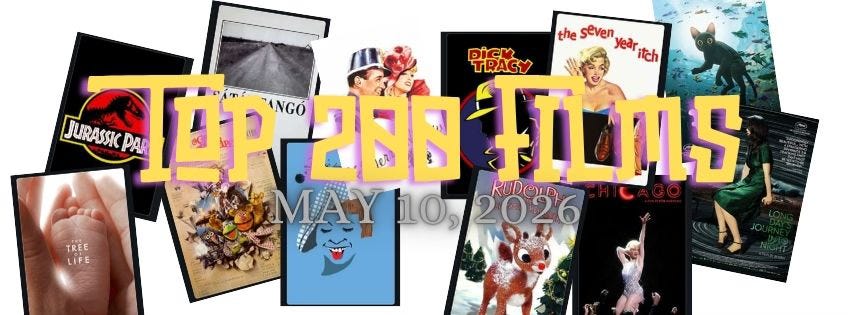
Top 200 Films
with commentary
I am perpetually tinkering with my list of favorite films, but about once a year (or more), I dismantle it and rebuild it anew. Lately, the process for this overhaul has been roughly as follows. Looking through my 4-5 star ratings on Letterboxd, I note down any films that I could see adding to my list. Next, I go through my list and note which films I would be okay with dropping—for now. Almost always—because I cannot think outside of even numbers and numerical milestones—I choose ten films to take off the list. Many of these have simply not been viewed in a number of years, and so my passion for them is at ebb tide.
This time, I removed the following ten films from my extant list: My Neighbor Totoro, Official Competition, All Quiet on the Western Front (2022), Lady Bird, The Passion of Joan of Arc, The Third Murder, Four Daughters (2023), The Muppets Take Manhattan, Drive My Car, and The Dark Crystal. After rewatching a couple of my possible replacements, I landed on the following ten new (and returning) films: Nashville, I’m Thinking of Ending Things, It Happened on Fifth Avenue, Sunday in the Park with George, The Turin Horse, Watchmen: Chapters I and II, The Lady from Shanghai, Blue Moon (2025), A Canterbury Tale, and No Other Choice.
I collect all of the DVDs (and blu-rays and 4K discs) for the resulting 200 films, and I shuffle them into random piles. Then, one by one, I pick up a film and put it in one of eight piles based on the general section of the list where I feel it belongs. Finally, starting from the bottom, I take these eight piles one at a time, sorting them into a satisfactory spectrum from greater to lesser. When this is done, my new list is before me on the shelves dedicated to it, and I go about the process of adjusting my files and online versions of the list.
Every time I announce a newly ordered list, I desperately want to add comments explaining what I love about each film. But, you know…there are two hundred of them! (I’ve tried, and a list any shorter than 200 inevitably leaves off films that should be represented and therefore is not a fair reflection of my thoughts on the matter.) Well, for the first time—right here and now—I am indulging myself and adding (hopefully brief) commentary on each movie. I hope that reading it gives you the smallest fraction of the joy I derive from making it!
Fargo (1996) dir. Joel and Ethan Coen
In its triumphant return to the top spot, we have the Coen brothers’ dark comedy about a nation blunted to the idea of violence. Appetites (for money, status, sex, connection, and food) are indulged or controlled with the same measured apathy until the shock and “awwww” of the final three scenes.
Chelsea Walls (2001) dir. Ethan Hawke
Steeped in the late-nineties indie aesthetic and featuring powerhouse performances, this film is a poem or collage—a movie about being (and, yes, Hamlet, not being) instead of doing. And I am eternally grateful it exists.
Nausicaä of the Valley of the Wind (1984) dir. Hayao Miyazaki
Miyazaki’s pre-Ghibli animated…windpunk?…movie is arresting and exciting by itself, but once you have read the 1,104-page manga, you will never watch it the same way again. It’s all about world-building here, and the world Miyazaki has built is expansive, complex, and beautiful.
Company: a musical comedy (2008) dir. John Doyle
The first of a few proshot plays on this list, Doyle’s minimalist cast-as-orchestra rendering of Stephen Sondheim and George Furth’s narrative-busting musical is everything! Raúl Esparza is flawless as Bobby, and the woman playing Marta? She went to Binghamton HS! Which is better: the music or the dialogue? Why ask, when they’re both firing on all cylinders?
Network (1976) dir. Sidney Lumet
You can’t read about Network without coming across the phrase “eerily prescient”—and for good reason. Legendary screenwriter Paddy Chayefsky imagines a world where corporations usurp nations as the world powers and the TV news is turned into an entertainment spectacle. The fact that we’ve far surpassed his nightmarish visions doesn’t blunt the comedy and drama of this expertly-acted masterpiece.
Singin’ in the Rain (1952) dir. Stanley Donen and Gene Kelly
What can you say? By repurposing songs from early movie musicals in order to tell a story about the birth of the movie musical…! It’s foundationally postmodernist, reveling in the use and reimagining of musical conventions while spooling out the perfect movie musical. Gene Kelly! Cyd Charisse’s epic train that seems to move by some divine power! I have to stop, or I’ll try to say it all.
Everyone Says I Love You (1996) dir. Woody Allen
Speaking of lovingly tweaking musical conventions, Allen’s jukebox musical enlists actors with only passable singing voices to dramatize the stark contrast between our disappointing fantasies and our beautifully chaotic realities. And right when that shoe drops, Goldie Hawn levitates in the most gorgeous passage ever put on film.
Sátántangó (1994) dir. Béla Tarr
Tarr referred to his work as “sculpting with time,” and it is most evident in this seven-and-a-half-hour film that makes duration its theme and its material. Mesmerizing from beginning to end, this is cinema taken to mystical heights.
Playing by Heart (1998) dir. Willard Carroll
I have never seen anything else by writer/director Carroll, but that makes him the greatest one-hit wonder in film history. (Yes, Charles Laughton, I said it.) At this time, it seemed as if every movie was trying to nail the postmodernist “surprisingly intersecting multiple storylines” schtick, but Carroll had it on lock. Angelina Jolie turns in an early performance that is undeniably her best work. Gena Rowlands is married to Sean Connery, for heaven’s sake! What more could you ever want than this tender, touching, funny romance?
Einstein on the Beach (2014) dir. Don Kent and Robert Wilson
Philip Glass’s legendary five-hour deconstructed opera is put on film in the most celestial way, as time, movement, repetition, and change somehow manifest exactly what I think Einstein’s mind would look like while relaxing on the beach. Don’t look here for “sense” or “plot,” but if it’s transcendent revelation you seek, strap in!
Evita (1996) dir. Alan Parker
Why don’t we know the name Alan Parker? In ‘76, he made the amazing all-child gangster musical Bugsy Malone. In ‘80, he reinvented the musical again with Fame. He’s at it again in 1991’s The Commitments, and finally he gave unto us his masterwork: a glossy, perfect film of Andrew Lloyd Webber’s musical about the crossroads of politics and superstardom. Every frame of this film could be…framed. Every note lives in my head. And casting with cojones: Madonna and a never-sung-before Antonio Banderas set it all afire with glorious abandon!
The Tree of Life (2011) dir. Terrence Malick
The merciful dinosaur. Jessica Chastain dancing a foot off the ground. Family reunions on a celestial beach. The Divine Flame in the darkness. Is Sean Penn’s part really necessary? I don’t know, and I don’t care.
Magnolia (1999) dir. Paul Thomas Anderson
There are so many wonderfully drawn characters here: the quiz kid, the ex-quiz kid, the toxic son, the dying man, the compassionate nurse, and the strangest and most beautiful will they/won’t they couple you’re likely to find anywhere. And then it rains. Frogs. And everyone sings a song. And writing it down feels like sacrilege, because how dumb does that movie sound? But this one is profoundly moving.
The Muppet Christmas Carol (1992) dir. Brian Henson
What raises this Carol above all the dozens of others? The brilliant alchemy of Gonzo as Dickens, spooling out his amazing prose, and Rizzo as the audience stand-in commenting on it. Also, Michael Caine and a killer score by the always brilliant Paul Williams!
Marcel the Shell with Shoes On (2021) Dean Fleischer Camp
A one-line review I saw on Letterboxd says it all: “Damn, did a shell with an eye just teach me the meaning of life?”
Modern Times (1936) dir. Charlie Chaplin
Chaplin’s undeniable genius hits its peak in this origin story/farewell to his indelible character, The Little Tramp. This film brims with astounding scenes, from the famous “Nonsense Song” to the so-dangerous-it-makes-you-laugh rollerskating tour de force. Charlie always nails the right balance of hysterical humor and eye-wetting sentiment.
Rear Window (1954) dir. Alfred Hitchcock
There are just too many great films in the world. I hate putting this masterpiece so low on the list. In Rear Window, everything works. The groundbreaking set and pitch-perfect costumes. The interest created by watching small scenes from everyday lives. The very real suspense. And, to break the tension and monotony, the always great Thelma Ritter.
Nope (2022) dir. Jordan Peele
This film pulls me in again and again. Peele’s control over the publicity made you think he was giving big things away, but the movie was something very different. Right from the start, with the sounds over the credits and then the terrifying first scene, I thought, “What am I doing watching this? And what is this?” What it is turns out to be a densely symbolic monster movie about the erasure of the Black Man from the American West, the tricky balance of naming animals vs. taming them, and the awful single vision of media and those who seek celebrity thereby.
Moulin Rouge! (2001) dir. Baz Luhrmann
The world had never seen anything like this before! I didn’t breathe for the first twenty minutes. (Well, clearly I must have.) This film may be the perfect postmodern parody—a genre that (as the quote goes) “both underlines and undermines” its subject. Visionary editing. Kidman’s entrance! The Tango Roxanne! The only flaw (for my tastes) is the “Like a Virgin” scene, which takes a long side trip into slapstick.
Kill Bill vol. 1 (2003) dir. Quentin Tarantino
Speaking of films the world wasn’t ready for…! Another postmodern parody, though much more concerned with underlining than undermining, Tarantino weaves a basket out of old movie reels and then fills it with his favorite things. Kids have ruined the word, but this film really is iconic.
Farewell My Concubine (1993) dir. Chen Kaige
Something about Chinese cinema connects with me (Mainland, not Hong Kong), and it all started with this Palme d’Or laureate that traces three lives through the Cultural Revolution. Inevitably, this movie is saddled with the term “love triangle,” but it is about so many things besides the complex dynamic between the three impressive leads.
A Star Is Born (2018) dir. Bradley Cooper
God bless Bradley Cooper! With this film, he showed unmined depths of performance, writing, and directing. He deserved Oscars for all three. I love three out of the four iterations of this story (Sorry, Babs), but this manages to be the best through fearless leads and the best movie soundtrack of all time. Never did I expect to love Lady Gaga.
Chicago (2002) dir. Rob Marshall
This may be the best musical-to-movie adaptation because it embraces the theatricality of the piece while creating two worlds: real and imaginary. The real world just keeps interfering with the delusional fantasies of its stars, but this is a film about the cutthroat pursuit of fame, so, of course, the delusion wins. And it does it with class.
Jurassic Park (1993) dir. Steven Spielberg
Never has there been a “wow moment” like Alan Grant’s first sight of a dinosaur! With better effects than most films thirty years later, Jurassic Park saw the originator of the blockbuster reinvent it all over again. And yet, the film is so special even despite the groundbreaking special effects. A perfect movie and a shrewd adaptation from the novel, this is a watershed of cinema.
Cabaret (1972) dir. Bob Fosse
One of my very favorite quotes is “Liza is this year’s Liza.” Minnelli may bring high-wattage starpower to this so-much-better-than-the-play adaptation, but it’s Fosse who pulls the strings, making an eerie musical masterpiece out of some crummy nightclub acts and a sprinkling of Nazis. Speaking of great quotes, here’s a whopper: “Screw Max!” “I do.” “I do, too.”
All That Jazz (1979) dir. Bob Fosse
I’m embarrassed that the two Fosse films on this list got placed side-by-side, but maybe that shows that no one can stand next to Bob Fosse but himself…which is kind of what this movie is. A not-really-fictionalized autobiography in which the writer/director/subject comes off as the crummy guy he was, with a genius that made everyone overlook that fact. This movie is full of showstoppers, from the adorable to the darkly erotic. Roy Scheider, Ann Reinking, and Leland Palmer all put in all-time great performances.
Nine to Five (1980) dir. Colin Higgins
“It looks just like Skinny ‘n Sweet except for the skull and crossbones on the label.” “Judy, can you come back here a minute, honey?” “We got another stiff in the john!” Lily Tomlin, Jane Fonda, and Dolly Parton have mythical chemistry in one of the funniest films from any era. I am literally proud to have been born the year this movie came out.
The French Dispatch of the Liberty, Kansas Evening Sun (2021) dir. Wes Anderson
Enter Wes. He’ll be back. And back. And back. But this is my favorite (and apparently only mine)! Structured like The New Yorker, this film gives us a travel piece, three features (art, politics, and cuisine), and an obituary. All of them are inventive and terribly funny. An elegy for physical journalism, French Dispatch mocks everyone who takes what they do too seriously…and then thanks them for their service.
Kill Bill vol. 2 (2004) dir. Quentin Tarantino
Elsewhere on this list, I bunch some films together into trilogies. So why don’t I consider Kill Bill one movie (like Quentin does)? Because each film has its own vibe and presents a full story. When I combine films on my list, it is only when I feel that they need to be watched together in order to appreciate the filmmakers’ genius. (And The Whole Bloody Affair is just not nearly as good as volumes 1 and 2 are separately.)
The Sweet Hereafter (1997) dir. Atom Egoyan
Hey, kids, want a downer? Skip the drugs, because this movie will take you as far down as you can go. And yet, because of the beauty in the writing (especially Ian Holm’s pied piper speech), it simultaneously lifts you up to the heights of aesthetic rapture. Perhaps it should be called The Bittersweet Hereafter.
Amélie (2001) dir. Jean-Pierre Jeunet
Is the charm of this film Audrey Tatou or Jean-Pierre Jeunet? We’ll never know (but another pairing of theirs shows up further down the list), but charming is what it is. Idiosyncratic in the best ways, Amélie—character and film—takes the scenic route to a happy ending because the journey is the best part.
Nashville (1975) dir. Robert Altman
The fact that Nashville has never appeared on this list before and debuts at #32 would suggest that I had just discovered the film. Not at all. I first saw this movie years ago. But I recently picked up the soundtrack LP in a used record store, and it made me relive the film again, but in a way that illuminated its greatness. It now passes The Player as my favorite Altman movie.
The Hudsucker Proxy (1994) dir. Joel and Ethan Coen
My favorite genre is screwball comedy. Don’t mistake it with the “stupid comedies” of later years that have somehow co-opted the name. Screwball is a style of stylish comedy that ruled the thirties and forties. The Hudsucker Proxy is an homage to those films, and it hits the bullseye. You don’t need to catch all the references to enjoy it, however. It’s a typical Coen comedy about a guy with a circle in his pocket and a head full of dreams. You know, for kids.
The Fountain (2006) dir. Darren Aronofsky
Visually gorgeous, achingly beautiful. This mystical tale takes place in three times, each starring Hugh Jackman and Rachel Weisz. The Fountain is a vibe, and a lovely one. It wrestles with the pain of grief and the exuberant hope of a rebirth to perfection. The Fountain of Youth is reached through dying. Heaven is death’s final cure.
Three Colors Trilogy (1993-1994) dir. Krzysztof Kieślowski
Blue, White, and Red only reveal their insane richness of vision when taken as a single work (although the films don’t really have any overlap). One for each of the colors of the French flag and each of the ideals of the French Revolution: Liberty, Equality, and Fraternity. Death, marriage, and love. An anti-tragedy, an anti-comedy, and an anti-romance. The technical achievements here are astounding, and the symbolism never exhausted.
National Theatre Live: Follies (2017) dir. Tim Van Someren and Dominic Cooke
Another proshot performance of a Sondheim musical: this time a London production of the brilliant Follies. The performances are exact. The book is sleek. The music is classic. But the blocking makes it all work, as aged follies girls are shadowed by their glamorous past selves. Amid it all, two couples fall apart through follies of their own.
Eyes Wide Shut (1999) dir. Stanley Kubrick
A profoundly moral work, Kubrick’s last film is a fable, a parable, and a nightmare. A happy marriage threatens to implode over drunken insecurities that drive Tom Cruise’s wealthy doctor onto the sex-saturated streets of a midnight Manhattan that reveals the progressive circles of Hell. A scathing critique of our society’s impersonal treatment of sex and a rallying cry for its proper place in the family. This film elevates me every time.
Over the Garden Wall (2014) dir. Nate Cash
This animated limited series is a turn on the basic absurdist plot: two fools wander around a world they cannot understand. The world in question is a sort of liminal space where forgotten narrative forms go to retire. Our heroes stagger around a forest menaced by the mysterious and frightening Beast, encountering 20s cartoons, classic melodrama, folksong, rural legends, and all the stock scenarios that lay like silt at the bottom of the lake we call America. (And it may be the funniest thing ever!)
Cape Fear (1962) dir. J. Lee Thompson
Know what’s not funny? This absolutely terrifying thriller that sees released sociopath William Holden stalk the wife and daughter of the DA who put him away. It’s a harrowing look at true evil—bestial and implacable—and the struggle of good men to not grow weary of fighting it.
The Grand Budapest Hotel (2014) dir. Wes Anderson
A crazy quilt of scenes from Hitchcock films, prison break flicks, and war resistance movies, this pastry of a film uses all the usual Anderson tropes: a Russian doll form, an overdose of whimsy, and more famous actors than you can fit on a poster. This may have been his most successful at the Oscars, but it still lost to the wonderful Birdman.
The Seven Year Itch (1955) dir. Billy Wilder
There aren’t many films more iconic than this one, what with Marilyn Monroe’s skirt blown up and Tom Ewell’s overactive imagination complicating everything. Monroe basically plays herself—her character is compared to “Marilyn Monroe”—and it’s the perfect situation for her brand of the self-aware fantasy woman. Ewell is equally impressive as her neurotic downstairs neighbor. Every scene is a classic.
The Return of the King (1980) dir. Arthur Rankin, Jr. and Jules Bass
Forget Peter Jackson’s bloated monster movies: this is the closest and most elegant adaptation of a Tolkien book. Yes, it picks up in medias res, as it only dramatizes the final Lord of the Rings novel, but it creates that world so wonderfully (especially through narration from the text à la Muppet Christmas Carol) and even finds a musical language to express it in Glenn Yarbrough’s modern-day canticles.
Yi Yi (2000) dir. Edward Yang
Yang may be the most reliable director who ever worked. He made less than ten movies, but almost all of them are five-star affairs. This is the only one that currently resides on my list, and there’s no doubt that it is his strongest work. A kunstlerroman? A generational transition? A film about Taipei? All of that and more!
Gypsy (1962) dir. Mervyn LeRoy
I have seen multiple divas belt out Mama Rose’s songs (most memorably, Imelda Staunton), but this faithful film adaptation starring Rosalind Russell as Rose, Karl Malden as Herbie, and an out-of-the-blue homerun performance by Natalie Wood as Louise, somehow has my heart. The core of Gypsy is not the musical numbers but the heartbreaking scenes in between, and several moments in this film always draw my salt. (I sometimes say that to mean “make me cry”…is that a quotation, or did my brain invent it?)
Grave of the Fireflies (1988) dir. Hayao Miyazaki
Drawing salt is the name of the game in this early Ghibli film about two children orphaned in WWII Japan. What gets to me most is the way that the backgrounds are mostly static—smoke arising from the horizon never rises—behind the animated characters. To me, this shows the endlessness of war, the freeze frame of death, and the completely ungenerative nature of violence. In the words of Shakespeare’s Marc Antony, “this foul deed shall smell above the earth/With carrion men, groaning for burial.”
The Firemen’s Ball (1967) dir. Miloš Forman
Forman’s final Czech film, this sidesplitting comedy makes perfect use of non-actors to portray a charity dance gone wonderfully wrong. And if, on the way, you want to make some connections to the Soviet regime controlling the country at that time, that’s up to you.
The Green Knight (2021) dir. David Lowery
Lowery’s adaptation of the medieval poem somehow captures all the beauty, sparseness, and majesty of ancient iconography. Dev Patel is excellent as Gawain, and Alicia Vikander is undeniable in a double role! Lowery knows the brains of his viewers intimately, and he manipulates them in fantastic ways that bring immediacy and surprise to the deliberately paced narrative.
All of Us Strangers (2023) dir. Andrew Haigh
I saw my own soul in every minute of this haunting story of families and isolation. Haigh uses the term “gay loneliness” to explain the theme, and just hearing words put to my existential separateness made me cry. You can imagine what the entire film does to me. This movie is somehow a core sample of me.
Gentlemen Prefer Blondes (1953) dir. Howard Hawks
Sparkling repartee, plot reversals, outrageous characters, AND some of the most famous song and dance numbers ever shot? As much as I adore Carol Channing (the Broadway Lorelei), I am not complaining about her part being given to Marilyn Monroe at the height of her electrical powers. You won’t know whether to hum or guffaw through the entire film. “Talk to me, Harry Winston, tell me all about it!”
The Hunchback of Notre Dame (1996) dir. Gary Trousdale and Kirk Wise
True, this film is not perfect. They’ve gotten Esmeralda completely wrong, and the Court of Miracles comes off as silly. But A for ambition! The team that made Disney’s Beauty and the Beast chose for their next animated musical…a tragic Victor Hugo novel? You go, guys! And they pull it off, in my opinion, given the time constraints they have. But the binding agent here is the incredible score and songs by Alan Menken and Stephen Schwartz! That fireplace scene alone earns it a spot on this list!
The Game (1997) dir. David Fincher
There’s nothing like a moody and ambiguous opening to get me involved! Here, it is flickering, partial home movies overlaid with the most beautiful, spare, and haunting piano composition. (Deep strings come in quietly after a bit.) Yes, the movie is a tense, brilliantly written thriller with lots of why-is-that-so-disturbing moments. But I just play the soundtrack and lose myself in that windblown piano melody that is breaking and resolving at every second….
Sunset Boulevard (1950) dir. Billy Wilder
My Sunset Blvd. story is not the normal one. I had seen the film, of course, as a young teen, but I didn’t have the capacity to appreciate it. Instead, I fell mad-about-the-boy in love with Webber’s musical stage adaptation. I played that cast album through countless times, saw Glenn Close reprise her role on Broadway, and eventually came back to the movie—just to see what had and hadn’t changed in translation. Thankfully, very little had changed, including William Holden’s noir-perfect voiceovers. Now both pieces have my love, and I wait in impatient speculation for the ever-promised movie musical version that would win Close that Oscar.
Beauty and the Beast (1991) dir. Gary Trousdale and Kirk Wise
The first animated film nominated for Best Picture, this film marked the birth of my Oscar obsession. My parents taped the telecast. (I couldn’t stay up that late at almost-eleven years old.) I played that VHS nonstop, sitting inches from the television screen. I made a cassette of it to listen to while away from the TV. I fell down the rabbit hole immediately and forever. (Oh, the movie’s great, too.)
The Artist (2011) dir. Michel Hazanavicius
I liked The Artist when it came out and was fine with its Best Picture win (though I wanted Berenice Bejo to win Supporting Actress), but it is when I return to this shiny little film that I realize its genius. Each time, I have more knowledge about silent film history, more ability to recognize the homages, more love for the medium the film celebrates. I do weep that Best Actor champ Jean Dujardin didn’t become a massive Stateside star, though. Can James Bond be French…?
Lost in Translation (2003) dir. Sofia Copolla
It was still two years before I would live out my own temporary life in Asia, but this film still gave me all the feels. It was refreshing to drink something so undiluted and fresh. I had been following Scarlett Johansson’s career with a sneer for years, but her performance here suddenly showed what she was capable of, what she was meant to be doing. I was also a huge Giovanni Ribisi fan at the time and loved Anna Faris, so this had some bursts of joyful energy for me in between the quarter- and mid-life crises at its center. One of the most thrilling moments in cinema history is when Johansson and Bill Murray are lying on the bed, his hand inches from her foot. The potential energy crackling between those digits puts the Sistine Chapel centerpiece to shame.
Bullet Train (2022) dir. David Leitch
Leitch was originally a stuntman, so it makes sense that his films (like this and The Fall Guy) are strings of amazing stuntwork broken by wonderful, hilarious character work. The real juice at the center of this criminally fun film, though, is the structure. It’s a marvel of form, as it uses the train’s travel time and stops to build a ticking clock and locked room at the same time. And the cast is expertly chosen, perfectly deployed, and continually surprising.
Blue Moon (2025) dir. Richard Linklater
I may have decided to give it second place in my year-end Posties, but here it is, above then-victor No Other Choice on the Big Boy List. Honestly, it is not just that this is a play-like showcase for Ethan Hawke about a musical theatre watershed…! (Truly, who leaked my hopes and dreams to Linklater?) It’s the script! Such writing! And, yes, it’s about Lorenz Hart and has a ten-year-old Stevie Sondheim appearance. But all that theatrey treacle is just the glaze on an already delicious pastry. (One of those pastries you douse with liquor and set on fire.)
A Very Long Engagement (2004) dir. Jean-Pierre Jeunet
Tatou and Jeunet reteamed for this sweeping romance. I should mention, however, that while I feel this is the most romantic film ever, when I showed it to my mother with that appellation, she labeled it “gruesome.” But for me, this has what I think other people find in The Notebook. A tubist heroine? Yes, represent! But is there any more affecting ending in film? “Elle le regarde. Elle le regarde. Elle le regarde.” 😭
Zazie dans le Métro (1960) dir. Louis Malle
Those wacky Frenchmen are at it again in Malle’s second feature film, a surrealist romp around Paris with crossdressers and pedophiles. … Well, it’s technically a true statement. But in the world of Zazie, these are just more dumb adults to aggravate. Unrelentingly funny, incisive, and go-for-broke in every way, this movie deserves much more attention.
Children of Men (2006) dir. Alfonso Cuarón
Don’t read the P. D. James source novel, because it’s not very good. But watch this film! It’s a slam-dunk trifecta of sustained tone, Christian allegory, and technical virtuosity. For those who have seen it, you need only mention “the scene in the car” to induce rapturous speechlessness. Watch the credits, people. They’re important. Where did Clive Owen’s career stop short of the stratosphere?
Schizopolis (1996) dir. Steven Soderbergh
More surreal than Zazie dans le Métro. More WTF than Mulholland Drive. Soderbergh’s unhinged look at the emptiness of suburban routine is everything I want in a movie. At the same time uproarious and profound, it can convince you that it has nothing to say. Lies! Elmo Oxygen might be giving too much Pee Wee Herman, but roll with it. Oh, and did I mention that it stars Soderbergh himself in a dual leading role?
Donnie Darko (2001) dir. Richard Kelly
This is a zeitgeist film. Would I love it if I weren’t Gen X? Don’t know; don’t care. This movie defines what that term means. Chilling, bizarre, relatable… Watch the theatrical cut and NOT the director’s cut. And if you aren’t crying by the end of Gary Jules’s “Mad World” cover, you have no part with me!
Last Year at Marienbad (1961) dir. Alain Resnais
Longtime readers, what do I love? Genre play! And here is the grandmother of permeable-genre films. Resnais has pieced together a sonic/visual experience that interrogates memory and identity, and he’s done it with grace and elegance. Pure beauty from start to finish. Don’t ask your friend what’s going on. Don’t strain your brain constructing a master narrative. This isn’t that movie. Just float away on the river of words and let the sights pass through you. And then ask yourself what you did a year ago.
Eternal Sunshine of the Spotless Mind (2004) dir. Michel Gondry
While Marienbad is too all-in for most people, this is a mind-bender that seems to please all who see it. Kate Winslet’s Clementine is her best work. Mark Ruffalo may seem out of place in retrospect. But with a script from the inestimable Charlie Kaufman, you’re guaranteed a good time. (You’re allowed to think during this one.)
The Great Muppet Caper (1981) dir. Jim Henson
The Muppets’ frequent composer, Paul Williams, set a high bar for songs, but Joe Raposo’s pastiche work here is more than a match for “The Rainbow Connection.” I love the off-the-wall genre-exploiting chicanery. I adore the scene with John Cleese and Joan Sanderson! But the music is pure genius.
Rudolph the Red-Nosed Reindeer (1964) dir. Larry Roemer
This kicked off a lot of stuff for me: my rabid love of Rankin/Bass Animagic, my love affair with Burl Ives, a truly unhealthy passion for Rudolph merchandise, my desire to own (or at least befriend) a lion with wings, endless quotes for all occasions, and an undying hatred for Hermie the Elf. You’ve seen it; you love it (but not as much as me).
Mary Poppins (1964) dir. Robert Stevenson
Never forget that this is the movie (her first ever) that won Julie Andrews Best Actress. What’s not to love? Glynis Johns is a tireless crusader for women’s suffrage…’nuff said. The music, the cast, the dancing, the chalk world…! All with a Dick Van Dyke to top it off. Pure cinematic joy food.
Once Upon a Time…in Hollywood (2017) dir. Quentin Tarantino
While I enjoy the Kill Bill films more, I consider this Tarantino’s masterpiece. (And, let’s face it: it’s probably his last movie, because he painted himself into a corner with the “only ten films” thing, and now he can’t commit to anything.) There’s something electric about combining a cowboy stuntman and the Manson family. This film buzzes. Margot Robbie does so much doing so little. And have you counted the number of young actors from this film who went on to become today’s superstars? Margaret Qualley, Maya Hawke, Mikey Madison, Austin Butler, Sydney Sweeney, Victoria Pedretti…
Scott Pilgrim vs. the World (2010) dir. Edgar Wright
Speaking of young stacked casts…! Everyone is in this incredible film (including some Oscar winners). The life-as-video-game premise is a conceptual chef’s kiss. Endlessly entertaining and enduring, this movie is everything. The music! The characters! Toronto! It’s the little details that Edgar Wright has sprinkled in the background that elevate it to the heavenly realm, though. Nothing was too small for him to make better. I wasn’t allowed to play video games as a kid (what video games existed then…), but I had no trouble following every beat of this clever script.
Nine (2009) dir. Rob Marshall
Do I love Nine on its own charms alone? Yes, and… Let me make this clear: I do not like the Broadway musical that this movie was made from. Not at all. But through lots of smart cutting, a couple of new songs, and a focus on making each number its best self, this very-trimmed-down adaptation hews closer to the original inspiration: Fellini’s 8 1/2. Cut free from all its gristle, it also rises to become a charmingly simple, cunningly structured film that achieves the greatness the play falls short of.
Down with Love (2003) dir. Peyton Reed
I do tend to do things the wrong way around. I had seen this parodic bauble half a dozen times before I ever watched the films it was parodying. As it turns out, I loved those Doris Day-Rock Hudson romcoms (Lover Come Back is my favorite) almost as much as this bullseye reinvention. Ewan McGregor and Renee Zellweger are a great team, Sarah Paulson steals the show, and David Hyde Pierce was born to play Tony Randall! A smart tweak of a very specific film formula, just the sets and costumes could carry the whole thing into my heart.
Schindler’s List (1993) dir. Steven Spielberg
What do you say about Schindler’s List? I think silence is the best response.
Coffee and Cigarettes (2003) dir. Jim Jarmusch
Okay, so this one’s no Schindler’s List, but I love its every bizarre quirk. A series of shorts about the knots involved in connection, communication, and competition, this anthology movie is my kind of crazy. And, when I started guiding my flummoxed parents through what it might “mean,” I realized that there is a lot boiling beneath the surface. Take just the main image: a black and white checkered tabletop (you have to look more closely in some of the shorts to find it). Between the two or three characters in each scene, there is a chessboard pattern built into the furniture. Where two very different things (black and white) try to come together, they fracture and become a battleground. And yet, this is also the field of reconciliation and enlightenment for those who choose to see it and reach across the combat zone.
C’mon C’mon (2021) dir. Mike Mills
After watching this in the theatre, I decided that all films should be shot in black and white, if this is the quality that the medium has reached. There are more shades of grey in any one scene than colors in a “regular movie.” But let’s talk script and performances. A true bricolage made from original scenes, real interviews with kids, an astounding children’s book, and several reference sources, C’mon C’mon may best exemplify the proper structure for the media of this moment. And how good are Gaby Hoffman and Joaquin Phoenix? Shockingly, not as good as twelve-year-old Woody Norman!
To Be or Not to Be (1942) dir. Ernst Lubitsch
A smartly written farce directed with Lubitsch’s trademark sparkle, this anti-Nazi comedy is most impressive for being made during the war! Lubitsch was never going to be safely neutral. There is terrific suspense and tension in this film to match the zany comedy and witty banter. Carole Lombard and Jack Benny make both work equally well, and the result is utterly unique (except that Mel Brooks literally remade it with his wife, Anne Bancroft, in 1983).
Mon Oncle (1958) dir. Jacques Tati
Tati was a Chaplinesque French actor/director who had a consistent (often nonverbal) persona. Here, he is the uncle of the title. His work centers around the absurdity of modernist life, and this is where he really picks that subject up for a closer look. The film shows the stark differences between his character’s simple, old-fashioned life and the minimal futurist home where his sister, brother-in-law, and nephew live. It’s one long gag with a million faces, but they’re so expertly done! One of the funniest films I know.
Casablanca (1942) dir. Michael Curtiz
Casablanca. The stylized dialogue. The love stor(ies). The anti-Nazi undercurrent. The dozen small stories that take place in the background. Despite all of that, it comes down to a movie about “the beginning of a beautiful friendship” and the moral impossibility of the US maintaining a neutral stance in WWII. But mostly? I do adore the drastic cool of the stylized speech patterns.
Thoroughly Modern Millie (1967) dir. George Roy Hill
Parody keeps rearing its lovely head as we go down the list, and here’s another treat of a film that never takes itself or its subject (the hip modernism of 1922) with a grain of salty seriousness. The two original songs (the title number and “Jimmy”) are superb compositions that fit seamlessly into the anything goes (bob your hair!) anarchy of the vintage songs. This is also a movie that improves with the viewer’s knowledge of the era and exposure to early films, as everyone is a stock type (including, yes, Beatrice Lilly’s dragon lady villain). John Gavin, Julie Andrews, Mary Tyler Moore, and James Fox sizzle and pop, but the main event is the divine Carol Channing going full Channing and earning an Oscar nomination for one of the very few films brave enough to cast her.
Forget Paris (1995) dir. Billy Crystal
This, in BrettWorld, is the classic romcom. With a winsome structure, some great supporting characters (“You want it. You got it. Toyota.”), and a tone that somehow keeps one foot in reality, it doesn’t get better than Forget Paris. Strangely, few people seem to remember it. But it does get a shoutout in a film lower down the list!
Cat People (1942) dir. Jacques Tourneur
Yes, Tourneur was the director, but the vision belongs to producer Val Lewton, whose nine genre-eschewing horror films are each an unexpected treat. (Go nowhere near the 1982 remake!) The dual heart of Cat People is the power of the unseen and the uncertainty that anything supernatural is actually occurring. A man marries an Eastern European woman who is terrified by stories of a curse on her family that makes them transform into deadly panthers when they kiss someone. (Hello, Freud. The forties dressing can’t disguise the story of the fear of losing control by yielding to sexual desires.) But is the legend true? And does it matter, as long as the characters begin to believe it?
A Letter to Three Wives (1949) dir. Joseph L. Mankiewicz
This seems to be a hidden gem for no good reason. Nominated for Best Picture, it won Best Director and Best Screenplay. And yet, it seems to have been forgotten. The movie creates one of the great never-seen, often discussed characters in the medium: Addie Ross. When three friends arrive as chaperones at a school field trip, they discover a letter addressed to them, from Addie, that says she has run off with one of their husbands…but she won’t ruin the surprise of which one. It’s a great setup for drama, as each woman flashes back to times when her husband may have given signs of infidelity—and yet, there is just as much full-bodied humor in the script as there are anxious looks between the women. It’s a pretty perfect movie that deserves to have a higher profile.
V for Vendetta (2005) dir. James McTeigue
Like Nine, this is another film adaptation that improves on the source material (a graphic novel by the legendary Alan Moore and David Lloyd). Don’t misunderstand me: the comic is great. The screenwriters, however, have smartly jettisoned a plot involving a sentient computer that doesn’t play believably in a world where we think we might have those for real. It’s largely a two-hander starring Hugo Weaving as V and Natalie Portman as Evie (I love how open it is with its symbolism, as evidenced by the characters’ names). If you don’t know the story, you will find it unpredictable and unsettling and effective. McTeigue brings it to life beautifully.
Love Affair (1939) dir. Leo McCarey
I gave myself a choice: include this Irene Dunne/Charles Boyer film or its very faithful Cary Grant/Deborah Kerr remake, An Affair to Remember. In the end, I went with the OG film in part because it was the first and in part because the remake’s 1957 sensibilities drag it a little more into melodrama. A shipboard romance develops through witty, flirtatious bickering…but will it last once the ship docks and the lovers go back to their lives? Chic and swoony, with a spine of biting humor, Love Affair is a joy every time.
Paris When It Sizzles (1964) dir. Richard Quine
Can you guess the genre? It’s parody again! Here, Audrey Hepburn is hired as a typist for William Holden’s alcohol-distracted screenwriter so that he can meet his deadline. As they write the script, we see Hepburn’s lovelorn brain’s imaginings of each scene. It is, therefore, a very humorous look at the tropes and clichés of moviemaking. It contains a lot of in-jokes (that you won’t even notice if they’re beyond your familiarity with film), including references to Holden’s Sunset Boulevard character and the soon-to-be-released Hepburn spectacle, My Fair Lady. In my opinion, though, Tony Curtis steals the show as himself…or Hepburn’s idea of himself.
Wings of Desire (1987) dir. Wim Wenders
Often only known to Americans as “the film they based City of Angels on,” Wenders’s Der Himmel über Berlin is nothing like that terrible so-called remake. The film is less about the angels that people it and more about the city they wander through. (That’s why I used the German title a couple lines ago.) As Bruno Ganz’s angel patrols bisected Berlin, he hears the thoughts and prayers of its varied citizens like a constant hum of poetry. Yes, he falls in love with a human, but it’s far from the point of the film. He also meets Peter Falk (as Peter Falk), whom we learn was once an angel himself. This film is a beautiful floating city-poem anchored by the legendary Ganz.
Notorious (1946) dir. Alfred Hitchcock
Nazis! Spies! Secrets! Love! And a breathtaking camera shot that descends forty feet to reveal a key clutched in Ingrid Bergman’s hand—all while staying in focus! Hitchcock’s signature suspense suffuses this film, but the way the staging mirrors Bergman’s mental state adds an edge of technical ingenuity. If you like Claude Rains in Casablanca, you’ll hate him in Notorious (to your delight)!
In Bruges (2008) dir. Martin McDonagh
McDonagh is my favorite playwright, bringing a pitch-black humor and disturbing violence to the stage. After winning the Best Live Action Short Oscar in 2004, he entered the big leagues with this hitmen-in-trouble comedy featuring the irresistible trio of Brendan Gleeson, Ralph Fiennes, and a heartthrob recently turned serious actor named Colin Farrell. It’s brutally violent, overwhelmingly f-bombed, continuously hilarious, and deeply touching.
Bullets Over Broadway (1994) dir. Woody Allen
This checks a lot of boxes for me. It’s a theatre film. It’s about a writer. It’s set at the end of the twenties. It’s by Woody Allen. Back in the nineties (my favorite Allen period), he was still an Academy darling, and this was a large player at that year’s Oscars. Most notably, Diane Wiest won her second Best Supporting Actress statuette. (Her first was also from a Woody film.) Amid all the theatre person stereotypes and battling philosophies of writing, the movie is just plain funny. It’s proven a big hit with friends who have no arts background, so it’s clearly not too insider.
From Up on Poppy Hill (2011) dir. Goro Miyazaki
Goro—son of Hayao Miyazaki—redeemed himself after Tales from Earthsea with this slice of life high school romance. As with all Ghibli films, it’s masterfully observed and knows the proper balance of sentiment. And, obviously, it’s beautifully drawn. Sadly, we went on to make Earwig and the Witch, which is NONE of those things. But, he had a brief flare of genius with this quiet story set in a seaside town in Japan.
Sunday in the Park with George (1986) dir. Terry Hughes and James Lapine
This is what I have decided is my favorite musical. In reality, that’s one category I probably can’t hierarchize. But it’s about the nature of art and the artist. It tells the story of pointillist painter Georges Seurat through pointillist music. It stars Bernadette Peters. And, of course, it’s a Sondheim and Lapine brainchild. I have held off on including this on my list because I have seen better productions. Bernadette’s “Marie” in Act II is weak, and Mandy Patinkin (like his name) is an acquired taste. However, this is the original production and the only one on film. So here it is, because even an imperfect Sunday…is incredible.
White Noise (2022) dir. Noah Baumbach
For a long time, I hated Baumbach films. I wasn’t interested in the things he found interesting. But then he made Marriage Story (with quite fine performances and a central Sondheim scene), which he eventually followed with this Don DeLillo adaptation. It’s a great adaptation of the (excellent) novel, and it scratches my surrealism itch. I find so much of DeLillo’s acutely observed IRL surrealism farcically hysterical, and the performances here—especially Greta Gerwig—find just the right rhythms to highlight it. This film also contains one of my all-time favorite movie scenes: when Adam Driver and Don Cheadle end up in a spontaneous dual lecture (on Hitler and Elvis) that is gladiatorial as well as supportive.
Newsies (1992) dir. Kenny Ortega
For many years, I assumed that my halcyon childhood memories of this film would be shattered upon watching it as an adult. Not so! I appreciated it even more, now that I knew more about movie musical tradition and the technical creativity required to make it look so easy. Is Christian Bale a singer? I’ll say this: he can sing, unlike Angorie Rice in Mean Girls. He even dances passably. Max Casella—as he always does—grabs the film and runs with it through the streets like a banner.
Adaptation. (2002) dir. Spike Jonze
Charlie Kaufman returns! (And it’s not his last visit.) Adaptation. is an old-fashioned barrel of fun. OK—not too old-fashioned, but very typically postmodernist. I love seeing what fiction writers do when asked to dramatize nonfiction. Tina Fey slayed it in the 2004 Mean Girls, and here Kaufman turns his gaze on the whole process of adapting anything. He creates a fake twin and gives them each opposing views on writing. The result is very much in keeping with Bullets Over Broadway’s suggestion that aiming for art is a fool’s errand. Only the message is conveyed through the transformation of the film itself from one brother’s version to the other.
Everything Everywhere All At Once (2022) dir. Daniels
I can’t tell if it’s cool or uncool to love this film in 2026, but since when did I care? Daniels took their very unique schtick (seen in Swiss Army Man) and intensified it while grounding it in real character and genuine emotion. The most astounding thing about this film is that it works! I waited on tenterhooks to see if they could stick the seemingly impossible landing…and they did! The other reason this film actually coheres against all odds is a certain Malaysian superstar named Michelle Yeoh.
Pulp Fiction (1994) dir. Quentin Tarantino
I am old enough to remember all the ado when this movie exploded into the world, winning the Palme d’Or. Was it trash? Was it genius? Was it obscene? Was it masterful? Those questions still get asked of every Tarantino film, but I think a major reason that this one was accepted (and therefore all those to come) was the choice of title. No disguise, no veneer. Here’s what you’re gonna get. And then he oh-so-subtly attached a metaphysical mystery to the undercarriage. (For the record, I don’t think even QT knows what’s in that suitcase…or cares.) It was so bizarre to watch modernist brains try to make sense of the nonchronological story—and fail! To me, it was obvious almost to a fault that the chapters weren’t linear, and I was fourteen! And that’s the film’s true legacy: bringing American film into the postmodernist era way behind every other country.
Birdman or (The Unexpected Virtue of Ignorance) (2014) dir. Alejandro G. Iñárritu
I feel like, in writing these notes, I’m revealing so many biases that you may not think objective quality is even a factor. Oh well, one should name their biases. A theatre film full of amazing ensemble acting, Birdman is also a formal experiment, made to look like one long shot with a magic realist ending. If many of those words sound familiar, at least you’ve been reading these comments (which are taking days to write!).
Bye Bye Birdie (1995) dir. Gene Saks
I wrote a whole post about this show’s development here. Basically, this is the only final draft of Charles Strouse’s musical. I realize that it’s not perfect. But it’s perfect to me. One of the movies I have watched the most often, this Birdie should never be confused with the sixties film. The score is amazing, and it’s carried effortlessly by the likes of Jason Alexander, Vanessa Williams, Marc Kudisch, and Tyne Daly. Chynna Phillips is also in it, but enough about that. Any musical whose songs include an ode to English teachers and a lament over annoying kids has my vote. And this has so much more! And Chynna Phillips.
The Graduate (1967) dir. Mike Nichols
Mike Nichols, amirite? To think that he and Elaine May were a wildly popular comedy duo blows my mind! His films are so erudite. He is at his best here, using a million easy-to-miss shooting techniques to mirror Benjamin Braddock’s floating through a life he is too ennui-ed to take control of. If this film consisted only of the first and last scenes, it would still be on this list (but confusingly short). They are two of the most transcendent yet fully grounded moments in cinema history!
The Living Trilogy (2000-2014) dir. Roy Andersson
It is a bête noir for me that Andersson’s films are not available on disc in Region 1/A! The most singular voice in absurdist cinema, he crafted these three films so that they almost feel indistinguishable. Hence, they are one entry here. In a world that has refused God’s calls, pale drone-like figures plod around Sweden repeating various texts while the world prepares for its imminent bang or whimper. Oh, and a lot of it is dryly riotous. (I also consider the 1991 short World of Glory an unofficial prelude to the trilogy.)
Dick Tracy (1990) dir. Warren Beatty
And on the fourth day, Brett reached #100. And he thought that the fact that he was only halfway through was not that good. Anyway, I love stylization, and Beatty went all-in creating this comic strip come to life. For example, there is only one shade of each color present in the film. All the reds are the same red. All the yellows are the same yellow. Like the limited palette of a midcentury newspaper. Say what you want about Madonna as an actress (seriously, do), but this is her second notable performance on this list. She’s exactly right as Breathless Mahoney…and she gets to sing pastiche numbers written for the film by Stephen Sondheim!
Sister Act (1992) dir. Emile Ardolino
This choice likely tips more into the realm of nostalgia. If I had not watched this film a hundred times as a teenager, would I still consider it such an achievement? I’m willing to admit that if I saw this for the first time today, I would find it enjoyable but unremarkable. But this is MY list of MY favorite movies, and long familiarity and comfort are valid reasons to add it. If I were making a list called “Greatest Achievements in Film,” it would be a drastically different list. Sister Act is not only a great film, but it has one of the most perfect titles ever…though we must make room for the better title (worse film), Sister Act 2: Back in the Habit.
Fantastic Mr. Fox (2009) dir. Wes Anderson
I’m going to say this, and you get three seconds to deal with it before moving on: I hate Roald Dahl. One, two, three. Great. Wes Anderson has taken all the good bits of the book, added a whole lot of extraneous but detailed context, and given us this marvel. Stop motion animation is the perfect medium for Wes, because his sets are even more like the “dollhouses” everyone talks dismissively of. The best part of this movie is the sophisticated culture of those underground that never seeks to hide the fact that they are wild animals. Mr. Fox sits at his lovely table, places his napkin delicately, compliments his wife on the spread, and then devours everything in a few seconds with ferocious abandon. More kids’ films could do with this caveat: animals like these are wild…as in dangerous…and you should only enjoy their adorable bloodstained faces from a safe distance.
The Shop Around the Corner (1940) dir. Ernst Lubitsch
Lubitsch is a wonder! From his early silent films to his Chevalier musicals and into his famous comedies of worldly sophistication, there are very few missteps. Here, he gives us a Christmas movie set in Budapest that never tries to look Hungarian and has only a tangential connection to the holidays. Not only is this film filled with great characters, it’s filled with great character actors like Frank Morgan and Charles Smith. My question is, whatever happened to Margaret Sullavan? I would love to see her in more films like this, and she proves a good match for James Stewart. In some alternate universe, the two of them were the Myrna Loy and William Powell of their day. (Be prepared to laugh, gasp, and cry.)
Paper Moon (1973) dir. Peter Bogdanovich
Ryan O’Neal is far from a favorite of mine, but cast opposite his daughter, Tatum, their chemistry and frisson elevate the whole movie. The youngest Oscar winner ever, Tatum deserves her accolade. But it’s not just the O’Neals that are running hot here. Just try to resist Madeline Kahn and P. J. Johnson. A road movie, a heist flick, a child-on-the-doorstep comedy…it’s all of that. But mostly, it’s just plain old fun! One of the top comedies of all time.
Inglourious Basterds (2009) dir. Quentin Tarantino
I could do without the Brad Pitt scenes, but they’re fine. What is better than fine is the revelatory performance by Mélanie Laurent and America’s introduction to Christoph Waltz! Any scene involving those two is unbearably tense and wonderful. My favorite is the restaurant scene, but there are plenty of great ones. The Diane Kruger plot is also great, expertly simulating the feel of movies from that time period. Inglourious Basterds, like its spelling, never goes quite where you think it will go…and so I will say no more.
Angels in America (2003) dir. Mike Nichols
And now to the other end of Mike Nichols’s career and the HBO event that put one of my favorite plays onscreen! (Okay, it was technically two plays.) The material is treated with the proper respect, due to Tony Kushner’s involvement, and I feel incredibly lucky to have access to such a perfect Angels in America film! The casting is miraculous, and the visuals are slick while remaining somewhat vintage.
One Flew Over the Cuckoo’s Nest (1975) dir. Miloš Forman
Warning: I am told that my thoughts on this movie are controversial (well, the word used was “wrong,” if I remember correctly). I love Forman’s Czech films, but they are markedly different from his Hollywood movies. Most of his work after this is pretty awful, but Cuckoo’s Nest deserves to be one of only three films to sweep the Oscars, winning Picture, Actor, Actress, Director, and Screenplay. It’s a great piece, and the impassioned responses I get when discussing it are only proof of that. What I love is that both Mac and Ratchet are sympathetic characters. He arrives out of a vastly different world and has big ideas about how to “fix” the mental institution. His concern is praiseworthy, but he doesn’t have the knowledge and experience to make good decisions (as the bus trip shows). She is a woman in a lead position at a men’s psych ward. She must have had a very tough time trying to earn respect among her all-male peers. And their assigning her to a male floor reeks of professional sabotage. She cares as much as Mac about the men there, but she is also tasked with running an institution. An institution of any kind is not a democracy, but here comes this cocky guy ready to “reform” her carefully controlled workplace. The tragedy is that both of them lose sight of their ideals by making the situation a personal grudge match. They both fail—badly—but they are always granted the respect of the filmmaker that allows them to be complex—and partly correct—humans.
Burn After Reading (2008) dir. Joel and Ethan Coen
If that last film became too much of a downer, or if I made you think too hard, then put on Burn After Reading. It’s an unpredictable comedy that throws gym workers and spies together without any introductions. What is it about? Bureaucratic red tape. The ways in which the American Dream can seem wasted on Americans. Ambition, big and small. And systemic incompetence. In the end, though, it truly is a “tale told by an idiot, full of sound and fury, signifying nothing.” And I love that about it.
Cluny Brown (1946) dir. Ernst Lubitsch
Here’s one you may not be familiar with. Another raucous comedy by Lubitsch, Cluny Brown follows the eponymous young woman who is sent to be a servant in a stuffy manor in order to keep her away from plumbing. Yes. All Cluny wants out of life is to fix toilets and sinks. She is disarmingly passionate about being a plumber. Clearly, hijinks (and romance) ensue, but so does a very serious message about the upper class’s appeasement of Hitler. If you want to see plumbing as a metaphor for sex…you might not be wrong.
Good Morning (1959) dir. Yasujirō Ozu
It is shocking to me that there are only two Ozu films on this list. I really think a lot of the problem, though, is that it’s impossible to remember any specific film when they all have titles like Late Spring, Late Autumn, Early Summer, Early Spring, Early Summer, The End of Summer, An Autumn Afternoon… His masterful tales of daily Japanese life are beautiful, but they also hold emotions in a delicate balance, bringing both humor and melancholy. If you have never seen a film by Master Ozu, you owe it to yourself to do so.
Parasite (2019) dir. Bong Joon Ho
I love Bong Joon Ho’s work. Another of his films will appear soon on this list. It’s hard for me to say for sure which is better, but I’m following popular opinion here by leading with this wonderfully dark and twisty class drama. (Guess what? That explains every one of his films.) Beyond what made it onto this list, you should also check out Barking Dogs Never Bite and Mother.
Long Day’s Journey into Night (2018) dir. Bi Gan
The next entry is a film version of Hamlet, but this is in no way related to Eugene O’Neill’s famous play with an “A” at the beginning. Bi Gan is an experimental Chinese director who loves (here it is again) playing with genres. This film is functionally split in two. The first half is a neonoir full of romance and mood and danger and mystery. Then, the main character falls asleep. The second half of the film is his dream. As dreams do, it incorporates and remixes elements from his “real life” as glimpsed at the beginning. However, since he has not found any answers in his case yet, all of the elements being woven together in his dream are mysterious and open-ended. The film ends where the dream ends. What makes the movie exceptional is that the 59 minutes of dreaming are filmed in 3D and in ONE SHOT. One hour-long shot that moves through caves, down mountains, floats across impasses, and passes in and out of an intricate world. One shot. It’s gorgeous visually and logistically and technically and tonally. There isn’t much of anything out there to compare it to.
Hamlet (1996) dir. Kenneth Branagh
And now, Hamlet. This is the only film version you should watch. It is the entire unedited Shakespearean text (and yet, Branagh got an Oscar nom for his “adapted screenplay”). It also does a great job of playing with many of the metaphors embedded in the material, such as mirrors that conjure endless self-examination. The ghost scene is not great…but the rest is, I promise! Just the ambition and scale of this endeavor are staggering. Branagh’s bleach-blond prince is oddly out of sync with the extravagant older world around him, which is another nice touch. And the cast! I won’t list them, because who has time? Everyone is in this movie. Everyone. It is The Definitive Hamlet.
Hot Fuzz (2007) dir. Edgar Wright
On first consideration, Simon Pegg can seem like a one-note character actor. Thank Edgar we have the trilogy of parody genre films that includes this movie as well as Shaun of the Dead and The World’s End. Pegg’s range and comic skill in so many different kinds of humor is impressive. Hot Fuzz is a deconstruction of the American police action movie, set in a sleepy British hamlet. A comment on English society, it’s a riotous comedy with a lot to say in the weirdest ways.
Steve Jobs (2015) dir. Danny Boyle
Boyle is a director whom I have a history of underestimating. Don’t make the same mistake. His films cover so much ground and uphold such a high standard of quality that it’s amazing. From a brilliantly symmetrical script by Aaron Sorkin, Steve Jobs is exactly what Boyle makes: simply a darn good film. Michael Fassbender and Kate Winslet are phenomenal, but it is Sorkin’s tightly formatted screenplay that takes center stage.
Memories of Murder (2003) dir. Bong Joon Ho
Bong Joon Ho is back! This early film of his was his first masterpiece and gained him worldwide acclaim (although the American public is always a late adopter when it comes to art). A serial killer film based on real events, Memories of Murder is continually unexpected, relentlessly tense, and quite dark. Still, among all the thriller trappings, Bong Joon Ho finds plenty of time to criticize Korean class mores, a corrupt police system, and America’s ever-present pressure on the other countries of the world. If you like The Silence of the Lambs, you’ll love this one.
Honk for Jesus. Save Your Soul. (2022) dir. Adamma Ebo
This satire of megachurch culture is one of the few films I’ve seen that felt made for me, by people who understood my life. I’ve never gone to a megachurch, but the church-lady politics, masks of blessedness, and proselytizing gimmicks are universal to the American Christian experience. In my original review of the film, I had this to say: “Through cunning escalation and perfectly modulated tonal drift, the situations presented in the film become less and less funny. Because the laugh of recognition has a duty to lead to the cringe of conviction.” By the end, ain’t nobody laughin’.
Sherlock Jr. (1924) dir. Buster Keaton
One of Buster Keaton’s most highly praised films, this 45-minute charmer never stops being great. Keaton’s humor is based in the surprised laughter of an impossible stunt coming off perfectly—again and again and again. Of course, Keaton and Co. make it all look accidental and nonchalant, but the stunts they barrel through in these forty-five wonderful minutes are mind-blowing.
The Little Mermaid (1989) dir. John Musker and Ron Clements
Another childhood favorite, this film is hard for me to watch objectively. But since I am far from the only person who loves it, I believe it has to be skillfully done. For me, the most heartbreaking scene in all of cinema is Triton’s destruction of Ariel’s sanctuary of art. (That should imply a lot about my experience of growing up an artist in an unsafe world that didn’t know what to do with deviants like me.) The score is amazing. The songs are great. Eric is the dreamiest Disney Prince. Ursula is a fantastically countercultural figure. And…well, let’s not start on Disney’s revisionist stance on fairytales. But that climax is a spectacle, even if everything that follows is mouse scat.
The Circus (1928) dir. Charlie Chaplin
Chaplin’s humor, like Keaton’s, is also stunt-based, but it’s more about the anticipation of the stunt. We fear it will bring disaster on our witless hero, and the release of that tension causes the laugh. (Whereas Keaton lets the stunt whiz by without comment, and our disbelief at what just happened and the way everyone ignored it makes us laugh.) The Circus is one of my favorite Chaplin films because its setting makes a string of stunt-based scenes completely natural and because it features such an exemplar of a Little Tramp ending. The curse of Chaplin’s immortal character is not that he never gets a break, but that he doesn’t believe he deserves one.
Floating Weeds (1959) dir. Yasujirō Ozu
A remake of Ozu’s own 1934 film, A Story of Floating Weeds, this is another great theatre film. A traveling troupe of Japanese actors are the weeds of the title, never settling for long, never setting down roots. It is the tension between this peripatetic life and the human desire to make a home that infuses this story. Those “stuck” in small Japanese towns feel the same pull in reverse. And how can those opposed desires find common ground? It is also—in the nature of most theatre films—about playing roles and wearing masks. All Ozu plots are simple domestic stories, but this one has a little more melodrama touching it, due to its theatrical characters.
I’m Thinking of Ending Things (2020) dir. Charlie Kaufman
Adapted from Iain Reed’s seriously freaky novel, Kaufman’s film takes the same tantalizing roundabout route to what answers it is willing to give. Rooted in absurdist tradition, this memory and identity play is coy—and much less disturbing than Reed’s book. There is a special aptness in the fact that the film’s central couple is played by actors with homophonic names: Jessie Buckley and Jesse Plemons (both of whom have exploded since this movie). Yes, Kaufman’s writing is often very intellectual and makes you work for any satisfaction you desire. But this film is also so lovely in the way it balances a very specific atmosphere and mood. I think that the final scene is unneeded and indulgent (a word Kaufman has never heard before…lol), but there are so many brilliant moments within the maintained tone of uneasiness…! I’d love to tell you about them, but this film should never be spoiled. Contact me after you’ve watched it, and we’ll talk.
Godland (2022) dir. Hlynur Pálmason
Like Fargo, Godland invents the framework out of which it is made. In this case, we are told of a mysteriously ill-fated expedition of Danes into Iceland, the only trace of which is a crate of very early photographs. We are to believe, then, that the story is a presumed and proposed tale of that expedition created by connecting the daguerrotypes (or whatever that specific style of photography was called) into a narrative. The film can seem long, but that is purposeful. It displays all the beauty and horror of untamed Iceland as it tracks a missionary and his journey to set up a church for the Icelandic peasants. Pálmason shows an exquisite mastery of film technique and the patience required for a grand vision to come together.
Death Proof (2007) dir. Quentin Tarantino
I love this “grindhouse” story of two groups of young women who cross paths with a misogynistic psycho with a car complex. All of the performances are great, especially the acting debut of stuntwoman Zoë Bell, who gets to strut her stunts to spectacular effect. Tracie Thoms and Sydney Poitier (daughter of Sidney) also turn in charismatic girl-power characters. It’s sort of a hang movie with a chase movie inside it. Whatever it is, I definitely want to spend more time with these women!
Celebrity (1998) dir. Woody Allen
The film that made me fall in love with Woody Allen, this ensemble piece uses a structure that I love but have trouble describing. It takes a topic (celebrity, here) and then circles it, drawing ever closer to its center while showing it from every conceivable vantage point. Kenneth Branagh is the Woody surrogate this time, and he’s the best to ever try the persona on! Who knew? Judy Davis, Charlize Theron, and a sprawling cast put every ounce of their star power into characters representing all realms and varieties of celebrity.
The Trial (1962) dir. Orson Welles
Welles has managed to make a pretty faithful adaptation of the Kafka classic. Anthony Perkins is a great choice for Josef K., and the film takes him through some beautifully freaky environments. Perhaps it is the small, tony details that make this movie come alive: courtyards of men standing immovable with numbers around their necks, a statue covered in a white cloth, a swarm of rowdy little girls peeking through the large gaps in the walls of a small room.
Blow-Up (1966) dir. Michelangelo Antonioni
I recently watched all the Antonioni films in the Criterion Collection, and while I only disliked one (Identification of a Woman) and really liked the architectural existentialism of films like La Notte, this London-set film was my favorite. This is a director who can ask a lot of the audience. There is a very disjointed conspiracy story going on, but it doesn’t provide any answers. Instead, the film is about looking. A photographer thinks he sees something sinister in some random shots he took, and he blows up the images again and again until they are abstract pixels. By that stage, he is sure he sees what he’s looking for…but the audience no longer sees a recognizable image at all. David Hemmings is alternately intense and devil-may-care as the fashion photog, and he is backed up by a young Vanessa Redgrave.
Whisper of the Heart (1995) dir. Yoshifumi Kondo
Studio Ghibli shows up again with this middle school romance/kunstlerroman that has historically held a higher spot on my list. I’m trying out a lower placement to see if it feels right. I adore this sweet, quiet movie that takes an aspirational but sober look at choosing the life of an artist. Here (unlike most American films), art is strenuous and rigorous, and the results are celebrated for the effort and potential they show. Our heroine is not revealed to be a prodigy. She is given hard but honest feedback, but she learns to rejoice in it. It’s catnip to a fellow writer…and it features The Baron, a gorgeous statuette of an anthropomorphic cat that got his own spin-off in The Cat Returns.
Mean Girls (2004) dir. Mark Waters
Also usually higher up the list, Mean Girls is all about Tina Fey’s script, which I appreciate more and more as I grow as a writer. It’s tight and smart and toned—and adapted from a non-narrative book! Of course, anyone my age can quote half of this film, and the cast went on to notable careers—and two Oscar noms in The Plastics alone! There is no weak point here, unless it is the way the Spring Fling Queen crown pulls a loaves-and-fishes act at the end. Fetch can still happen, people!
Annie Hall (1977) dir. Woody Allen
Woody’s Best Picture/Actress/Screenplay/Director-winning 1977 work captured the zeitgeist in a way that has made it a classic of the era. Diane Keaton is set free to wear her own clothes and do her own thing…and it turns out to be entrancing. Another all-time great moment appears in this film. I refer, of course, to the cameo by Marshall McLuhan that is the daydream of every “smart kid” who grew up into a “weak man.”
Flow (2024) dir. Gints Zilbalodis
The little Latvian movie that could! Visionary animator Zilbalodis can do it all…literally. Until Flow, he made his films as a solo act (including the great feature, Away). This Oscar-winning fable has no dialogue, but the animal noises are genuine. When a Great Flood sweeps into his home, a cat tries to survive the deluge, eventually finding sanctuary on a small sailboat with a capybara. They band together with a dog, a secretary bird, and a lemur to take an ambiguous, epic journey across the flooded world. These are not anthropomorphic animals, by the way. They are animals as animals, but as they interact, they seem to develop some humanlike social attributes. It’s tense, beautiful, mysterious, and inspiring. I could watch this film over and over. Something about its word-free mythic quality makes it timeless even from the audience’s perspective.
Monster (2023) dir. Hirokazu Kore-eda
A thriller in reverse, this unsettling mystery concerning two Japanese schoolboys starts at high tension and strips it away very slowly for a beautifully cathartic ending. The tragedy of Monster is that the adults who are worried about the boys can’t communicate with each other. They each have a very specific, very limited view of whatever has been going on, but they are too defensive and combative to pool their information. I really can’t say much of anything about this movie without giving egregious spoilers, so just watch it.
Rope (1948) dir. Alfred Hitchcock
I love movies that feel like plays. Usually, like Rope, they are adaptations of plays, but anything in a single set with a small cast and slightly elevated language is for me! Like Birdman, this film is edited to look like a single take. What makes the piece tick is that it reveals a secret to the audience in the first scene, creating suspense as to if and how and when and who will discover it. I think the film would be helped by cutting the first couple minutes, just to give the audience an even higher sense of tension. There is something sinister and thrilling in the way the film deals with obviously coded homosexual relationships that are more overt in the play. It’s just one more layer of uncertainty hiding just beneath the surface.
The Village (2004) dir. M. Night Shyamalan
For the first half of this film, you think, “Did Sigourney Weaver forget how to say lines? How did this awkward acting make it into a major motion picture?” Eventually, of course, all is revealed, including why the elders of the village talk so awkwardly. But it’s not the elders I’m here for. It’s young Adrien Brody and Joaquin Phoenix and Judy Greer…but more than anything else, it’s Bryce Dallas Howard’s electric film debut! The lore surrounding the titular village is creepy and yet magnetic…but it’s her performance that sets off the lightning.
On the Waterfront (1954) dir. Elia Kazan
Elia Kazan is a director I really like but who never has too much of a presence on this list. It seems that when I add one of his films (Man on a Tightrope, Gentleman’s Agreement, East of Eden, and A Face in the Crowd have all been here), I seem to remove another. On the Waterfront always remains, though. The relationships between Brando, Eva Marie Saint, and Karl Malden ring true and draw our attention. The working-class atmosphere breaks with the usual concerns of the films of the time. The threats are palpable and therefore frightening. Malden’s priest is an excellent representation of a Christian in a medium that often misrepresents us. And somehow, Kazan creates the alchemy that raises the whole above all these worthy parts.
Escape to Witch Mountain (1975) dir. John Hough
Quick: how many Witch Mountain movies are there? Did you say six? Because that’s the correct answer (although we won’t mention the 1995 reboot, and I’ve never been able to find the 2022 iteration). This original tale is the best, of course. It’s another childhood favorite, but I still find a real sense of menace in the film that gives it an edge. Wonder is also on tap, as are Eddie Albert and Ray Milland! I try to judge the quality of a movie based on how well it achieves its purpose. This one is meant to be a children’s supernatural thriller, and it does a great job of being the best children’s supernatural thriller it can be. [The Watcher in the Woods (1980) also succeeds, but the lead teen actress is no good, sadly.]
The Hours (2002) dir. Stephen Daldry
The book is better than the movie, yes, but the movie is darn good, too. I am a Virginia Woolf superfan, so you know I have to either love or hate this. While I don’t think Kidman is Oscar-worthy, Ed Harris is superb. Daldry captures the otherworldly vibe of the book, as if the characters detach from their bodies at times. I like the little linking elements used to create cohesion. I like that each of the three heroines experiences a kiss that communicates a lack of love and passion instead of the reverse, just as Clarissa shares that ambiguous kiss in Woolf’s Mrs. Dalloway (which is, of course, the source material for all of this).
The Darjeeling Limited (2007) dir. Wes Anderson
The Darjeeling Limited was shot on a real train, really moving across India. It uses the Americans abroad trope to show the characters’ lost status in the world, as they try to make their lives make sense (see: the feather ritual). But the beating heart of this film is the family at its center: Adrien Brody, Owen Wilson, Jason Schwartzman, and Angelica Huston. They share all the unique communication patterns, awkward but sincere attempts at connection, and basic rhythms that mark an actual family.
Memento (2000) dir. Christopher Nolan
Do I geek out over form? You should know that by now. Nolan’s later films can sometimes feel like formal gimmicks with stories inserted, but the conceit of Memento—that Hugo Weaving can only remember fifteen minutes at any time—works perfectly as a crash cart to zap the noir genre back to life. Carrie-Anne Moss is excellent as a sort of anti-Trinity, and her Matrix costar, Joe Pantoliano, nails his annoying sidekick schtick. And yet, is anyone what they seem? Can anyone be trusted, even oneself? Not in noir, baby.
Being Julia (2004) dir. István Szabó
Annette Bening earns an Oscar she did not receive as Julia, a high-class grande dame of the theatre whose relationship with her husband, Jeremy Irons, is more than a little unique. A theatre film is always up my alley, but it’s the climactic scene that puts this movie on the list. For anyone who has navigated onstage crises, there is a familiarity that makes us so happy to be in the audience. It is in this scene that Bening does her best work, and Szabó manages to capture the electrifying immediacy of theatre, making us think on our feet along with the actors we’re watching onstage…in a movie.
Tape (2001) dir. Richard Linklater
Another film based on a play, Tape is set in a simple motel room. Most of it involves only Ethan Hawke and Robert Sean Leonard, but in the third act, they have a surprise visit from Uma Thurman. Like Hawke’s Chelsea Walls, this movie uses the nineties indie handheld camera aesthetic, which is a great match for the feeling of surveillance you get from watching people alone in a motel room. What I especially love about the play/film is its embrace of human mystery and our ability to deceive ourselves and others almost unconsciously. The entire film revolves around one night from the characters’ shared past…but they each have different narratives about what happened. It’s not even a matter of remembering different facts. No, it’s the story they have each assembled from the facts that assigns motivations to the others that may or may not be accurate. Just when Hawke and Leonard reach the point of possible agreement, Thurman’s character enters and throws everything into question once more. We realize that it’s not just the assumed motivations felt years ago that change our/their perception of a “true” account; it’s also the motivations of each this night in this motel room.
Noises Off… (1992) dir. Peter Bogandovich
At the risk of repeating myself, Noises Off… is yet another play adapted for the screen—but this time, it’s a play about a play. A company of actors (and their exasperated director) is putting on a fictional yet very recognizably generic farce. In Act One, we watch them rehearse. Chaos ensues. In Act Two, we watch the play from backstage, where even more chaos is going on. Act Three shows us the play’s presentation in front of an audience. The conceit of the structure (and its familiarity for those who have done theatre) is irresistible, but it’s the cast that sells the whole thing, including Michael Caine, Carol Burnett, and John Ritter.
Gilda (1946) dir. Charles Vidor
Over the past year, I watched eighteen Rita Hayworth movies in a row. I found her presence and energy onscreen to be impressively exciting. A couple of those pictures landed on this list, while some (like An Affair in Trinidad and Cover Girl) didn’t quite make the cut. I think I’m agreeing with most cineastes when I say that Gilda is the best Hayworth film. A noir about a gambler and his ex, who is now married to his boss, Gilda was made at a time when Hayworth was a big selling point, and the film uses her fame pretty overtly. I mean that as a good thing. For instance, Hayworth’s first entrance in Gilda is one of the most iconic in cinema. Vidor didn’t just make use of her skills and her looks, but he leveraged her screen idol status to give the character a power and mystique that are essential to the plot.
The Tragedy of Macbeth (2021) dir. Joel Coen
The separation of the Coen brothers (which was by all accounts amicable) is a real shame. It did prove beyond a doubt, however, that Joel was the primary director of the pair. Ethan has made some baffling and bad films since (Drive Away Dolls and Honey Don’t), but Joel has (as yet) given us only this masterful adaptation of Shakespeare’s masterpiece. I wasn’t worried about Denzel Washington’s casting as Macbeth. He can clearly make the language work. I was nervous about Joel’s wife, Frances McDormand, as Lady Macbeth. I didn’t need to be, though, because it turns out that—as far as it is from her normal acting style—she can speak the Bard’s words just as well as her costars. Two of those costars stand out: Kathryn Hunter as the three-in-one witches is truly unsettling, and Alex Hassell makes the usually-overlooked Ross the ticking clock behind the scenes. Bathed in the aura of German expressionism, this Macbeth makes some risky formal moves (whiteouts, titles), but they all end up working marvelously.
Nostalghia (1983) dir. Andrei Tarkovsky
Tarkovsky is one of those directors that cinephiles love to talk about. His films are imagistic and move with their own dream-logic. They are replete with repeating themes that are not quite as simple as symbols but more like tonal leitmotifs. My favorite Tarkovsky film is Nostalghia, because of its more deeply resonant imagery—particularly in the final scene, when a man must carry a candle across an empty hot spring without it blowing out. Why must he? Nothing less than the fate of the world. My review says, “Ultimately, it is a paean and elegy for the world as well as a grasping search for the True World that will one day be revealed in redeemed form. … And it is also an arrangement of image, movement, and sound that desires to be stared at.”
Prisoners (2013) dir. Denis Villeneuve
Was this my first Villeneuve movie? Probably, it was. It’s a very dark film about hard-to-fathom extreme acts. But it is cunningly made, diverting our attention and scattering breadcrumbs at the same time. A haunting tale of human depravity, it also boasts one of the greatest final shots you’ll find out there.
Code Unknown (2000) dir. Michael Haneke
Haneke is another intellectual director who demands your attention and doesn’t coddle your emotions in any way. He used to be a stronger presence on this list, but there is a certain difficulty and detachment in his work. Code Unknown remains, and it is in many ways about deciphering the world and people around us. The movie opens with a scene told all in sign language—with no subtitles. With all the languages we use—oral, gestural, cultural—how do we find ways to communicate or even understand each other?
No Other Choice (2025) dir. Park Chan-wook
The film I named the best of 2025, No Other Choice is a deliciously black comedy that unwinds as it unspools, eventually pushing the limits of what we can laugh at and what we can justify. (And just wait until you see Squid Game’s Lee Byung-hun dance!)
Elevator to the Gallows (1958) dir. Louis Malle
It seems impossible that this is Malle’s first narrative feature. It is so under his control, so tightly reined, and so sophisticated that it seems more like a director’s final work than his first! A noir suspense film, Gallows uses precise timing and editing to tell three wildly different branches of the story, ratcheting up the tension even when we merely watch Jeanne Moreau walk through the rainy streets of Paris. With a celebrated score by Miles Davis, the movie never suggests where it might be heading. What a ride!
Moonrise Kingdom (2012) dir. Wes Anderson
Moonrise Kingdom is one of Wes Anderson’s most baldly comedic films and one that works through the logic of children’s stories (whether found in novels, told around campfires, or performed in church pageants). It features the director’s usual reversal of kids and adults, showing that age doesn’t equate wisdom…but sometimes youth might.
New York, New York (1977) dir. Martin Scorsese
Are you shocked that there’s a Scorsese movie on my list? I am! But this has the honor of being the Scorsese film that everyone lists as his worst, so it makes sense that I adore it, somehow. The incomparable, inimitable Liza Minnelli effortlessly holds her own in largely improvised scenes with no less an actor than Robert DeNiro. As one of those crazy, ill-fated, why-are-they-together film couples, the two of them make beautiful music—literally. But can their 1940s relationship hold up when she becomes the bigger star? Watch it to find out…and to see the proof that the song “New York, New York” was written in 1977 by Kander and Ebb for Liza to sing in this film. Don’t buy any lies about it being older or Frank Sinatra being the original singer.
Terminator 2: Judgment Day (1991) dir. James Cameron
Ah, this may have been the first adult movie I owned on VHS. It still holds up. Most of the credit for that falls on Linda Hamilton’s impressively muscular shoulders and some cutting-edge special effects. I can quote this movie up and down, and I very often do now that AI is an everyday reality of our lives. Sometimes I just have to remind myself that before Titanic and the neverending story that is Avatar, James Cameron made some killer films. True Lies used to be a staple on this list, too, but “the future is only what we make it.” And I guess I made it a one-Cameron list.
Christmas in Connecticut (1945) dir. Peter Godfrey
Oh, Barbara Stanwyck! You could do anything, from the ice-cold villainy of Double Indemnity to this warm Christmas romantic comedy. This movie reteams her with the wonderful S. Z. Sakall. (They appeared together in Howard Hawks’s great film with a stupid title, Ball of Fire.) Women’s magazine writer Elizabeth Lane can’t let on that she lives in a tiny apartment in the city and can’t cook or sew, so when a wounded soldier is granted a holiday wish to visit her “Connecticut farm” for Christmas, more than one problem arises. What all has she written about her imaginary life? Oh yes, the baby. The cow. That infernal rocking chair. A family farce, Christmas in Connecticut ends up where you know it will…but you won’t see the path unfolding until you’re on it.
The Empire Strikes Back (1980) dir. Irvin Kirshner
I hold these truths to be self-evident: that there is only one Star Wars trilogy, and calling this Episode V is just obnoxious. What makes Empire the best Star Wars movie? Hoth, mainly. The wampa and the tauntaun. The AT-ATs! It may be the connecting middle chapter of a trilogy, but it becomes the best, not the worst, of the bunch.
Gattaca (1997) dir. Andrew Niccol
Did ever a couple look like the genetic elite of the future the way that Ethan Hawke and Uma Thurman do here? This film feels like a novel, full of small details and well-thought-out routines. Jude Law rocks (and rolls)! And the doctor’s final line is equally outrageous and utterly believable. For style, acting, and a sense of constant surveillance, Gattaca is incredibly valid.
Psycho (1960) dir. Alfred Hitchcock
It’s a classic for a reason. I prefer the first half—the ‘bait’ before the ‘switch’. There is something about masculinities in here, with Anthony Perkins on one end—a slight, effeminate mama’s boy—and John Gavin being everything that’s the opposite of that. But it’s the women who are the stars. Marion, Lila, and Mama. I suppose they each represent different brands of femininity, as well. But it’s simply a well-paced movie with innovative editing and iconic music.
tick, tick…BOOM! (2021) dir. Lin-Manuel Miranda
My theatre is showing. Yes, a film by a theatre icon ABOUT a theatre icon with cameos FROM theatre icons. But, clearly, you don’t have to be geeking out on the Sunday in the Park intertext and Bernadette Peters in a ray of sunlight to enjoy this movie. Pretty much everyone I know seemed to love it. And Andrew Garfield had never sung or played piano before, yet here he is, battering the keys and belting out his innermost thoughts, looking so much like Jonathan Larson! It was an award-worthy performance in a year of great male performances, but I hope he’s okay with his Golden Globe.
The Gold Rush (1925) dir. Charlie Chaplin
Right off the bat, I have to add a caveat. Chaplin later rereleased The Gold Rush with voiceover narration instead of intertitles. Don’t watch that version, because the original is actually much better. Even though I think it’s stupid every time, I always love the whole sequence with the tottering cabin! It’s just so funny. Then, of course, you get the boiled shoe and the eternal dancing dinner rolls. Chaplin imbues so much heart into his films that often, it’s not the gags that stick with me. It’s the bittersweet sections, like when he makes dinner for the girls. He’ll break your heart.
The Brave Little Toaster (1987) dir. Jerry Rees
I have loved this movie all my life (well, since I was seven, at least). The characters are so human, despite not being human. Blanky, Toaster, Kirby…all so relatable. But it’s the pastiche songs that are my favorite. Even eighties Disney cartoons can play with genre. And it was a complete coincidence that, as a teen, toasters became an integral part of my life.
The Turin Horse (2011) dir. Béla Tarr
This one has taken a while to make the list because it is just so grim. And yet, it’s also gorgeous. View it as a cautionary tale about Nietzsche’s philosophy or a divine parable about six days of un-creation. Or, if you don’t need nihilism in your life, don’t view it. Tarr is an acquired taste, but this was his self-declared final word on cinema. Afterwards, he promptly retired and then, well, you know, died last year.
Mighty Aphrodite (1995) dir. Woody Allen
I may not be a huge fan of the Woody Allen-Mira Sorvino storyline here. But I enjoy Woody’s homelife with Helena Bonham Carter, and I love love love the Greek chorus! Greek tragedy is a favorite of mine, and seeing it used (correctly, but irreverently) to comment on the actions of these modern characters is just too wonderful to pass up.
Vanya on 42nd Street (1994) dir. Louis Malle
Malle filmed André Gregory’s immersive production of Uncle Vanya, starring the always surprising Wallace Shawn. While Chekhov’s play is beautiful—especially the closing monologue—this isn’t quite a film of Uncle Vanya. It begins with the actors walking to the theatre space and greeting one another. And, at some point, you realize that their dialogue has seamlessly become the opening scene of Vanya. After that, the play is enacted on a spare stage with the director watching. It’s really kind of a filmed dress rehearsal. But, between the gifts of Chekhov, Malle, Gregory, and Shawn, it becomes a sort of meditation on performance.
Charade (1963) dir. Stanley Donen
Nothing is what it seems in this comic spy drama starring Audrey Hepburn and Cary Grant. She arrives home to find all her possessions—and her husband—gone without a trace. There are several people trying to convince her that they know what’s happening…but who should she listen to? Charade is a fun, fast-paced movie full of surprises and switcheroos. (And if any film had the right tone to justify the word “switcheroos,” it’s this one.)
The Lady from Shanghai (1947) dir. Orson Welles
This film was made while Welles was married to Rita Hayworth, so (of course) she is the inscrutable lady of the title. But this is far more a Welles film than anything Hayworth had done before. To signal the abrupt change, Hayworth cut her famous red locks short and dyed them peroxide blonde! And, baby, it works. A dark film about the orbits of the wealthy and destructive, The Lady from Shanghai embraces noir tradition while seeming to steep in sweat and deception. The climax is especially famous, and rightfully so, but I always think of the “picnic” the rich man arranges for his wife as the core of the movie.
The Power of the Dog (2021) dir. Jane Campion
Sometimes masculinity is quite literally toxic. Campion uses expert pacing to tell the heartbreaking story of two brothers and their ranch. Jesse Plemons is once again the pushover too-nice guy (see I’m Thinking of Ending Things), and a perfectly American-accented Benedict Cumberbatch is a man so confused about the concept of masculinity that he can’t help but target his brother, his brother’s new wife, and her effeminate son. The film makes my list because of the intelligent use of symbols that extends to entire vistas and scenes. And because Cumberbatch is brilliant in it.
It’s a Wonderful Life (1946) dir. Frank Capra
There are two labels that are often slapped on this film: Christmas (I demur) and Capra-corn (a pejorative term used to dismiss Frank Capra’s optimistic and principled films as corny). Also, we tend to believe that it’s all about this angel named Clarence. Wrong. Wrong. All wrong. Clarence (and Christmas) is only in a very short section of the movie, and the crowded house Christmas Eve ending is only corny taken out of context. This is a romance, and one of the best. James Stewart and Donna Reed play fated-in-the-stars lovers who do, or don’t, end up with the moon on a string. Everything else is window dressing.
Big Fish (2003) dir. Tim Burton
I love to speak with men and women about this movie. Women tend to think it a slight and frivolous novelty. Men are more likely to connect to the plot, themes, and imagery. Indeed, this is the best movie about being a man I’ve ever seen. As a father tells a fanciful slant of his life history to his grown son, the exaggerations end up capturing reality better than the bare truth could. Don’t you always feel that you arrived at your heart’s home too early and returned too late? Doesn’t first love feel like hundreds of daffodils extravagantly displayed? Don’t our perceptions of people and places change drastically over time, without the objects themselves having changed at all? For me, yes. This is the very real story of the male quest through life.
M (1931) dir. Fritz Lang
German expressionism is definitely one of my things, what with its stylized design, stark compositions, and dramatic use of shadows. There really should be a representative film on this list, and here it is. Metropolis used to be here, but I chose something in the sound era by the same director. This movie starts out as a serial killer flick, and then it evolves into a downright Brechtian examination of law, class, and the worth of human life. All that in one letter!
Stardust Memories (1980) dir. Woody Allen
This is another film that has traditionally been higher up the list, but I’m trying it out down here. An homage to the films of Federico Fellini with a defiantly Woody-an flair, there are two sides to this one: stylized, dramatic scenes are balanced with increasingly outrageous comic scenes as the Woody Allen character searches for meaning in the universe. Delightfully quotable. “We like your films, especially the early, funny ones.” Allen strives to break out of his crazy sixties mode by making a film about how difficult that is.
Jojo Rabbit (2019) dir. Taika Waititi
I appreciate the concept of an imaginary friend in the form of Hitler. It’s a perfect look at what the Führer and his cause meant to the Nazi Youth. However, I think Waititi plays the character too broadly, making him a buffoon. If that’s all Hitler had been—even the imagined version—we’d all be better off. I can accept the absurd elements that come later on, such as the evolution of Sam Rockwell’s character, because they are pointing to the absurdity of war, and especially ethnic/nationalist war. There is so much more here to love, though: Roman Griffin Davis and Thomasin McKenzie are both exciting arrivals on the scene, and Scarlett Johansson puts in an astounding and affecting performance that (Oscar-nominated in the same year as her other Oscar nomination for Marriage Story) forever banished my doubts about her as a serious actress.
2001: A Space Odyssey (1968) dir. Stanley Kubrick
There’s a lot more to this film than just the HAL-Dave standoff in deep space, but really, that is the most absorbing part. The calm, pseudohuman voice of HAL (literally one step up the scale from IBM, alphabetically and conceptually) is unforgettable, and Keir Dullea gives Dave the right balance of individualism and the everyman. But the style conquers all: the languorous pace and worshipful treatment of technology, all set to a perfectly chosen grouping of classical music pieces. (And if you want it explained, note that the monolith’s appearances presage the dawning of new races, marked by their ability to murder. The fetus at the end represents the germination of HAL’s sentience.)
There’s No Business Like Show Business (1954) dir. Walter Lang
I’m always tempted to think of this fantastic Irving Berlin jukebox musical as a guilty pleasure…but I feel no guilt. I love it all: the eldest brother’s vocational call, the sister’s last-minute gender-flipping of “Tattooed”, and especially Donald O’Connor’s romance with Marilyn (typified in “A Man Chases A Girl Until She Catches Him”)! And all with such musical royalty!
Fight Club (1999) dir. David Fincher
Fight Club was one of those defining movies of the turn of the century. It was also one of those movies that I watched with people who then went on about the surprise ending. And I thought, “Fincher made it clear what he was doing. It was done well, but it wasn’t a surprise.” The first rule of Fight Club is “it’s not about fight club.” Maybe the most beautiful shot for me is the pan around Edward Norton’s apartment, with all the text and prices from catalogs next to each item. That’s the soul of it, right there. Does this film encourage terrorist actions? I certainly don’t think so. Is Tyler Durden a hero? No. In a very real sense, he is the enemy—the evil twin of Norton’s character. (But the film does seem to say, “the only way out of this might prove to be collapse.”)
Return of the Jedi (1983) dir. Richard Marquand
One word, four letters: E. W. O. K. Seriously, the Ewoks aren’t the only good thing, but they can get some undeserved hate. You also have to take into account the Sarlac and Jabba the Hutt and Salacious B. Crumb and Max Rebo and Bibfortuna…the names of my childhood. Jedi is a great action movie that ties up a lot of story threads in a pretty elegant way.
Death by Hanging (1968) dir. Nagisa Ōshima
Ōshima made some really interesting films in the sixties, but most of them have a heavy sexual weight to them. Death by Hanging doesn’t. It’s like a lovely absurdist or surrealist story as filtered through Bertolt Brecht. A simple hanging gets out of control when the prisoner’s body can’t seem to die. From there, things go all kinds of sideways as representatives of societal institutions (the priest, the general, the bureaucrat, the doctor, etc.) voice their opinions on the matter, trying elaborate tricks to remind the body of the prisoner what it is (a Korean, a degenerate, and so on). In the course of these activities, they each make shockingly gauche (yet candid) statements about how they judge and categorize people. The danger of this film is in thinking that the last person to speak is the person the director agrees with. Everyone’s opinions are extreme here, and no voice is privileged. Just like in Brecht, you’re left to make the ultimate conclusions yourself.
The Best Years of Our Lives (1946) dir. William Wyler
There’s nothing showy or erudite or “artsy” about Wyler’s films, but there is nothing wrong with that. As long as a film achieves its goal masterfully, it’s a great film. The Best Years of Our Lives is one of those Best Picture winners that truly speak to their time. I really appreciate that in a BP. The film follows three men coming home at the end of WWII, and it is all the good kinds of emotional. One scene that always haunts me is an airman walking through a huge field of parked warplanes. The sheer number speaks to the toll of lives taken by the war, and their eerie solitude points out that they are now discarded and useless, like our airman. (Also like the car junkyard scene in The Brave Little Toaster, which is forever linked to this one in my head.) Bonus: this is the only film on the list that features one of my all-time favorite actresses, the wonderful Myrna Loy.
Watchmen: Chapters I and II (2024) dir. Brandon Vietti
A couple years ago, this two-part animated adaptation of Alan Moore and Dave Gibbons’s Watchmen was released. I was curious, but I had low expectations. (After all, the 2009 motion picture is really only good for scraps—though they’re good scraps—and some excellent casting.) Happily, this version of the classic comic story is quite good! It looks exactly like Gibbons’s art come to life. (The computers that rendered the animation were programmed with the exact widths of Gibbons’s brush strokes.) It also gives us a true and faithful adaptation of the graphic novel, while still having to trim that hugely ambitious work for time. My favorite thing about it is how it gives a lived-in, complete sense of the alternate NYC where it takes place. It may not stay on the list (future viewings will decide), but it’s definitely a film I want people to know about.
The Merry Widow (1934) dir. Ernst Lubitsch
Remember Lorenz Hart, the subject of Richard Linklater’s Blue Moon? Here is one of the musical comedies that we wrote with Richard Rodgers. (I trust you’ll immediately see the difference between this and Oklahoma!) The odd pairing of operatic blonde Jeannette MacDonald and Maurice Chevalier, who oozes sexiness from every pore instead of musical ability, works here. She is a rich noblewoman and he a soldier renowned for seduction. When she leaves her tiny European country for a life in Paris, he is sent to bring her back by hook or by wedding ring, because the country’s economy rests solely on her fortune. Cheeky, funny, and with some good songs, this movie makes me merry.
A Smoky Mountain Christmas (1986) dir. Henry Winkler
It’s the story of Snow White…except Snow White is a country superstar, she lives with seven kids, and her Prince Charming is “Mountain Dan,” Lee Majors’s terror of the woodlands. Obviously, Winkler knows comedy. Also obvious is that this is not Madame Butterfly. Dolly Parton—oh, sorry, did you not know she played the country superstar?—wrote and performed some really excellent Christmas songs for this television movie, and her performance as an obvious version of herself is sweet and winning, especially when she’s with the kids. It simply isn’t Christmas without watching A Smoky Mountain Christmas. Watch for John Ritter’s hilarious judge in Act III.
The Great Beauty (2013) dir. Paolo Sorrentino
Sorrentino makes films that thrill me (most of the time)! He has such a sense of timing, image, and music that his films feel like Italian perfume commercials. He also has a penchant for the absurd and the poetic, so we usually click. (Loro and The New Pope are very marked exceptions, which you should definitely not watch!) This film won the Best Foreign Film Oscar, catapulting him to deserved fame, and it is perhaps the most emblematic of his wider work. I sometimes toy with the idea of putting Youth or The Consequences of Love here instead, but his 2025 stunner, La Grazia, may be the new runner-up.
Once Upon a Time in the West (1968) dir. Sergio Leone
Boy, did I not expect to like this movie! Everything in me said to stay away…so what was it that made me finally give it a chance? Maybe Claudia Cardinale? I don’t remember. But this film is the definition of cool. It leads with style and backs it up with substance and some wonderfully disturbing revelations. The best sense I can give you of what the film is like is to say that Quentin Tarantino has clearly watched this one…probably 300 times.
Plaza Suite (1971) dir. Arthur Hiller
Neil Simon is usually a good bet…but not always. This is a great one: a triptych of one-acts, all starring Walter Matthau. The more I see of Matthau, the more impressed I am. I feel like the father of the bride scene in this film is relatively famous (should be, anyway), but the other two (one serious, one comic) are not to be overlooked!
A Canterbury Tale (1944) dir. Michael Powell and Emeric Pressburger
It is almost impossible to explain this film. The plot is ridiculous but seldom even mentioned. The characters are good company…but not too much more than archetypes. It’s the relationships. Between the characters. Between the characters and the setting. Within the characters—between them and themselves. Somehow, it captures what a pilgrimage is. Most of the journeying happens internally, but the end features an actual walk to Canterbury Cathedral, leading to a lovely, quiet scene that feels holy. There’s not another film quite like it, and that should be enough incentive for you to look it up.
The Square (2017) dir. Ruben Östlund
Satirist Östlund has two Palme d’Ors already. His first was for this satire of upper-class self-delusion among the art and social justice spheres. Claes Bang is great as the baffled protagonist, but Elizabeth Moss (whom I usually find annoying) steals the show with her completely chaotic and unhinged American abroad. You really never know what she’s going to do. This film asks questions about our desire for provocative art as long as it doesn’t provoke us.
A Master Builder (2013) dir. Jonathan Demme
An adaptation of Henrik Ibsen’s The Master Builder, this film sees André Gregory and Wallace Shawn back in a dreamy, hallucinatory take on the source play. The movie might never have gotten off the ground, though, without the sudden appearance of relative unknown Lisa Joyce. Joyce’s character seems to slip from little girl to woman, from hostile to worshipful. Meanwhile, Julie Haggerty is left to the side with a truly compelling performance of womanhood and age. It’s weird. It’s emotionally infectious. It’s a film to discuss after watching.
Midnight in Paris (2011) dir. Woody Allen
Allen’s last great film, Midnight in Paris combines Woody with literature geekery. It’s great fun to see Michael Sheen and Nina Arianda as perfectly pitched didactic snobs, partly because they’re so funny and partly because that’s me! Rachel McAdams proves a natural at Woody’s vibe. But then, the 1920s! Suddenly, all new prospects of excitement arise. Who will he meet? Who will play them? What in-jokes will they share? And then, there’s the perfect unattainable dream girl played so winsomely by the beautiful and talented Marion Cotillard! (Also, the First Lady of France has a cameo!) But, to top all of that goodness, Woody pulls his usual “wait—this has all been ABOUT something” shocker. In this case, it lulls you into falling in love with the good old days, only to prove that they don’t exist. The good old days (like the perfect girl) will always exist because they are absent.
The Prince of Egypt (1998) dir. Brenda Chapman, Steve Hickner, and Simon Wells
A year or two ago, watching this film again with my mother, I was hit by a thunderbolt: this is a great film! And I had never noticed before. Stephen Schwartz’s music may be a big part of it. “Deliver Us” is a banger. But the characters seemed much more nuanced and lifelike to me than they ever had before. And, straight up, crossing the Red Sea is an epic sequence! Surprise, me two years ago!
Red Cliff (2008) dir. John Woo
I love Chinese cinema. Curse of the Golden Flower spent a good decade on this list. It may have slipped off, but Red Cliff is (ready?) the best war movie ever made! It explains enough of the history to help us Westerners follow along. The feeling of this film is of an epic poem, like The Iliad. Acts of God, battles lost and won, intricate connections between the characters. At one point, a bird flies across the titular cliff, gliding over each army’s encampment in turn. It’s a God’s eye view that makes everything we’ve seen and invested in seem vast and pointless. And, man, is it a beautiful film to look at!
Stranger Than Fiction (2006) dir. Marc Forster
“I brought you flours.”
The Dark Knight (2008) dir. Christopher Nolan
Nolan’s films can feel plotty and conceptual but empty. This is the exception that proves the rule, giving us a brutally entertaining story of shadow selves. When Batman has The Joker caught by the legs, hoisted in front of him, the two obsessive narcissists face to upside-down face…. What more elegant image do you need? Because there are plenty more. Two-Face is the embodiment of shadow selves. The senseless violence of The Joker plays out as he walks away in the uniform of an agent of healing care. The two ships are given into each other’s hands. Oh, the tragedy that the follow-up film was such an obvious and empty-headed shootout!
Fences (2016) dir. Denzel Washington
I greatly look forward to a future when August Wilson’s entire Pittsburgh Cycle has been adapted to film. This was the first step in that direction (followed by Ma Rainey’s Black Bottom and The Piano Lesson), but we still have a long way to go before this ten-play chronicle of Black life in each of the decades of the twentieth century makes it to the screen. Washington proves a great director, as well as delivering a powerhouse performance. Viola Davis’s snot wins her an Oscar. Everyone in this film is hitting it out of the park.
Incendies (2010) dir. Denis Villeneuve
Villeneuve’s French-language thriller is dark and sad. But if you’re willing to surrender to its unpredictable turns and heartbreaking performances, you might see the beauty of it all. I don’t want to tell you anything about the plot, which doesn’t help you much, but I so appreciated discovering the way while on the road.
A Quiet Place (2018) dir. John Krasinski
Call it a horror movie if you want, and then show me all the places I said I don’t watch horror movies, but a good film is a good film. After feeling out the director’s chair a couple of times, Krasinski tore it to shreds (in this half-thought-out metaphor, that’s a good thing) with this most taut and suspenseful of movies. Gave his wife the role of a lifetime. Created one of the best nuclear families in film. Introduced us to Millicent Simmons and Noah Jupe. Well done.
Paris, Texas (1984) dir. Wim Wenders
Sometimes, an entire film boils down to one scene. Sometimes, it involves a peepshow girl in a fuzzy pink sweater listening to her ex-husband confess his brokenness from behind a two-way mirror. Every time, it makes you weep with such mixed-up and primal emotions that you can never see a pink sweater without crying again.
The Sound of Music (1965) dir. Robert Wise
Some classic movies are just darn good movies. It’s hard to argue with The Sound of Music as a film, but what makes it extra delicious is that it is such a huge improvement on the stage version! And, oh, the serious turn in the third act after all that “la ti do”ing! Look, if you don’t love this already, I can’t convince you to. But you do, right?
It Happened on Fifth Avenue (1947) dir. Roy Del Ruth
This has become a perennial Christmas favorite for me. A comic take on the same issues brought out in The Best Years of Our Lives, the film features returned GIs plagued by unemployment and a housing crisis. But, with help from Victor Moore’s bum with a taste for the good life, the holiday spirit spreads like secret wildfire, even consuming the rich socialites who are blamed for it all. A convergence of hidden identities, Fifth Avenue imagines a more humane life for us all.
Phantom Thread (2017) dir. Paul Thomas Anderson
Occasionally, I wonder why I love this movie. What I come up with is usually Vicky Krieps and beautiful dresses, but you know there’s a darker, hidden allure to watching Krieps battle with Lesley Manville for Daniel Day-Lewis’s body and soul. But, boy, those dresses! And from her first moment onscreen, Krieps emerges a movie star.
The Trip to Italy (2014) dir. Miachel Winterbottom
Long live Rob Brydon! Steve Coogan is only okay on his own, but with Brydon by his side, they are one of film’s great comic duos. I just want to watch them talk about Jagged Little Pill all day. There are four Trip movies, but this is my favorite. I find it has the keenest comic moments, and the theme of legacy running through everything cuts the humor without ever severing it. I didn’t expect a film about two comics, playing themselves, one-upping each other as they eat fancy food, to have such a thoughtful and poignant core.
East of Eden (1955) dir. Elia Kazan
For me, this is one of the hardest films to watch, period. The dynamic between the father and sons wrecks me. I don’t understand how Jo Van Fleet won an Oscar, but I would gladly give one to Juie Harris. But this film is just another Steinbeck adaptation without the beating, wild heart of James Dean. I always expected Dean to be a no-talent prettyboy, but seeing him in this was life-altering! How electric he is! How absorbing and physical! For Method acting, I put Dean above Brando. What a shame that we didn’t see his youthful energy honed into a cutting edge of sheer craft! Plus, if the movie’s relationships upset me so much…it must be doing a lot of things right.
Finding Nemo (2003) dir. Andrew Stanton
It may be about time for this film to slide off the list, but that’s why it’s last. I’ve loved this film since I first saw it. Although Dory is often annoying, her moments of triumph make up for it. (“You know, I can speak whale.”) Under all the Pixar fun and feelings, there is another story I see here, however. A story of a father who crosses vast distances in pursuit of his wayward son…whose story is told, spreading hope and joy across cultures…. One could say, a shepherd leaving his flock to chase down an errant lamb. A story that always pierces my heart and makes me want to fly up to the next pelican I see and say, “Have you heard about the dad who’s crossed the ocean looking for his son?”