The Silence of the Lambs
1991

Open: A lone woman is jogging through a silent forest. She is small, in the distance, but she steadily moves toward the camera while eerie music underscores her run. Yes, this is a (the) serial killer thriller. But this is no victim; it is our victor. Her vulnerability and aloneness will follow her throughout the entire film, though.
After years of squeamishly putting it off, I rewatched The Silence of the Lambs last night. I believe it was my first viewing as an adult—certainly my first as any kind of film expert. I remembered a couple brilliant scenes (the night-vision climax, the audacious trick editing that precedes it), but my focus this time was on the full meaning of the title and gauging how terrifying the film remained thirty-five years later.
Granted, it did not have the same shock value it did when I originally watched it at thirteen. I have seen a lot of disturbing, bloody movies since then. However, I now had a sense of the film’s context in history: in 1991, this was basically a harrowing new genre for mainstream Hollywood. As much as it has been endlessly copied, extended, prequeled, and parodied since, the dark realism of this genre film was almost as shocking in its moment as its sweep of the Oscars. (It was only the third film to take the five major awards: Picture, Director, Screenplay, Actor, and Actress. No movie has done it since.)
Here is what I noticed when watching this watershed film with more knowledgeable eyes.
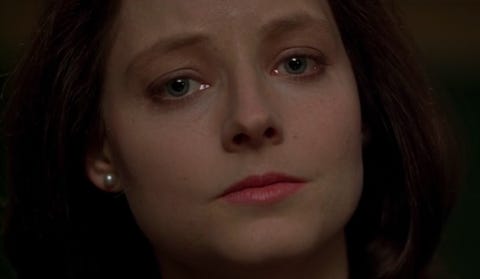
Clarice Starling is young and still very green. She is, in some very real ways, the fragile little bird her name implies. She remains alone, openly vulnerable, constantly threatened, and almost frustratingly as-yet unskilled as an FBI agent. In fact, she is not an FBI agent. She is only in training to become one. What quasi-sinister machinations by the male oversight led to her entering that dark, gothic dungeon of an “asylum” to chat with a master manipulator named Hannibal Lecter?
The camera shifts between an uncomfortable omniscient observer and the subjective first-person limited view from Clarice’s POV (and finally into the very head of the killer the film has spent two hours trying to “get into”). This subjectivity allows for such “tricks” as the two-house elision of the climactic approach that upends any comfortable distance…until that final God’s-eye view of a man walking away from the camera in echo of the opening shot.
There are two worlds represented in the scenic design. The Buffalo Bill storyline unfolds with an ultra-realism that mixes a decaying American heartland and the equally decaying victims and inner sanctum of the killer’s dark deeds. It is a disgustingly mundane world of beetles and slaughterhouses and crumbling comfort. The Lecter storyline, however, is just slightly elevated. Instead of unflinching reality, we are set down in a more typically cinematic world of heightened menace and horror. It is a world of fairytale evil and gothic nightmare…but also of an orderly gentleman in a well-kept cell. Where else could that dungeon-like crucible exist? The sudden appearance therein of a plexiglass cell? The elaborate staging of Lecter’s crime scene? Simply contrast the two killers’ names: the urbane and exotic “Hannibal Lecter” and the unnervingly wrong-looking “Jame Gumb”—a paragon of working-class nomenclature.
Every man Clarice meets comes off as predatory and sinister. They all eye her up (and down) openly, stare fixedly, make awkward and inappropriate passes, and seem to be eerily withholding a grand scheme. Many of them lean towards a Felliniesque ugliness. (For a film that loves tight extreme closeups of our characters’ eyes, it is unnerving to see the many glasses and sideways looks of the men. And when the entomologist looks up to reveal his crossed eyes…? Clarice lives the life of a lamb: surrounded by butchers, (again) vulnerable and always alone, leered at by all as if she were supper. (Her strength comes from the fact that this lamb refuses to scream or be silent, never lets herself close her eyes to the depraved displays around her.)
Speaking of lambs, the enigmatic title of the film refers to more than Clarice’s memory of screaming lambs, from which arises her need to save the victims of the world as well as her desire to distance herself from her past. (Does Clarice understand “Bill’s” frantic search for replacement and metamorphosis better than we think?) By the subtle placement of lamb imagery, we begin to associate all women with these victim lambs. Indeed, by the end—as we watch oblivious people stroll down the chute-like road—we have come to feel that all of us are walking silently to slaughter. The only ones aware of the threat are the killers like Lecter and those who have martyred their chances at a normal life in order to hunt those killers, hoping to save even one oblivious victim, like Clarice, Our Lady of the Lambs.
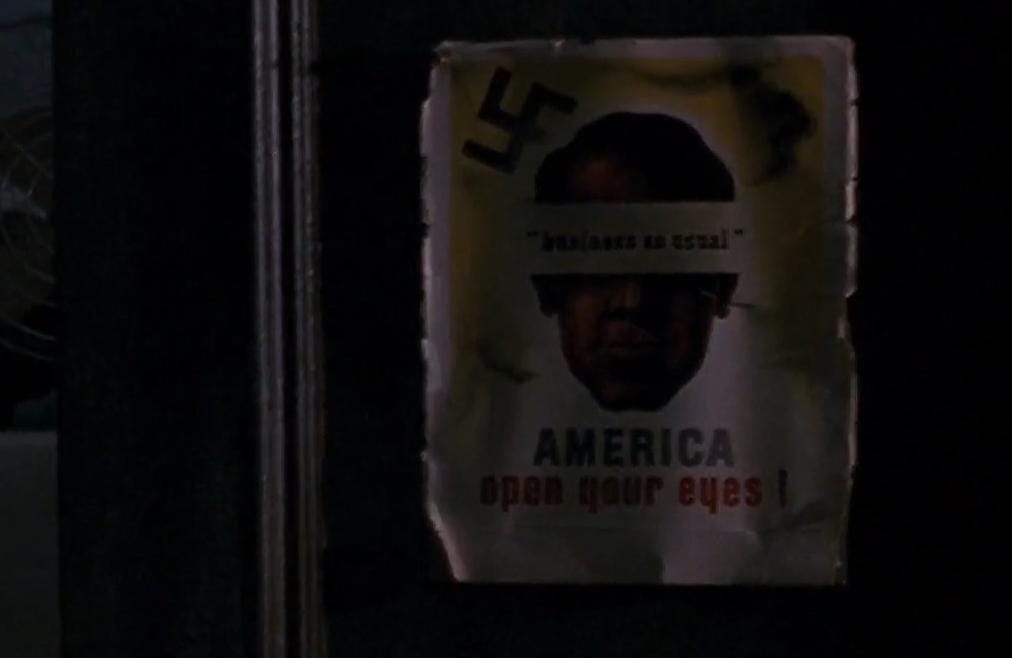
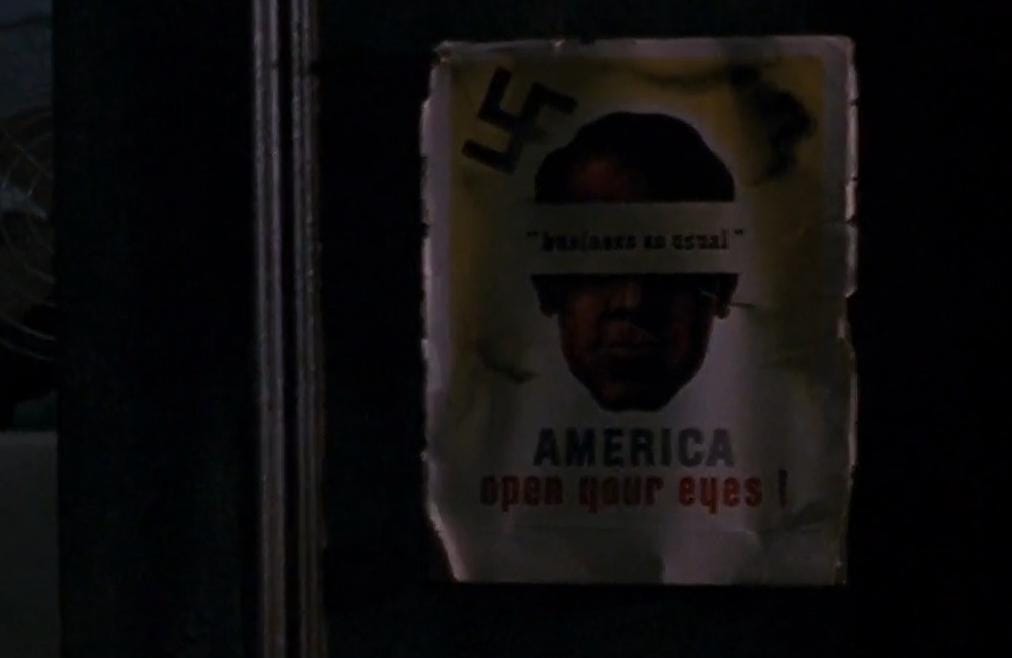
Finally—and most importantly—the film has a strong political subtext that goes beyond Jame Gumb’s cozy swastika quilt. Next time you watch The Silence of the Lambs, count the flags in the background. They haunt the margins of the frame, just as the two serial killers haunt the fringes of our world. American flags. In killers’ dens. Covering evidence in storage units. Hanging on walls and flagpoles. Decorating bloody crime scenes. Watching over the nameless Americans (the silent lambs) who wander through the world of the film as if lost, confused, and in shock. And just before the climax slams down on us, we see a WWII propaganda poster rather obviously displayed in Gumb’s house: “America, Open Your Eyes” and a face whose eyes are covered with a banner reading “business as usual”. This is the most frightening image in the film, because by then we know all too well what it means. And as we brace ourselves to open our eyes…the lights go out.