The Robe
1953
I think I speak for most of my generation (Gen X) when I say that I have a negative bias against the biblical epics of the 1950s. I’m not entirely sure why that is, but it has something to do with their sheer numbers and something to do with my image of overly earnest fifties melodrama. Well, it was Easter yesterday, and I finally watched The Robe, based on Lloyd C. Douglas’s novel of the same name. Now I feel silly for disparaging it sight-unseen.
Yes, The Robe can be overly earnest in a bad way. Richard Burton has moments of thespian apoplexy that ruin the scenes they take place in. For that matter, the score also indulges in this vice. And, since he needs to get in on any vice, Caligula is also infected, delivering all his lines in the same extreme timbre and volume. The film is slightly too long at two hours and thirteen minutes, and thirteen minutes would be my exact suggestion for how much should be cut.
On every other level, The Robe is a great film! It was the first film ever done in CinemaScope, which was a drastic change from the square aspect ratio of movies before it. The film makes full use of this spectacle-oriented format. The sets are beautiful! IMDb tells me it was filmed in California and Spain, but I fully believed that they were on location in Jerusalem, Cana, and Capri. The color (restored wonderfully) does not have the distracting vividness of some other Roman-set films of the period. It utilizes the entire range of pigments, giving us clear blue seas and foreboding clouds as well as breathtaking vistas. The film’s Oscar for set design was well-earned.
I was also shocked by some of the impressive “how did they do that in 1953?” camerawork. One simple shot shows us an archer in the foreground firing an arrow into a moving actor in the middleground. Seriously, how did they do that? They didn’t create a digitally animated arrow, I can tell you that. Another amazing shot shows four racing horses, hitched to a carriage, who seem dangerously close to the camera…until they overpower it, galloping right above the now ground-level camera. And these must have been new and bulky instruments, given the film’s revolutionary aspect ratio.
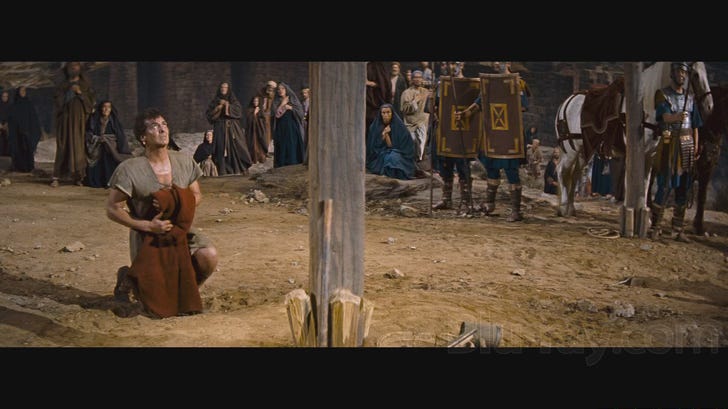
Most effectively, The Robe features perhaps the best crucifixion scene I’ve seen. Jesus, in the tradition of the times (a tradition I support) is never seen in an unblocked shot, meaning that we never see his head at all. I love this, as it strikes me as respectful and a helpful aide against the still-prevailing canonical face of Jesus and of the White actors who usually played him. The crucifixion scene includes realistically chatoic weather and a suspiciously shadowy noontime. When the centurion freaks out about killing the Son of God, we’re with him. Even a staunch unbeliever could not have ignored that apocalyptic scene. Yet, there sit Burton and his friends, throwing dice for the titular robe as if nothing were happening. (I still have yet to see a crucifixion scene which includes people exiting their graves, though, which, for my money, is the freakiest part of the whole supernatural grief spasm.)
Douglas’s story is actually rather clever, weaving between the New Testament narratives a very personal story of the Hound of Heaven and Irresistible Grace. The only possible weak link is the centrality of the robe itself. Firstly, it looks awfully small to have been Jesus’s robe. Secondly, it could be problematic to treat it as a holy relic with touched-by-divinity powers. Ultimately, though, I don’t think the film quite crosses that line.
Finally, the dialogue not only gives Christian belief and conversion the respect it deserves, but it includes several memorable scenes of both. There are a few killer lines, such as when Demetrius has a chance encounter with Judas Iscariot and asks him how he could have betrayed Jesus. His answer: “Because men can dream of truth, but they can’t live with it.” And isn’t that dead on? Later, when Burton’s character is tried for treason as a Christian, Caligula asks, “Do you really expect me to believe the stories of this man giving the blind sight and healing cripples?” Burton replies, “It makes no difference whether you believe them or not. What matters is that there is no story of him making someone blind or causing someone to become a cripple.” Which is a very solid point (if you aren’t a fig tree advocate).
And so, just like the robe of the title, The Robe touched me in a fully unexpected way, changing my view of some things and prompting awe-full worship. What a great thing to watch on Easter!


