

The Odyssey
2026

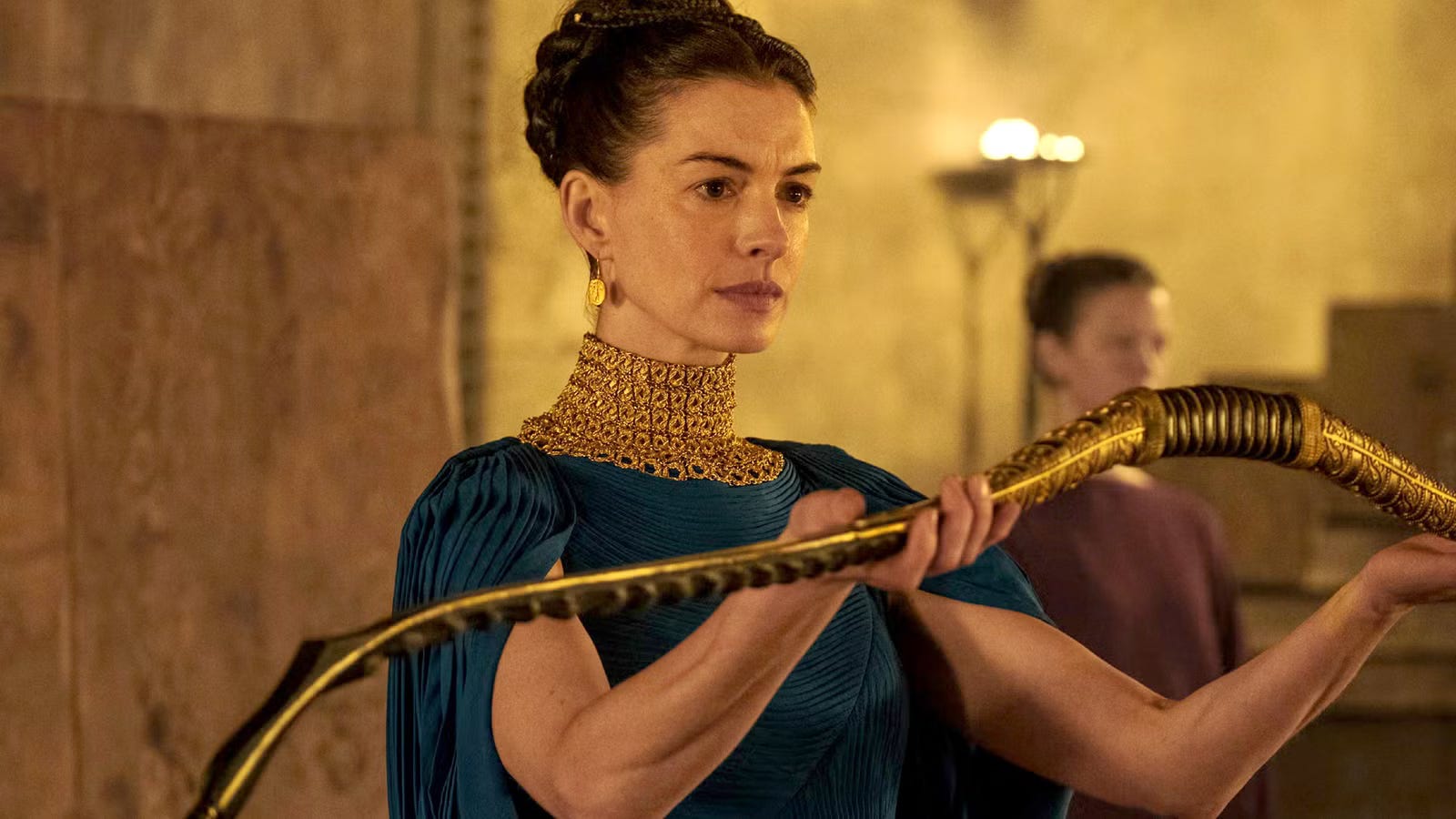
This is going to be a review full of disclaimers. I’ll get them out of the way up front, but they probably all could be placed under this one piece of advice: do not get caught up in the petty culture war discourse regarding this movie. It’s a bunch of ideological nonsense that has very little to do with this film or the epic poem it’s based on. For one thing, Elliot Page does not play Achilles. Achilles is not in this movie at all. Yes, Lupita Nyong’o plays Helen (and Clytemnestra), but it’s a very small role that amounts to being a trophy wife for much more important white men. Nothing about that is (oh, how tiring the phrase has become!) “woke”. This film is very orthodox, very conservative, and actually very heavily coded as a Christian parable. Yeah, how surprising is that? But I’ll get to that in a little bit.
More disclaimers. I’ve heard so much talk about “historical inaccuracy.” 1. This is not a historical tale but a fiction. 2. It is not even a historical fiction by genre: it is a myth. In literature, we use that term to categorize culture-spanning stories built on tropes found in all cultures. (Yes, the Bible is myth. The word doesn’t connote lack of verity in this context.) 3. The ancient world was much more heterogeneous than we have been taught by Hollywood. The world was at once very small and very diverse. Life in the Mediterranean involved cultures from Africa, the Middle East, Spain, Italy, and (yes) Greece, and those cultures were influenced by the “barbarian” societies of England and Scandinavia. They all intermingled. In a way, the Greco-Roman eras were times of globalization, but with the belief that the globe was much smaller than we now know. So, yes, Romanesque armor and Viking-style ships and “Nubian beauties” are not out of place in ancient Greece. 4. The Odyssey is not a novel. It is an epic poem from a long oral tradition. Therefore, there is no original or definitive text. This is another facet of myth. The story was passed down by traveling storytellers, and the poetry they recited was referred to as “songs.” Those songs changed from teller to teller and age to age. By the time anyone was able to write them down, there were many versions. When you add that all English versions are translations, the claim of a “correct” text is silly. Throughout time, each translation has reflected the mores of its time more than those of ancient Greece. I remind you again that this sort of fluctuating and living form is the essence of myth. (The Bible has the benefit of being divinely inspired and upheld, but you’d likely be surprised by the process used to select the 66 books we now refer to as Scripture.)
And so, what we ask when approaching an adaptation of something like The Odyssey is how the old story is retold and what that says about the artist’s thoughts about their own cultural moment. Through that lens, we can now begin to discuss Christopher Nolan’s new film mega-event that recently opened in cinemas.
This film does a great job of handling the most famous parts of the story. It doesn’t feel as if it were three hours long (although it is), and the filmmakers have managed to include all the classic episodes, giving each room and attention and never making any part feel rushed or squeezed in. It also excels at presenting those episodes with a simultaneous coherence and variety, finding new but natural ways to visualize each piece. Hades (Iceland) is especially effective (both creepy and almost holy), and Circe’s episode is creatively staged and disturbing. The cyclops is not a symmetrical being but a twisted and malformed distortion of the human form (the Imago Dei). The fall of Troy is appropriately huge in scale while still remaining a local, city-sized event. The suitors in Ithaca are portrayed as what we currently call “bros,” full of f-bombs and disrespectful slang. And it is all masterfully interwoven in Odysseus’s returning memories on Calypso’s island.
Calypso, it should be said, is presented as a much more sympathetic character than usual. This actually works well to distinguish her plot and Circe’s, which have always felt repetitive to me. The Trojan Horse is the most elegantly designed iteration I’ve seen, which may seem far-fetched, given what the men had to work with.—but it is another mainstay of myth that objects and events are more signifiers than naturalistic plot devices. (It could help immensely to think of this film as a parable.) The narrative bounces back and forth between Odysseus’s trials and Penelope’s siege by the degenerate suitors in Ithaca, including Telemachus’s coming-of-age story (which made the boyish Tom Holland a great casting choice who was callow but could command authority by the story’s end). All the character arcs are well-defined and rather beautifully portrayed. The acting is good, with everyone acquitting themselves well, especially Matt Damon, Anne Hathaway, and Tom Holland as the central family unit.
Nolan managed to have a viewpoint (which we’ll discuss in a second) and yet allow the events of the tale to retain their mythic breadth of meaning, interplay, and resonance. Odysseus is, fittingly, no hero here. He begins his journey while being hailed as a war hero, but his acts and motivations are prideful, irresponsible, and ultimately despicable. He only becomes the hero people believe him to be at the end of his long journey, returning to Ithaca a very different (and more worthy) man. This change is wrought slowly and poignantly, and his monologue before the final climax—in which he confesses the sins of his past self and his gradual alteration at the hands of the gods— is the heart of the film.
So let’s talk about the gods. They are treated much more in keeping with Christian belief than polytheist demagogues. Odysseus’s reaction to the idea of the gods could be said to be the core of his real journey. In the beginning, he mocks his crew’s superstitious worries about offending the gods and attributes his ensuing chastening to normal bad luck which they insist on imbuing with divine significance. He calls them “your gods,” and even when he is haunted by visions of Athena (the only Olympian we ever see in the film), he doesn’t know any more than we do if she is in his imagination or a true outside being. The short explanation of his transformation is that he learns to stop denying and fighting against divine forces and to instead surrender to their unknown and mysterious will. (Usually Nolan is more on top of his promotional campaign. All the posters read, “Defy the gods,” which is the exact opposite of the film’s main theme.)
This language should sound familiar, because Nolan seeds his screenplay with close paraphrases of Biblical texts. Much is made of “Zeus’s Law,” which amounts to loving your neighbor as yourself and taking care of widows, orphans, and aliens because you may be entertaining angels unawares. When Odysseus questions Athena, asking, “Why don’t you speak in ways we can understand?” her response is basically that the heavens declare the glory of God and that no man has an excuse to claim ignorance. In another conversation, she chastises his refusal to listen to what he knows the gods are telling him with a statement that might easily be paraphrased, “I sent you Athena and Circe. If you will not listen to them, you will not believe, even if blind Tiresius returns from Hades to warn you.” Such near-quotations of Scripture are surprisingly common and well-deployed.
The film’s weakest element is (unfortunately) its opening. After a bafflingly pointless title card (“In a time of apparent magic…”), we see rapper Travis Scott as a bard “singing the song” of Odysseus’s victory at Troy. Scott (real name: Jacques Bermon Webster II) cannot act, and it’s a bad first impression. However, by the end, when Scott helps perform a gorgeous song over the credits, I realized that Nolan is quite rightly linking the oral tradition with its closest modern equivalent: rap. After this dubious beginning, which foregrounds the suitors’ very non-Homerian contemporary speech patterns, the movie slowly finds its footing, and once it does, it catches the wind and never stops.
Trust me, I tried to hate this movie, but it just couldn’t be done.