

The Love That Remains
2025

Just as Hungarian filmmaker Béla Tarr made movies about and from duration, Icelandic visionary Hlynur Pálmason works with span. It took me almost a week to write this review because that first sentence immediately entered my brain, but I could not find a suitable word for the aspect of time Pálmason works with. Finally, I have chosen “span,” but it is still an ill-fitting enough word that I must try to define what I mean by it.
Both directors (RIP Tarr) sculpt with time, specifically the passing of time. The difference between their media, though, is that of being inside that time as it passes versus outside of it. Tarr bewitched with long, almost static shots accompanied by a repetitive score. He spoke with this duration (his greatest film is seven and a half hours long) about the drudgery and stagnation of the Eastern Bloc after the fall of communism. The viewer is enclosed in the pace and aesthetic of that creeping time. Pálmason works from the outside, making films about the passing of time as viewed from a more-or-less omniscient place of observation. His films also build using stillness across time, but they do so through processes such as time-lapse photography. This is a particular favorite of his, and he is happy to condense three years of filming into ten minutes for us by the use of a still camera recording short bursts of action over that entire time.
He uses other, perhaps more subtle, ways of showing long-term temporal progression. In The Love That Remains—a deceptively mundane chronicle of a family dealing with a recently dissolved marriage—another striking device is the work of the artist mother (which is actually art long practiced by the director himself). Over the course of the movie, we watch her slow process from beginning to end, intuiting the final product in the process. She cuts metal sheets into large shapes, arranges those metal shapes on top of outdoor canvases, and waits while the elements rust the patterns into the cloth. (Even then, there is a lengthy process of cleaning, drying, and setting that makes the entire process about a year in length and creates some visually interesting and beautiful pieces.)
Yet another image of what I’m calling span is the pet project of the family’s three adolescent children (who are also Pálmason’s own children, just as the house and lands where the film is shot are his). It begins with the digging of a deep hole. A tree trunk is placed upright in the hole, and the earth is gradually packed around it to create a beautifully ancient-looking monument pole. Next, they begin to cut and shape styrofoam, attaching it to the pole over time into what we begin to recognize as a human form. The form is given clothing and antique armor before becoming a target for the children’s arrows. This slow building from a sort of grave to a sort of memorial to an image of saintlike martyrdom suggests many themes, ranging from the Icelandic family’s Viking heritage to the human drive towards violent entropy and the slow death and salvation of the family following the parents’ divorce.
Shall I go on? The father, Magnus, is a commercial fisherman who spends long tours on an industrial boat in the middle of the ocean. As with the activities of the other family members, Magnus’s time is spent in a long, stark, and unforgiving process of laying nets, gathering them, sorting fish, cleaning fish, and filleting fish. When he is not on the freezing deck, he is uneasily berthed with about half a dozen other men who walk through their onboard domestic life like particularly randy zombies. (And wait until you see the ultimate image of time passing when Magnus is called to return home…!)
Amid all of this, everyday life trudges on. The parents are often on autopilot and cannot work out a way to draw new boundaries post-divorce that may keep the family unit intact. The children are flurries of energy, aggression (simultaneously playful and in earnest), discussions about adult life, and endless archery practice. The family takes hikes across the local hills and mountains. They harvest berries. They squabble. And surrounding all of this seemingly banal activity, Iceland shows a thousand gorgeous faces, like a protean landscape of wrath and grace.
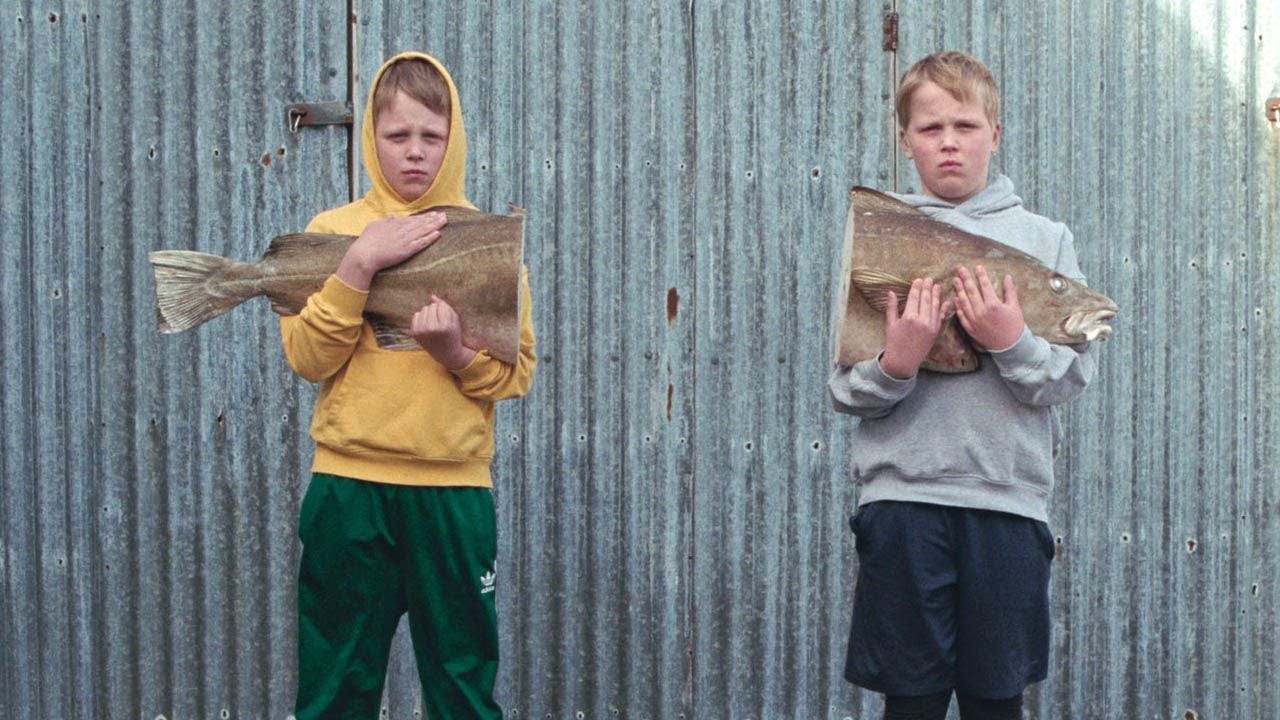
The last piece of this lovely film is the penetration of images on a vast continuum of surrealism. Sometimes, small incidents occur in the distance (did the mother just successfully wish that plane to crash alone and unwitnessed?). Sometimes, we are treated to quick montages of striking images—the twins holding the two halves of a large fish, the same cradling nothing gently in their cupped hands—and eventually the movie breaks out into full-bodied…dreams? (I could never spoil the exquisite surprise of these moments for you.)
Hlynur Pálmason’s fourth feature (after the likewise beautiful Winter Brothers, A White White Day, and Godland), The Love That Remains is not interested in grand plot or moral lessons. Instead, it is a mood board of memories, textures, and dreams that weaves a complex but perhaps ineffable portrait of one family as time passes over and through them, invoking the symbology of Jonah, Joan of Arc (“You mean Noah’s Ark.”), Galilean fishing trips, and more, all in the span of their potentiality.