The Human Condition
1959-1961
Masaki Kobayashi’s three-part epic, The Human Condition, doesn’t seem to show up on many Best Films of All Time lists, and yet all three installments (technically, there are six chapters, presented two at a time, but I don’t want this to get too confusing) are perpetually in Letterboxd’s Top 25 Narrative Films (based on user ratings). It is spoken of with great reverence among cineastes. Perhaps it doesn’t show up on official lists because it is one story told in three sections—each of which is officially considered a separate film. Whatever the reason for it not appearing on the Sight & Sound Top 100, this trilogy (which is more like a single, nine-and-a-half-hour film) is universally loved and respected.
The Human Condition makes sure you know its guiding philosophy. In the first film, the word “humanism” comes up enough times to feel a little awkward. (How many people pepper their speech with such abstracts?) Humanism is, without a doubt, the focus of the movie(s).
In Part I: No Greater Love, our protagonist, Kaji, marries and is appointed to a high office at a mine in Manchuria. Japan was occupying that area during WWII, which is the time the films span, and thus, many of the workers are Chinese POWs. Kaji has recently written an exhaustive thesis on the problems with using POWs for labor, and he is bursting with humane and practical ideas for improving the living conditions of the prisoners and thereby increasing the productivity of the mine. His ideals and ideas are good, but when put into use among real-life humans, they fail again and again. Sometimes it is the personalities and priorities of the other mine managers that disrupt his experiments, and sometimes it is the reality of working with non-hypothetical heterogeneous prisoners of war. Eventually, all his efforts fail, and he becomes hated by both the Japanese management and the Chinese labor force. “It’s not my fault that I’m Japanese . . . yet it’s my worst crime that I am!” he bemoans.
Part II: Road to Eternity begins at a low point, as Kaji’s failure and loss of face at the mine directly lead to him being drafted into the war. This chapter has many parallels with Kubrick’s later Full Metal Jacket. Amid the brutal treatment of basic training, Kaji still tries to stand up for his dream of humanism by reporting unlawful abuses of power and helping the weakest among his unit. Once more, he is foiled at every turn. While the Japanese army may have humane and reasonable rules, there is no oversight to ensure that they are complied with. Worse, Kaji begins to realize that the entire organization is built on the informal culture of abuse that pervades the training camp. Laws may say one thing, but an unspoken understanding among the officers makes them of little consequence. “The Soviets and the Chinese are not our enemy,” he says, “it is the Japanese army that is our enemy.” Among his herculean efforts at reform, Kaji becomes embittered by the personal biases and hatreds that form the true structure of the army. While he excels and becomes a model soldier, he is once again beaten down and branded with the reputation of a dissident and bleeding-heart troublemaker. His behavior at both the mine and the training camp also lead to him being labeled a communist. He begins to espouse the political beliefs he is accused of, because he believes that communism may be the only good alternative to the broken system he has been run through.
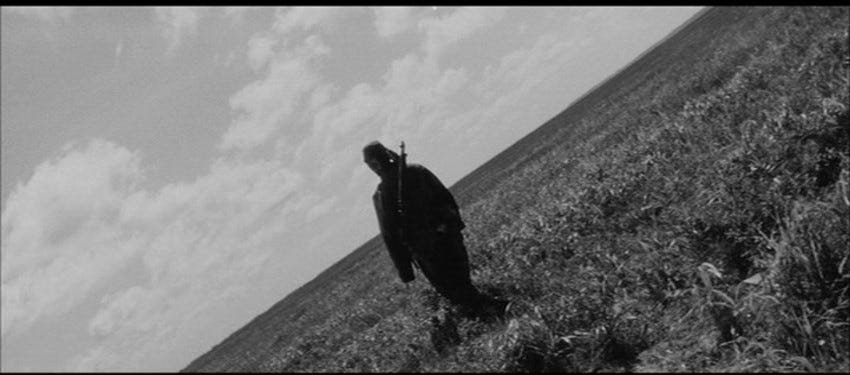
Finally, Part III: A Soldier’s Prayer turns the tables on the dynamics of Part I when Kaji himself becomes a Soviet POW. The horrors of warfare have refined Kaji’s skill as a soldier but almost killed his humanist ideals. Suddenly, he finds himself at a labor camp just like the one he tried to reform in No Greater Love. By now, he has seen and experienced enough to fully embody the contempt, despair, and desperation of the POWs he initially could not understand. Even more than before, there is a major language barrier between the prisoners and their masters. Kaji tries to explain and demonstrate his communist beliefs, but human weakness, personal ambition, and retaliatory sabotage make this impossible. Eventually, beaten down relentlessly by life, Kaji sees that communism is, like humanism, an ideal that cannot be achieved by humans. Nearly dead inside, he becomes increasingly more violent in his successful escape from the Soviets and flight through a liberated Manchuria. His skill and the remnants of his conviction mark him as the chosen leader among all the different groups of refugees he joins up with. And, his will broken, the burden and power of leadership drive him to horrific acts of murder and selfishness. The fact that he is surrounded by colleagues who behave with a truly evil disregard for others allows him to rationalize his innocence for a while. By the film’s end, though, he has no idea what has become of his wife or where exactly he can go to return to her or his country. A walking dead man, he finally falls into a winter marsh and quietly freezes to death.
It is certainly a sobering story, but it is also a painfully familiar one. I related to Kaji at every step. I am pushed forward by unwavering ideals that refuse to settle for casual human sinfulness. Obviously, I fare about as well as Kaji in this fight. I offend. I make enemies. I sin. I bewail the way things “should be.” And little pieces of my soul are sliced off constantly. This film hit me where I live, and it proceeded to beat a little more hope out of me.
Yet here is the difference between Kaji and me: humanism, by definition, relies on and ends with humanity. I have a strong tower into which I can run and a loving Sovereign whom I am constantly returning to. When I am reduced to a crawl, I surrender to the Lover of my Soul, who patches me up, helps me refine my beliefs and methods, reminds me of my first love, and eventually sets me on the wings of an eagle. This is not pretty Sunday school rhetoric. It is the one thing that I rely on and the only thing in this life that has proven trustworthy. The devastating defeat of humanism is the starting point of faith.
As for The Human Condition, its reminders are true and useful, if hard. It is also, however, a stunning film. The excellent Criterion restoration renders the stark black and white imagery both beautiful and unforgiving. A recurring motif finds the camera tipped at a thirty- or forty-degree angle. The world is out of balance. The scales of justice rarely hang level. And our view of the world is skewed even further. In some of these shots—and in repeated scenes set on steeply rising hills—we watch the human form, alone or in an endless line, making its Sisyphian journey towards an end not in sight. Another visual technique (which is often combined with that of the tilt or incline) is Kaji’s tiny human figure among a vast emptiness. This is the image that remains: a small man in a flat, upturned landscape that stretches endlessly across the screen. This is the Road to Eternity. And we all arrive at one end of it eventually.