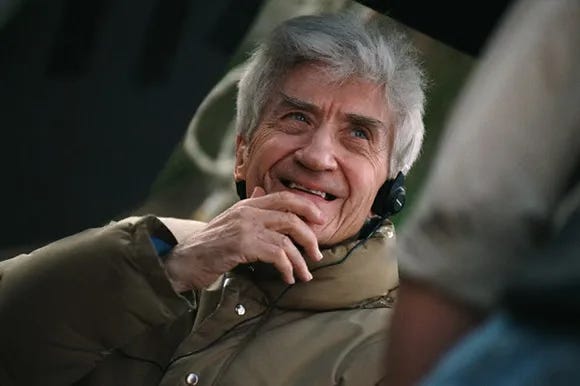
The films of Alain Resnais
another director's oeuvre completed
French director Alain Resnais currently occupies the twelfth spot on my Favorite Directors list. That may seem low, but it’s a crowded and competitive group. He is one of the best of all time. And I have finally watched all of his feature films (some of which have been near-impossible to track down)!
My concluding film was his 1993 two-movie film Smoking/No Smoking, which swept France’s César Awards, winning Picture, Director, Actor, Actress, and Screenplay. (Only three films have achieved the same feat at the Oscars.) That double-film, split into two films (can you guess their titles?), adds up to almost three hundred minutes and features only two actors—Resnais staples Sabine Azéma and Pierre Arditi. The film(s) is from the second half of Resnais’s career, in which he frequently explored questions of reality and artifice through adaptations of plays by British playwright Alan Ayckbourn, as he does here.
Set in a small Yorkshire village, Smoking/No Smoking is a branching-reality film in which we see small choices play out across five years with vastly different results. (Ah, the nineties, when every filmmaker wondered how small decisions change our lives in big ways. So, maybe it started in 1987 with Blind Chance, but the following decade gave us Run Lola Run and Sliding Doors and Smoking/No Smoking. And likely others.) Ostensibly, these choices have to do with a cigarette being lit or not lit in the film’s opening scene…but I fail to see the connection. Nonetheless, it presents multiple versions of the story of the interlocking lives of three couples [who are distributed in multiple pairings over the course of the film(s)]. The two actors play ten characters, with Azéma portraying six women and Arditi playing four different men. There is no screen magic here, such as split screens or doubling. Only two characters can be on the screen at any one time.
I like the premise of these two wonderful actors playing all the roles, and they do a great job. The characters are interesting, for the most part, and some sequences are quite lovely. I definitely prefer No Smoking—especially the scene set in dense fog. If these are archetypes representing humanity, I have a feeling I am “a Miles.” He is certainly the one whom I cared about most.
The “anyone could end up with anyone else” romantic tangle is a bit odd...more in keeping with French culture than English. I wonder if Resnais enhanced that bit from Ayckbourn’s play. Can all these people play musical beds with so little drama? Not in Yorkshire, methinks.
As with all of Resnais’s ‘second era’ films, there is little attempt to court realism. Perhaps, however, there is a bit too much. As he progressed, his artifices became starker, ending with Life of Riley’s mere suggestions of setting. I don’t necessarily want that level of bare theatricality here, but something in between.
Sadly, it is impossible to overlook the fact that both Smoking and No Smoking are too long, let alone when seen as one film...which they really are. I love Sabine Azéma and Pierre Arditit, but I don’t want to spend this much time with them, no matter how many characters they play. Between the two films, I watched this in four installments because it just felt never-ending. And what does the smoking do to change who enters Celia’s garden? It’s a weak choice for the title (and not Ayckbourne’s).
But these later Resnais films are more experiments than declarations, and I appreciate that choice on his part. When he began his feature film career, Resnais specialized in difficult and intellectual memory plays in which times and spaces and facts changed often. These very poetic stream-of-memory films play with form in extreme ways and therefore can demand a lot of a viewer who wants to fully “understand” them. I suggest you under-stand them, as you would a beautiful sky, allowing them to shift and exchange beauties while complicating the concept of “facts” in a past that is always remembered through fickle and finite human brains. Some of this disavowal of objectivity is also at the center of his later films, which play with staginess and distancing techniques meant to disrupt the audience’s suspension of disbelief, forcing them to consider that they are watching a fictional world.
Here, then—at last—is my (current) ranking of Alain Resnais’s films (with Smoking and No Smoking listed separately), including his documentary shorts and one anthology film in which he cooperated with other directors.
Last Year at Marienbad (1961)
Hiroshima mon Amour (1959)
You Ain’t Seen Nothin’ Yet (2012)
Providence (1977)
I Want To Go Home! (1989)
My American Uncle (1980)
Statues Also Die (1953)
Private Fears in Public Places (2006)
Wild Grass (2009)
Night and Fog (1956)
The Song of Styrene (1958)
Muriel, or The Time of Return (1963)
Far from Vietnam (1967)
L’Amour à Mort (1984)
No Smoking (1993)
The Mystery of Workshop 15 (1957)
Life Is a Bed of Roses (1983)
All the World’s Memory (1956)
Not on the Lips (2003)
Smoking (1993)
Mélo (1986)
Life of Riley (2014)
Same Old Song (1997)
The War Is Over (1966)
Je t’Aime, Je t’Aime (1968)
Stavisky… (1974)
Guernica (1951)
Gauguin (1950)
Van Gogh (1948)
Visite à Oscar Dominguez (1947)
Visite à Hans Hartung (1947)