Rental Family
2025
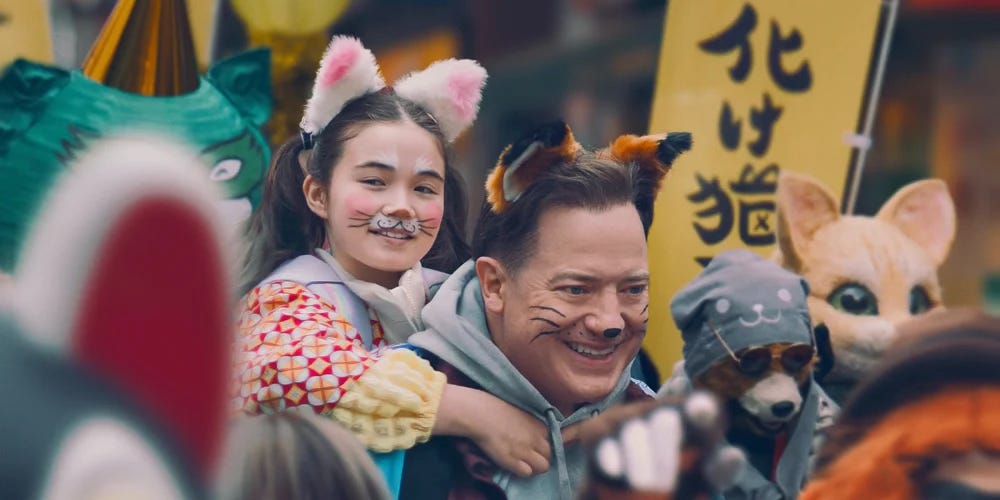
A small warning: this film involves a scene (above) set during something called The Monster Cat Festival, and I may not be able to focus on writing this review knowing that such an incredible event exists. Look at those people in giant cat heads! The Monster Cat Festival, people! Why was I born on this boring continent? Would you rather celebrate Presidents Day or The Monster Cat Festival?
Rental Family (now streaming on Hulu) is a high-grade if somewhat middle-of-the-road feel good movie. A struggling American actor living in Japan (Brendan Fraser) takes a job at the titular company, which provides a very real Japanese service: simulated relationships. To give you a sense of what they do, Fraser’s Phillip is sent on jobs posing as a long-gone white father for a girl who needs an intact family to be accepted into a prestigious school, a journalist writing an article about an actor who feels the world has forgotten him, a best friend for a lonely middle-aged gamer, and a Canadian husband for a daughter who is “escaping her family” for a life in the West.
This is the type of job I would really enjoy. My favorite acting assignments were relational role play, such as embodying case studies for social work students. Of course, Phillip learns that there is a dark side to this kind of work when not everyone is aware of the simulation. The girl will end up being abandoned by her father again when the job is over, and the article on the old man will never be printed. Also, when you’re a tall White guy in Tokyo, you will be recognized by people who then think you are any number of fake people.
I am only slightly more interested in Fraser’s new Oscar-winning serious actor career than I was in his Encino Man goofball years, but he is the perfect size to portray what it feels like to live in Asia. You stick out—or up. You are always watched curiously. You are alone amid a sea of faces, and nothing seems built with your bodily dimensions in mind. It is a kind of Wonderland experience. (And I miss it so much!) It is nice—at this exact historical juncture— to watch a film in which the American is the immigrant, however.
The film is about the importance of human relationships that model honesty and genuine care. It is about accepting responsibilities, whether they are from past mistakes of your own or handed to you in the awkward guise of manufactured connections. The film focuses on the father-daughter and journalist-actor relationships, which (shock and surprise) provide what is lacking in Phillip’s life, though he bristles beneath the artifice. Both relationships are touching, with the child actress giving an especially “precious” performance.
The film is quite self-aware and doesn’t try to be more than is required of it. That’s a good thing, but it also keeps everything within predictable narrative norms. I appreciated that Phillip unwaveringly identifies Japan as his home and is the only American we see, without the writers feeling that they need to defend this “odd” choice. We don’t all have the luxury of being born in the places that we recognize as home. And it is overwhelmingly difficult to immigrate anywhere unless you are rich or famous. Phillip may never come to a full understanding of Japanese culture—which the movie overtly addresses as nearly impossible—but he has chosen the country as his home, making him in many ways the truest member of said culture, even while he lives a lonely and separated existence.
The one thing that I didn’t appreciate was the matter-of-fact way that Phillip employs a regular prostitute. It is not simply implied, but stated, that his job is no different than hers, only “more personal.” The movie doesn’t seem to see a problem with this, and neither does Phillip. By the film’s end, though, I do believe that he has moved past needing this artificial connection in his life…but it is not addressed.


