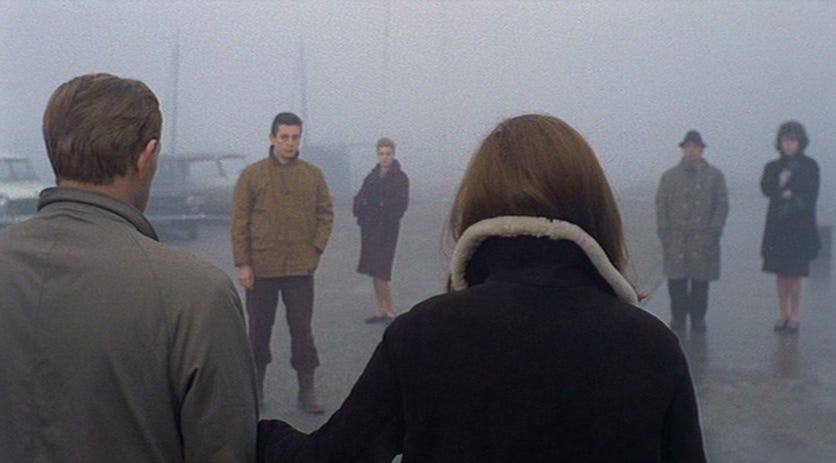
Red Desert
1964
As I continue my journey through the major films of Michelangelo Antonioni, I reach his first color work, Red Desert. It’s always promising when the first scene or two of a movie fills your head with the correct number of questions. Here, that disorientation that makes us look for answers and footholds happens quickly, and it never lets up.
Set in a sickly, hellish world of factories and industrial sludge, the film centers (one last time) on an adrift woman played by Monica Vitti. Mother, wife, aspiring shopkeeper…Giuliana has all the trappings that suggest stability, but from our first sight of her, we see that she doesn’t fit into the world. Our curiosity about her deepens as she pays a striking worker for a half-eaten sandwich, which she surreptitiously devours before continuing to her husband’s office in the factory. This initial action on her part is never repeated or commented on. Giuliana lives life moment to moment, and she likely has forgotten the sandwich by the time her husband introduces her to a Robert Redford version of Richard Harris. She acts desperately, with passion and little sense, driven only to get and eat that specific sandwich as soon as possible. It’s a disturbingly inexplicable introduction to a woman who we quickly learn is spiralling out in an existential panic.
Red Desert does an exceptional job of presenting that state of mind—or rather un-state of mind. I know the world Giuliana inhabits too well. She is overwhelmed by everything around her, frantically reaching out in several directions with no clear sense of what she needs. In interviews, Antonioni describes her as “neurotic” and “unable to adapt to the modern world.” Vitti understands her in a more thorough way, thankfully. How does she feel? “Like there is no ground under her.” Indeed. Everything is ominous because she (and by extension, the audience) cannot tap into the logic of what is happening in the way those around her seem to.
Throughout the movie, sounds and colors shift menacingly, and we are left to determine how much of this Giuliana is “actually experiencing.” Indeed, I don’t think she would understand that phrase any more than I do as I type it. Relationships are all unfixed and shifting. The material world seems to take on the same characteristics. Truth and deception and illusion are constantly jockeying for position. Watching it all is intensely uncomfortable and upsetting—at least to someone whose everyday life feels very much the same.
What is the answer—the cure—for Giuliana? This is an Antonioni film, so we’ll never know. But, by the film’s end, she has started to find ways to express it better. “I just have to accept that whatever happens to me, that’s my life,” she stammers to a stranger who doesn’t speak Italian. “There is something awful about the world,” she finally enunciates to Richard Harris’s character, “but I don’t even know what it is. No one will tell me.” Both of these statements hit me hard and conveyed so much truth about my experience in this world that the film’s subsequent end did not feel random (as it must have to others). Reaching those sentences, that depth of description of her life, is a true arrival and breakthrough. Giuliana will not feel any more at home in the world of “factories, colors, people, everything” than she did to start with, but she has found words to root her confusion in, and that is what will allow her to keep a grasp on her sanity. They may not be answers, but they are footholds. And we could each breathe a little easier.


