Project Hail Mary
2026
One review I read of the new sci-fi film Project Hail Mary said that it desperately wanted to be a film from the seventies or eighties. After seeing it, I totally get where that sentiment comes from, but I want to be quick to point out that it is simply a way to give you a sense of the film and not a negative criticism. Yes, in many ways, the movie trades in nostalgia in both plot and form…but it is a thoroughly modern movie, Millie. And the one the world needs right now, as evidenced by its box office popularity.
The ad campaign for this film chose to make no secret of the story or characters, so I will follow suit. Ryan Gosling plays a scientist—a self-described “failure”—who is pulled into a multigovernment project (guess what they call it) by recent German acting phenom, Sandra Hüller. He quickly learns that the sun is being devoured—all stars are…all but one. Just as quickly, he becomes the leading scientist of the project, discovering the nature of the threat and its strengths and weaknesses.
He wakes from an induced travel coma in a faraway quadrant of space, orbiting the only known star that seems unaffected by the universal problem. His suspended animation has led to memory loss and confusion, but he eventually pieces together where he is and why. However, he has no faith in his ability to do anything until an alien spaceship starts throwing messages at his ship. Voila: he finds another lone scientist in the rocklike creature aboard that ship, and together they have a reason to solve this whole dying-star problem.
The film wisely tells these two stages of the story concurrently. Nothing signals that the sections detailing Gosling’s work on Earth are traditional character flashbacks. That is, the structure of the movie uses flashbacks, but we never know how much Gosling’s character remembers from that time. The alternating narratives of past and present are what make the film work, as both parts of the story are rather solitary and repetitive. The flashback structure gives them rhythm and movement that they otherwise would lack.
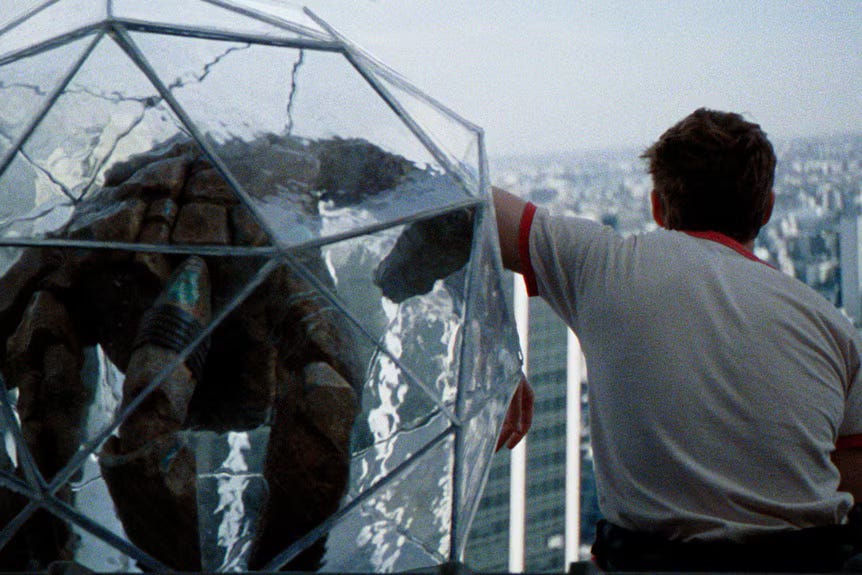
Gosling is—in true Gosling fashion—a nerdy guy with unexplainable muscles, and he translates the sound his alien cohort identifies itself with as “Rocky.” Soon, they are cohabitating (except that they need different heat and oxygen levels, etc., which is solved with a crude hamster ball), communicating through immediate translation, and making breakthroughs in their work.
Basically, the film is a buddy scientist story. The Earthbound sections feature Gosling and Hüller tentatively bonding, while the space timeline is literally just Gosling and Rocky. I feared that the rock puppet alien would be too cutesy and the film’s 2.5-hour runtime too long. Neither was the case, although there was plenty of cuteness and palpable passage of time. The filmmakers walked that line extraordinarily well.
The screenplay by Drew Goddard is based on a book by Andy Weir (The Martian), but I have not read it to know how they compare. The story is serviceable but not great. The dialogue, however, is very well done (this is exactly Goddard’s sweet spot) and occasionally lovely. Each character gets at least one great line, and this is one more reason that the movie works so well. It is not a space mystery; it is about relationships.
Indeed, this film is very much in the mold of Flight of the Navigator or E.T., but it uses modern tools and addresses modern problems. It is very family-friendly (never in a cloying way) and manages to be—and remain—heartwarming. All of the scientific feats in the film are nothing compared to the balance and skill that make the whole thing so effective and entertaining. It is filled with humor and pathos, and it throws in enough action that it never feels like a one-trick pony. Project Hail Mary is a perfect film for our current climate, as it deals optimistically with world peril, foregrounds the beauty and annoyance of working together, and still remains escapist.