Phantom India
1969
I am not a fan of documentaries. I dislike their tone of omniscience. I hate their pretended objectivity—but I hate those with obvious agendas more. I don’t like the social contract that we will pay no attention to the man behind the curtain/camera. They almost all ignore the fact that observing a thing alters it—especially if you put a camera in someone’s face and expect them to act normally. I find the ones that try to adhere to “just the facts” usually boring. I find the ones that set out to prove something with a veneer of fact enraging. I need a narrative! Without a story, I have no interest. But, obviously, every documentary is creating a narrative through selection, presence, and editing. But they aren’t honest about that. (You can see my INFJ flaring.)
Thankfully, there are documentaries that do name their biases, acknowledge their subjectivity, and don’t try to cover their storytelling. In fact, there are a lot! My favorites are (in random order) Four Daughters (2023); Spellbound (2002); Stories We Tell (2012); Man on Wire (2008); The 21 (2024); Billy & Molly: An Otter Love Story (2024); Voyage of Time: Life’s Journey (2016); Sans Soleil (1983); Baraka (1992); Man with a Movie Camera (1929); Close-Up Long Shot (1996); Mother, I am Suffocating, This Is my Last Film about You. (2019); Vive le Tour (1962); First Case, Second Case (1979); Place de la République (1974); Statues Also Die (1953); Nest (2022); Animals Distract Me (2011); African Cats (2011); Billie Eilish: The World’s a Little Blurry (2021); Song of Styrene (1958); Live from Shiva’s Dance Floor (2003); Night and Fog (1956); and Wait for Your Laugh (2017). That’s SO many! And now we add one more, making a lovely 25: Louis Malle’s Phantom India (1969).
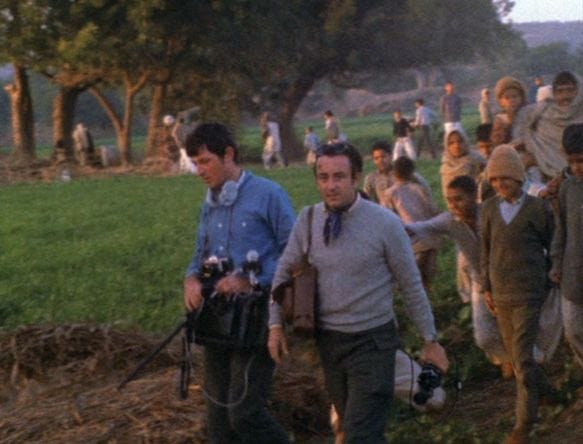
Malle wasn’t intending to make a documentary about India. He was there presenting a slate of French Cinema, and he decided he needed a break. That break turned into six months of traveling across the subcontinent and filming this six-hour doc (which was made along with a 99-minute companion piece on Calcutta alone).
From the very beginning, Malle, in voiceover, tells us that he isn’t looking for anything, admits that his camera enters these places as a weapon, and opens up about trying not to interpret what he sees. Of course, he’s human, so he cannot shed all of his sixties French ideology any more than he can always resist trying to make sense of his experiences. This, then, is the narrative I seek. The protagonist is Malle, and he goes through a very complicated and interesting inner conflict, creating a simple plot. His ideas, however, are anything but simple.
Phantom India (the Frenchman cannot truly touch, let alone grasp, either a specific or abstract “India”) embraces confusion, contradiction, mutability in himself and his subject, and the existential impossibility of cultural translation. At times, he tells us that he could find no explanation for the behavior he was filming, and yet he sees its importance to those who do live and understand it. He wants to release India from his Western political and social assumptions…but he often fails, lapsing into a judge instead of an observer. This attitude would have been radical in 1969, and the real practice of it remains rare over fifty years later.
One of the most important realizations Malle makes is that India is a collection of many religions, cultures, languages, and lifestyles. He begins and ends by talking to “the right people,” i.e., educated Anglophones. He immediately senses that their India is no less a phantom than his (only 2% of the population even spoke English at the time), and he basically flees into the villages. As the population of India exceeded the combined populations of Africa and South America, though, that’s a lot of villages! And so he shoots what he encounters, tells us what basic information he can find out from the people of each area through local translators, and marvels at what seems to be a tolerant diversity at every level of society. (Especially given that this was during Indira Gandhi’s rule, it’s clear that a lot of that tolerance is likely an illusion, however.)
As he watches throngs of Hindus worshiping at their shrines of choice in a large temple, he perceptively wonders if it is in their religious devotion that the Indian people find their only solitude. Although surrounded by milling crowds, the people do have very interior expressions. Even though they are often performing the same actions as the people around them, they are doing so alone and at their own pace. And so he hypothesizes that the lack of codified Hindu rituals and beliefs (and the sheer number of gods) allows each person’s faith to be their only individual possession.
Indeed, he points out that in the West, the base unit of society is the individual. In India, he seems to see a completely different structure. In this structure, he spends a lot of time musing about castes. In France, he reads that there are four castes, but in reality, he encounters more like 200 subdivided groups on an instinctual hierarchy. The government does not acknowledge caste, and yet the system solidifies and perpetuates itself through ages of cultural memory. Not many Indians will talk about caste, and he is unable to identify any outward distinctions, viewed from the outside. Everyone seems to intuit caste at microscopic levels. Nor is it about wealth or privilege. He meets many Brahmans who are penniless and stuck in stigmatized professions. The Untouchables are not all miserable or downtrodden. All his categories explode as he tries to understand this world even a bit.
Phantom India is full of fascinating footage, interesting stories, and unapproachable questions. What’s a Frenchman to do? It is perhaps even more revealing when he breaks into value judgments, praising certain villages for their sexual freedom and dismissing others for their radical religious activity. Usually, if you wait, however, he comes around later in the documentary with corrections, repentances, or abandonment to the unreadable world around him. At all times, it’s engaging and open to unknown complexity. It may be one of the best examples of what I find necessary in a good documentary.


