Moulin Rouge! at 25
2001
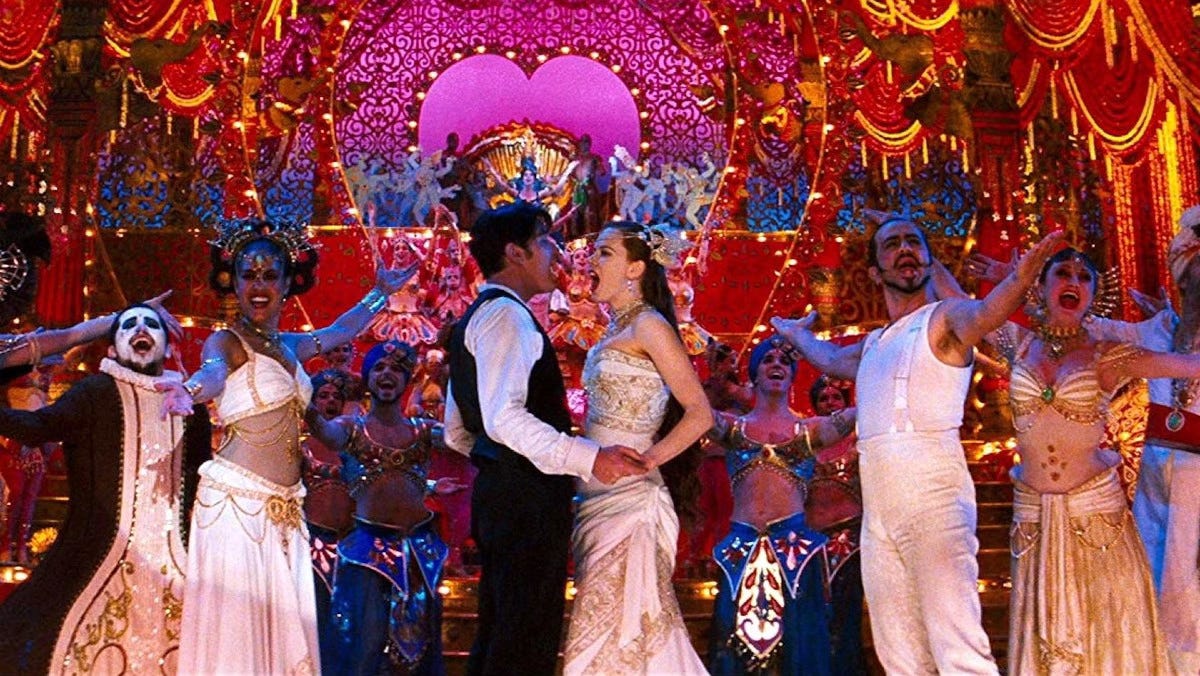
Baz Luhrmann’s Moulin Rouge! turns 25 this year, and it still deserves its exclamation point. In the intervening years, the movie had fallen off my Top 200 Films list, but it’s back at #38 after tonight’s rewatch. Not only is Moulin Rouge! a perfect movie, but its influence has proven to be impossible to underestimate.
I hope that this anniversary sees the film rereleased theatrically. Almost nothing can compete with seeing this in the cinema for the first time! I realized at some point during the first scene set in the titular Parisian nightclub that I was not breathing. There had never been anything to prepare audiences for the unrelenting aesthetic assault of the film’s first twenty minutes. It was a physical sensation. It made my body want to flee the theatre and my mind wonder if someone had slipped me LSD. Truly, this was the revolution on screen.
While it had been developing throughout the nineties, postmodernist cinema arrived fully realized in 2001, with the release of Moulin Rouge! Levels of reality? Got ‘em, starting with the production company logo. Coopting of historical people and places into a fully fictional narrative? It’s baked into its DNA. Melding of high art and low art? All over the place. Simultaneously celebrating and ridiculing popular culture? That’s its form! Endless interactions with theories of storytelling itself? More than I can count. Genre mélange? Hoo boy!
And at the same time, the film works as a model example of all it is parodying. Even those of us who were sure to mention its undermining of the traditional movie in every conversation also took it seriously as a new kind of traditional movie. Who wasn’t singing “Come What May” on campus that semester? How much did I try to dress and look like Ewan McGregor? What popular songs that I had never heard were suddenly thrust on my radar? The soundtrack (like that for Luhrmann’s Romeo + Juliet before it) was everywhere! Fashion changed. The jukebox musical exploded beyond Mamma Mia! and took over Broadway. Popular entertainment became more self-consciously prostitutional. “Tom Cruise’s ex-wife” became an A-list movie star. And the aesthetic of film was never the same—excepting those films which prided themselves on staying the same.
Even the Academy Awards—which were a long way from today’s indie acceptance—sat up. Moulin Rouge! was nominated for eight Oscars, winning for Design and Costumes. It was in the five Best Picture nominees, along with The Lord of the Rings: The Fellowship of the Ring, In the Bedroom, Gosford Park, and eventual winner (and the squarest of the bunch) A Beautiful Mind. What was it not nominated for? Best Original Song. It’s completely bizarre that the huge generation-defining ballad, “Come What May”, was passed over for songs from movies like Kate & Leopold and Monsters, Inc. (for which Randy Newman took home the trophy)! Three years earlier, the same had happened with “Kissing You” from Luhrmann’s Romeo + Juliet, which is, for my money, the greatest movie song ever written. (Randy Neman got a nomination that year, too, if you’re counting.) But, then again, 2001 was when Amélie lost Best Foreign Film to No Man’s Land, so iconic genre-breaking movies didn’t fare well that year. (All anyone remembers today is Halle Berry’s hysterical, historical time at the podium. And her dress. And that Adrien Brody kissed her without consent.)
But, looking back after a quarter of a century, who would pick A Beautiful Mind over those other nominees for Best Picture? How much did it change the very fabric of cinema? How was it at all representative of what film was doing in 2001? And, if you happen to know that Kate & Leopold song—those who remember the movie—please hum it for me. I’ll be reliving the incredible tango sequence set to “Roxanne” and the spectacle of the Hindi remix of “Diamonds Are a Girl’s Best Friend” among other immortal music moments from Moulin Rouge!
And while we’re talking Oscars (and when am I ever not?), Nicole Kidman was the only acting nominee from this film. No argument that she deserved it just for her sparkling entrance number. (And does anyone else remember Halle Berry’s performance in the grimy Monster’s Ball? It was only good because we expected so little from her then.) Jim Broadbent should have gotten in as Harold Zidler—but he still won that year, just for a different movie (Iris). And why does no one talk about Caroline O’Connor as the duplicitous prostitute so charmingly named Nini Legs In the Air or John Leguizamo’s comic/tragic Tolouse-Loutrec?
Put this film up there with the overwhelming cinematic achievements, with PlayTime, Sátántangó, and Jeanne Dielman… Add it to the list of movies that changed the art form, like Breathless, The Jazz Singer, or The Cabinet of Dr. Caligari. But it also holds a spot on the beloved love stories list, beside Titanic, The Way We Were, and Kate & Leopold, I mean, While You Were Sleeping. Should I go into box office hit musicals? Moulin Rouge! lives in all those worlds equally. And what kind of movie does that?
And that is the only reason we allow Elvis and Australia.


