Mother Mary
2026
One of the strongest films of the past decade is writer/director David Lowery’s The Green Knight, in which Dev Patel’s Sir Gawain seeks to be worthy of a beautiful halo-shaped crown. Finally, Lowery is back with Mother Mary, in which Anne Hathaway plays a pop megastar whose signature look is the same sort of halo headdress. One might even say that she, too, is trying to prove worthy of the headwear.
I entered the Vestal AMC theatres on my birthday (Saturday) ready for this film to become my newest obsession. Recent films that held the same promise have sorely disappointed (Joker: Folie à Deux, Love Hurts, even the film adaptation of my beloved musical Mean Girls), and so I was also ready for deflation. But hope was foremost in my thoughts as I settled in to watch Hathaway’s Mother Mary face off against ex-bestie fashion designer Sam Anselm (Michaela Coel) in what promised to be an unexpected and twisty pas de deux. (“Are you making me a hate dress?” Mother Mary asks in the trailer. “Maybe,” Sam replies.)
Rather than extend the suspense any longer, I will tell you that I wandered out of AMC that afternoon in a slow-motion, unreal world and then sat in my car for an hour and cried over the beauty and perfection I had just been swept up in. Lowery for the landslide win.
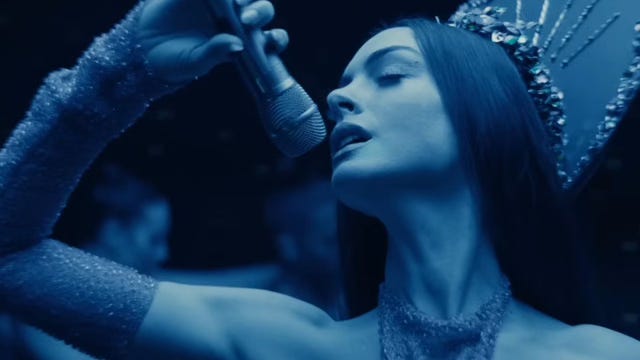
Mother Mary is a superstar we could dub Taylor Gaga. Both inspirations are clear, and yet she achieves an unbroken uniqueness of both sound and image. Yes, the Virgin Mary is her schtick, and she always—always—performs with some sort of (gorgeous) halo. Her clothes are also icon-inspired, playing with the white of purity, the red of a bleeding heart, and the silhouettes of armor and sainthood alike. Her music is mesmerizing and like nothing I have heard before. Her stage presence is commanding, as she struts and dances with the impressively toned body such exercise requires. Her voice is ethereal and earthy at once, befitting her name. And her wardrobe is unceasingly inventive and beautiful.
However, when MM (We’re never told her actual name.) shows up uninvited at Sam Anselm’s breathtaking barn-cum-studio, she is wearing sweats, and her hair is a mousey wet tangle. She lurches through the atelier, shouting for her ex-best friend (of course, they have coded it to be read as a romantic relationship if that’s what one wants to read it as) and manically/brokenly demands a dress. Mother Mary has been going through a mysterious media-tracked rough spot, and it’s written in every millimeter of her body and soul. She knows that the only person who truly knows her—the friend she betrayed a decade ago—can design an outfit that will acknowledge and shed all of that in a triumphant return to the stage. She has only one caveat: no red.
Sam “can feel her coming miles away” and steels herself for the reckoning with the woman whose brand she created…who cast her off casually…whom she hates as much as she can muster…the hate for whom has propelled her to become one of the top fashion designers in the world. Michaela Coel is radiant in every way. She is styled to understated perfection, her stunning eyes and cheekbones carrying the inscrutable emotions locked inside. She projects such an aliveness on screen that makes her an easy match for the bedraggled, humbled popstar at her doorstep. She holds such palpable power with such a light hand. It makes her enchanting and terrifying. It also makes us feel that she is the one in the right in this grudge.
Most of the film puts these two actresses alone in the vast space of Sam’s studio, verbally sparring as their past is slowly revealed. This electrifying faceoff is broken by flashbacks to MM onstage, confident and glamorous as she belts out strangely sad and angry songs with a deceptively slinky beat. Both these worlds are fully embodied and seem like little Edens, although they are stark opposites. Interestingly enough, each woman is the snake in her own garden. Or—she thinks—the other one is the true Deceiver.
Several amazing scenes follow (which you must discover for yourself), including a genuinely haunting dance done by Hathaway in the open barn to demonstrate how she needs to move in the desired dress. The catch: Sam refuses to listen to her music, and so the increasingly erratic dance is performed in silence. Only the grunts and gasps of Hathaway’s well-trained-but-still-taxed body accompany what soon begins to look like a possession or an exorcism. Eyes wide, Sam calmly asks in a tone of half-hidden victory, “My, how can you sing while doing all of that?” Mother Mary returns a curt, “Practice.”
This scene is the center of the film and marks a definite shift in the direction of the narrative. But the point is clear: each of these women must exorcise the other if they hope to live with themselves. This entire film is a ritual cleansing of years of painful history, a stripping off exactly like MM desires for her upcoming performance attire, a shedding of old skin and a starting anew—but maybe forever apart.
Lowery released an opening day statement which mentioned that this was his third picture with the hot studio of the moment, A24. Previously, he made A Ghost Story and The Green Knight with them. I cannot shake the implication that this is a loose trilogy of sorts. Each film moves at a slightly faster pace, starting with the glacial rhythms of A Ghost Story, and progressing through the slow-but-inexorable pans of The Green Knight, to the more conventionally timed (but still unhurried) march toward heaven or hell that Mother Mary and Sam Anselm walk together. I have mentioned the halo connection that seems to bind the latter two films. The posters for Mother Mary provide a clue to its relationship with the former, declaring “This is not a ghost story.”
I have to get back into this film as soon as possible, and maybe I will be able to glean more evidence for this three-film cohesion. Perhaps not. But no force, natural or supernatural, real or metaphorical, will keep me from another rendezvous with Mother Mary and the career-best work of its two stars. (And, obviously, although I just typed “two stars,” this film is getting the full five.)


