Lady Gaga: The Art of Personal Chaos
Coachella 2025
I recently watched Lady Gaga’s incredible 2025 Coachella performance, titled The Art of Personal Chaos. I am only casually interested in Gaga, mostly because of her acting and the theatricality of her persona. When she first stepped into the spotlight (I saw her first appearance on TV!), she was a very different entertainer than she is today. Her songs and videos were crudely sexual (I just read the lyrics to “Poker Face”, and I am literally shocked and appalled.), and her persona was a daily cycle through random personae. She always appeared in costume, and she promoted herself with a foregrounded shock factor. Over the years, so much has changed. The costumes remain, but they’re reserved for actual performances. She tamed her wild-girl image (supposedly after Elton John held a private intervention), embraced a wide range of musicality—especially jazz—and matured into a well-spoken adult in a world of baby celebrities shooting from the hip. Essentially, her focus has tightened while her persona has opened up.
The Art of Personal Chaos floored me with its epic theatricality, narrative structure, expansive sets and costumes, and impressive choreography and arrangements. One fan noted that it is “Wagnerian in scope,” and that is quite true. This show was a rare example of a true Gesamtkunstwerk, Wagner’s term for an art made up of all the arts. Music, dance, story, fashion, sculpture, design, theatre…they are all utilized to the fullest. It was (surprisingly, to me) one of the best stage spectacles I have seen!
I suppose what drew me to watch this concert (basically a film) was what little I saw of Lady Gaga’s recent iteration, wherein she walks shakily, bent over, with a huge gnarled cane. I thought, “What is that about?” Also, this was (I read) a tighter, more operatic version of her free concert in Rio last year, which drew a record crowd of over 2 million people. Clearly, there was a lot of interest out there.
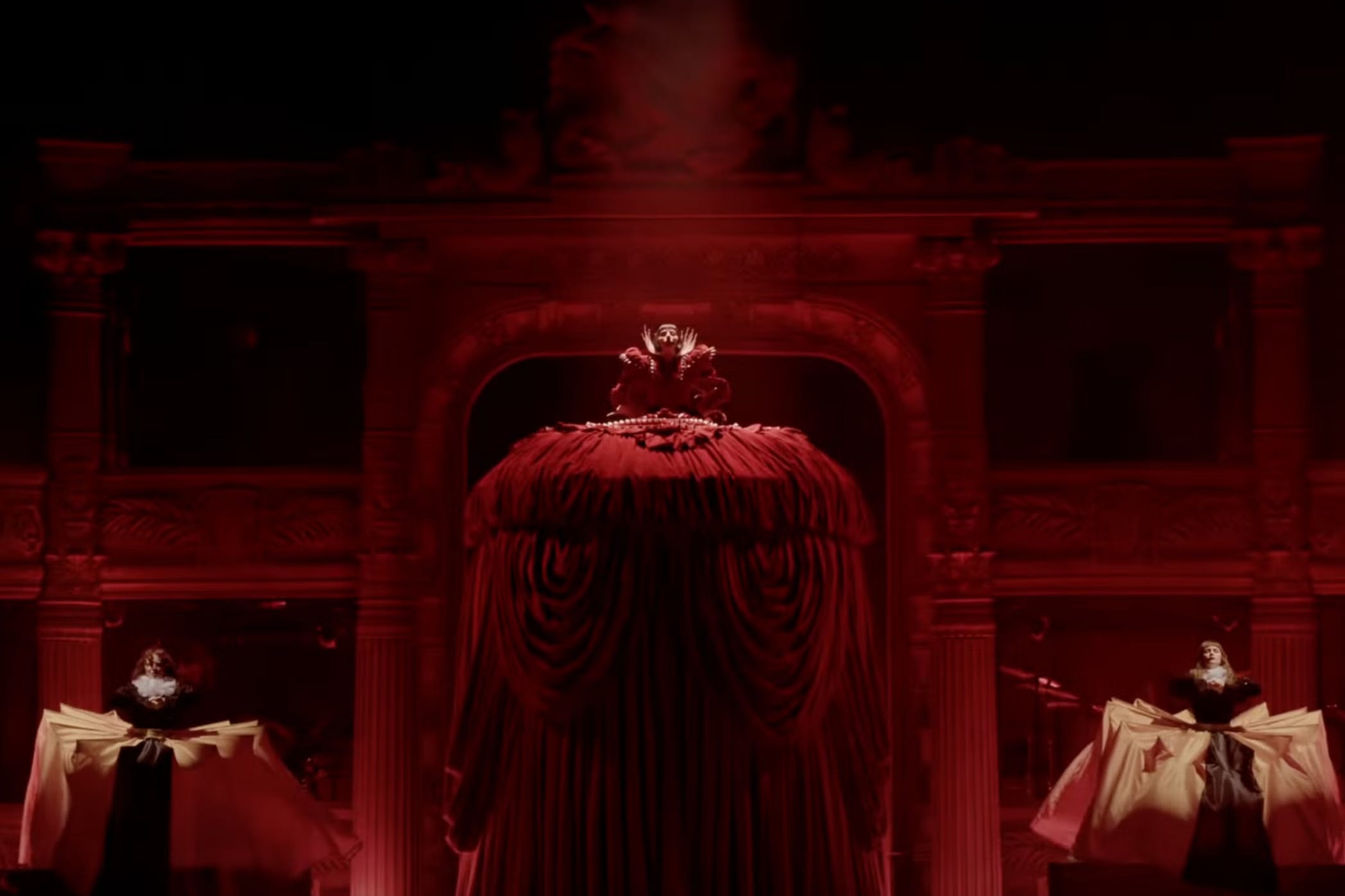
The show itself is an epic gothic pop opera about two deuling monarchs (both Gaga herself): The Mistress of Mayhem (she with the cane, in severe red or black) and The White Queen (in flowing white). The main set was a full-sized opera house (well, half of one, as with most performative spaces) with two or three storeys and dozens of arched performance spaces (think The Muppet Show opening). Attached to this, there was a very, very long causeway that led to a square surface with a screen for a floor. Gaga was buried in sand, played human chess against her other self (with a huge crew of talented dancers!), and played two different (stylized) pianos and an electric guitar between dances that often led to her audible gasping for breath into her head-mic. There was a string section in exaggerated 18th-century dress, a 360-degree keyboard, and a dress at least forty feet tall (which opened to reveal a two-storey cage full of dancers instead of the whalebone hoops one would expect). There were four titled acts and a massive finale. The songs were arranged into a mix between opera and electronica, flowing from one into the next seamlessly. There was even a keyboardist who seemed to be dipped in undried carbonite! It was hypnotically grand.
Look at this guy!!
I had only heard a few of the songs before: this was no “play the hits” affair, but a narrative told through selections of her music. This made me wonder. If the concert is a straightforward parade of greatest hits, then the recorded music is the primary text. Sometimes, an artist themself (Taylor Swift) becomes the primary text of their career. What, I wondered, was Lady Gaga’s primary text? Was it the concert itself? For some rock stars, this is indeed the case, but Gaga’s show was clearly referencing something else…something more than just her music, more than her persona, more than the experience of the audience and artist communing, and more than her music videos. All of those things were reference points, out of which the performance was constructed, but none was the main thing.
As best as I can see it, Lady Gaga’s primary text is something that we never see. It is a mythos, an intricately constructed world, from which we are told stories. This type of grand, extravagant concert is perhaps the closest we get to seeing that place, but it’s not nearly the whole. Gaga’s main work is world-building, but we can never enter the world she has built. Each album, each persona, each thematic playground is a piece drawn out of that unseen world. It is, however, the very sense that a complete world lies behind it all that proves so magnetic. It is a kind of performance art from an undiscovered country.
I have a weakness for gothic literature, and so that is partially why this spectacle delighted me so. The concept may have been simple (each person’s internal struggle between chaos and order), but it was not dealt with simplistically. There was no winner at the show’s end. The Mistress of Mayhem and The White Queen are locked forever in an embrace that can be both belligerent and conciliatory.
This is what I want from a concert—an ordering and reimaging of the music, placed in some sort of context. Other concert films that I love include Bernadette Peters at Carnegie Hall, David Byrne’s American Utopia, Stop Making Sense, Taylor Swift’s Reputation Stadium Tour, and Happier Than Ever: A Love Letter to L.A.