La Notte
1961
Michelangelo Antonioni’s gorgeous 1961 film, La Notte, has few peers. It is a film about affectless, wandering, actionless characters, which overstuffs its sets, landscapes, and architectural backgrounds with all the profound meaning and plot that the human element eschews. (Perhaps Cléo from 5 to 7 is a cousin, PlayTime a wacky uncle.)
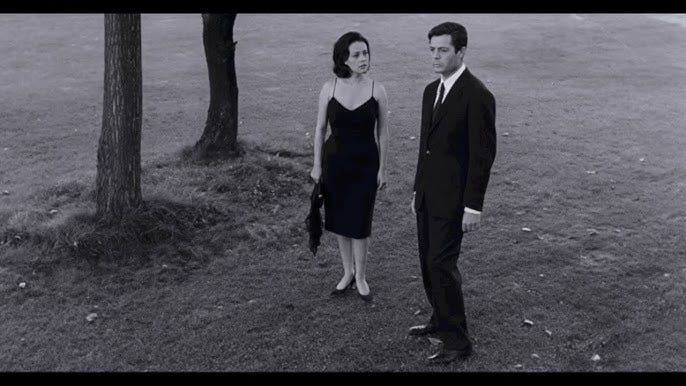
One academic discussing the film compares it to a Mark Rothko painting, saying, “There is tremendous substance in this void.” In a film populated with ever-moving crowds, what void is this? The narrative void, where we expect to see (or construct) a story. The emotional void within the characters, whose ennui, interiority, and soul-death lead to shots like the one above, in which two trees seem to be aping their hangdog shapes, and not the other way around.
This film is often grouped with Antonioni’s prior and subsequent films (l’Avventura and l’Eclisse) in a “trilogy of alienation.” Here, the married couple at the movie’s center is alienated from each other, the world around them, other people, and their own inner selves. As they wander blankly through a day, irresistible impulses to connect—by touch, by eye contact—arise and are frustrated. Several aircraft fly overhead, and the characters stop to watch them, perhaps recognizing that they, too, are floating “above it all” in their constant wanderings and parties, and even in the presence of actual death.
Architecture reveals what they have become unable to. The camera’s frame is filled with other frames—windows, doors, pillars—that cut people off from those around them. At the same time, they are never alone; in a world of balconies and glass walls, someone is always watching them or vice versa. In fact, the glass here is both window (allowing partial connection and denying privacy) and mirror (reflecting ghostly shapes of the protagonists that hover over the scenes inside, revealing the people to be but phantoms of themselves). In the modernist metropolitan world, what should be windows to the soul and reflections on identity are simply barriers and screens. They screen things out and screen things in. And they remind us that a movie screen is also both a window and a mirror, playing with light.
The central couple is played by some of the biggest European stars of the day, Jeanne Moreau and Marcello Mastroianni. Both actors disliked the film due to the restraint and ‘non-acting’ necessary to portray their characters. But Moreau is one of the great face actors: every thought and feeling plays across her face as she simultaneously fights to remain immutable. This is why her Lidia is the main character; Mastroianni’s Giovanni is too far gone to register anything on his perfect but flat face. Monica Vitti shows up eventually to create an existential love triangle, and though she is more alive than the couple (due to being younger), we can see her ability to feel and express feelings draining out of her through her interactions with them during the night (“la notte”).
I cannot talk about this movie without remarking on the nightclub act that serves as a segue to the film’s long garden party sequence. In a blend of striptease and elegant acrobatics, a woman guides a glass of wine from her forehead to her legs to her mouth, all the while standing, lying, somersaulting… It’s one of the best variety acts I have seen, and it also turns out to be the most active scene in the movie!
When watching an Antonioni film, one must always take note of the ending. His endings are perfect, surprising, and open to debate and meaning-making. By comparison, this one is almost conventional, as the camera wanders away from Giovanni and Lidia, focusing instead on more alive subjects: a group of trees. It is then that we realize that we have been the wanderers, watching and wishing to connect to what we see and to make meaning of the unexplained actions of those we have been following. In the end, however, we lose interest in such walking still-lifes and continue our peregrination.


