KPOP Demon Hunters
2025
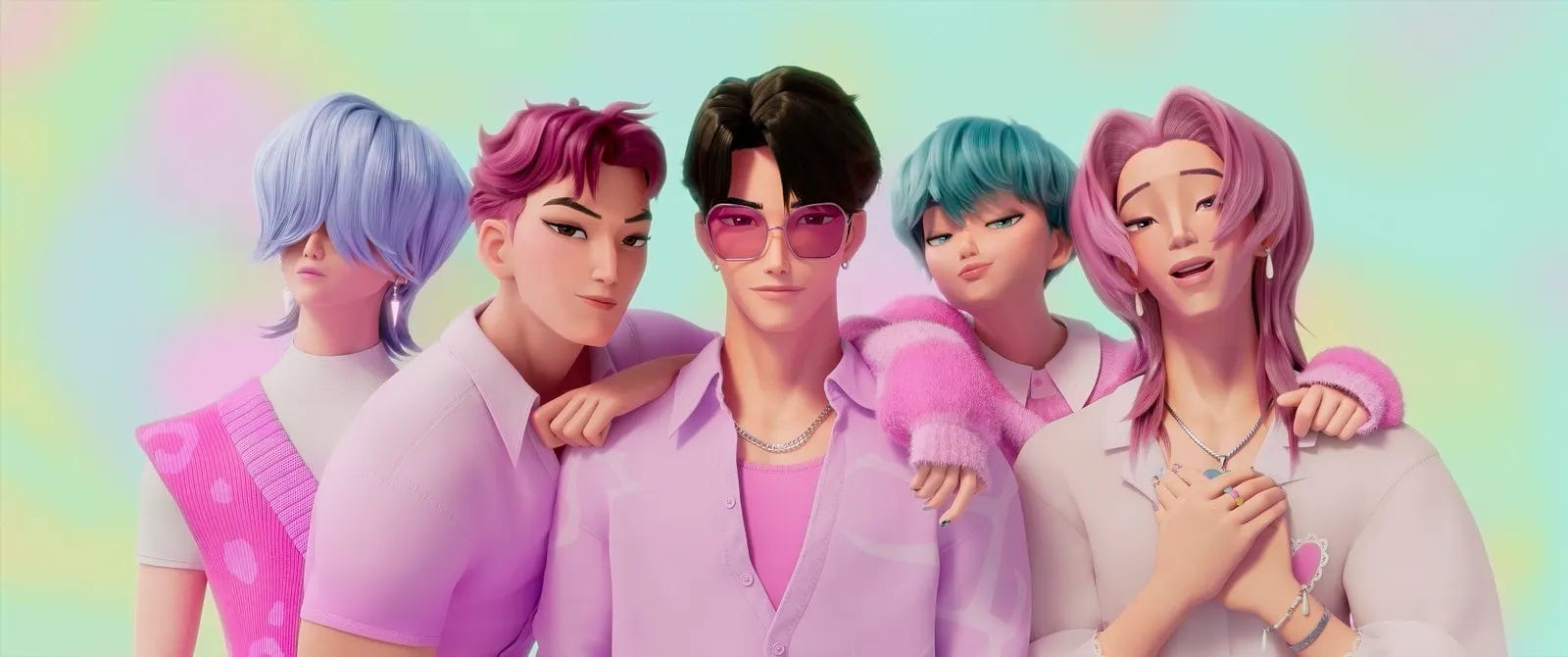
As you might be able to tell from the title, KPOP Demon Hunters fully embraces the good, bad, and unfathomable of its zeitgeist-synergy premise. In a musical twist on Buffy the Vampire Slayer, it posits that into every generation is born a totally cool Korean three-part girl group. Their job is not simply to make rad music but to kill demons in their spare time. Have they met their match when five demons form a boy band, leading to a climactic battle for pop stardom?
Yep, that’s the plot.
But, you know, today I interestedly watched a trailer for a film in which a woman trades bodies with a wooden chair, so I think it’s fair to say that a film does not live—or die—on concept alone.
KPOP Demon Hunters features the voices of most current Korean stars, from Daniel Dae Kim to Joel Kim Booster. It takes place in Seoul and seems to be entirely populated by (animated) Korean characters. It does that thing where characters shift in and out of different levels of lifelikeness. You know: when excited, their faces become sketches and their eyes turn into hearts, etc. It plays with the standard types used to create Korean pop groups. My point is that American audiences are now at a point where Asian conventions and stylizations are accepted and understood immediately. And that’s kind of cool. But not maybe my exact “thing.”
The film is full of expertly produced KPOP songs that have solid quality. The musical sections are exciting and catchy, and there is a thin and almost compelling romance subplot. The film moves very quickly, however, and I felt that it could have given a fuller sense of its world without sacrificing pace or length. Somehow, though, we know enough to not linger on what we don’t know.
How do the hunters’ voices dispel demons? What is the relationship between demons and humans? Does a human become a demon? Is this system held up by similar musical slayers in other countries? How are hunters chosen? What is it about the music that keeps the demons at bay: quality or popularity? These are some of the essential questions left dangling.
The hunters can recognize demons by “patterns” of color that appear on their skin. Over and over, they referenced those “patterns,” and every time I thought it was an awkward word to use. But I am happy to say that surprisingly complex psychological themes are at work in the film. The word “patterns” eventually breaks into the viewer’s mind in the therapeutic sense: patterns of behavior and cycles of thought.
While many people no doubt stop their interpretation with a simplistic moral about accepting every part of ourselves, the film thankfully has a bit more on its mind. It begins to break down the hero/villain dichotomy. Our fears and faults (sometimes our terrible mistakes) are also—when stewarded well—our strengths. When we are faced with these parts of ourselves, we must hope that we are ensconced in a committed and open community…like a KPOP girl group. By hiding what we don’t like about ourselves, we keep it from ever becoming a strength and ensure that it can only grow out in destructive ways. (Yes, shades of another musical film—but the lessons to be gleaned here are much more complicated and useful than those in Frozen.)
In the end, what makes a person act like a demon is the shame of those hidden parts. While it is beyond the scope of this film to bring God into the process, the truths it points to are actually quite biblical. We must confess our sins, one to another, so that we may be healed. This is deeper than merely countering self-condemning thoughts with reality-tested truths. It is more than building an identity that embraces our broken parts. And it is more profound than learning not to lie to ourselves and others. It is…somehow…a sort of three-part harmony that brings all those ideas into action amid authentic community.
And so, while the film could stand to be a bit more robust and complex, its themes and lessons are already there. And that I can respect.


