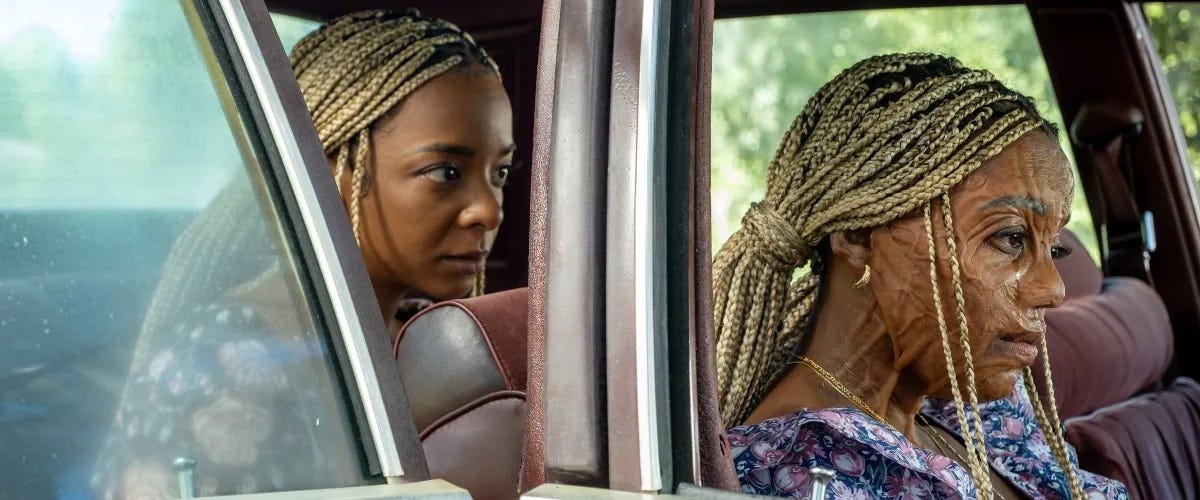
Is God Is and The Old Curiosity Shop
wherein I compare two very different works
Recently, in my journey through Dickens’s novels, I finished The Old Curiosity Shop. Very little of the book takes place in the shop of the title, which actually disbands during the very early chapters. (This book, more than others, bears the marks of Dickens’s serialized storytelling, frequently discarding characters and ideas—and even its narrator—as it goes.) And yet, the title remains apposite, conjuring first the dark and dusty world inside the shop, where its young protagonist may come across all kinds of odd and frightening objects, and then presenting the rest of England (and, by extension, the world) as a place not wholly dissimilar.
Dickens stacks his novel with an always-changing cast of what would have been called ‘grotesqueries’ at the time. In Dickens’s era, this was less a pejorative term, like it is today, and more a descriptor for anything unexpected or out of the ordinary. Like the gargoyles on cathedrals, grotesqueries were even considered an essential part of faith and an edifying source of meditation. Thus, Little Nell (our cloyingly perfect Dickens child du jour) finds her picaresque wanderings filled with dogs that stand on their hind legs and where silly hats, giants and dwarves (before such terms were deemed offensive), waxworks collections, dying children, cemeteries, gypsies (again, not yet pejorative), homeless gamblers, and all the denizens of the sideshow profession.
What is the point of this microcosm and then macrocosm of grotesqueries? Mainly, to point out that humanity is anything but ordinary. The world is anything but calm and unsurprising. It is anything but safe and pleasant. The novel’s antagonist, Daniel Quilp, is not only a man of unusual proportions (he is described as “almost a dwarf” with a gigantic head and a deranged smile), but his soul is twisted beyond all human recognition. He is often compared to an animal. He pulls off alarming physical feats that call his humanity into question. And he is the most disturbing and gleefully depraved villain I have yet to read about. He buys an old ship’s figurehead for its resemblance to a local boy and spends hours at a time sticking forks in its eyes and beating it with red-hot pokers. Any world that can give us a Quilp is a fallen, broken, disfigured place.
And yet, while not all of the heroic characters make it out alive, the denouement is a picture of tranquil domestic joy.
I could recognize that disturbing world, even while I rushed to finish the novel as quickly as possible in order to leave the fictional nightmare. After all, I was only going back to a living one. Our world is more than a tad grotesque right now.
When I went to the cinema and saw the recent brutal, gory Blaxploitation film, Is God Is, I immediately thought of The Old Curiosity Shop. Which likely makes me the only person alive to have that reaction.
Is God Is appealed to me for one big reason: Kara Young. I had never seen her act, and she is currently a very big deal on Broadway. The past four years, she was nominated at the Tony Awards, and she won two of those. Which is just insane. So I needed to see Kara Young act, no matter what she was in.
Despite its tantalizing title that promises search-for-God metaphysics, that facet of the film is very light. Rather, it is a super-bloody revenge road trip that piles up a whole heap of bodies, killed in physically shocking ways. And just as in Dickens, not all the heroes make it out alive. The film spends a lot of time asking about the nature of heroics, however, and no one in it might qualify for the title. The overriding theme is about how given deadly power or purpose—no matter your motivations—anyone is likely to eventually use that power in terrible ways. Because the world is a grotesque place, and there are always plenty of reasons we might want to hurt or kill another human, and we are apt to hide behind whichever one sounds most just if given the chance.
The film leans very heavily into the grotesque, dramatizing terrible, meaningless violence as well as twisted sociopathic sadism. The two protagonists are twin sisters who are covered with burn scarring after a horrific childhood brush with their own Daniel Quilp character. It happened long enough ago that they don’t know what it was (oh, they find out), and they have grown into their late twenties without a human interaction that did not demonize, mock, pity, or harm them. The film asks, How do those girls grow up? What do the sweetest of children become when constantly reduced to their physical deformities? Killers? Yeah, but there are plenty of them to go around in this movie.
Is God Is presents a NSFW version of the grotesque and unfair world represented in The Old Curiosity Shop. The twins are very interesting, multilayered characters, and yes, they are portrayed with intense skill. Kara Young deserves those Tonys. But they are the classic perpetual victims who have never understood that the world really can be the beautiful place they still try to see it as. That humans can return their love and generosity. They are profoundly hurt but essentially good people…until they are given the chance to wreak revenge on the world.
In Is God Is (think of the title as a problem of pain inquiry), the most beautiful people can be the ugliest, and vice versa. But it’s never anywhere near that simple.
How should we interact with this fallen, grotesque world? How CAN we? For all their narrative similarities, there is a great chasm fixed between the angelic Little Nell in The Old Curiosity Shop and “them burning twins” in Is God Is. Neither extreme is truly believable. But the worlds around them—as heightened as they may be—can seem awfully familiar.


