


This won’t be a traditional review. I can’t talk about Inland Empire without defending my interpretation of the film. I often feel that many don’t understand the film (but I don’t really run in Lynchian circles), but I feel immediate and sustained clarity when I watch it. Given my hatred of every other David Lynch movie, this surprises me. But it also shows me that when people praise films like Mulholland Drive (which is an abhorrent collage of pretension to me), they probably are experiencing a connection to the material that makes it seem as brilliant and coherent as this film does to me. Because I can easily see why people would call Inland Empire an abhorrent collage of pretentsion.
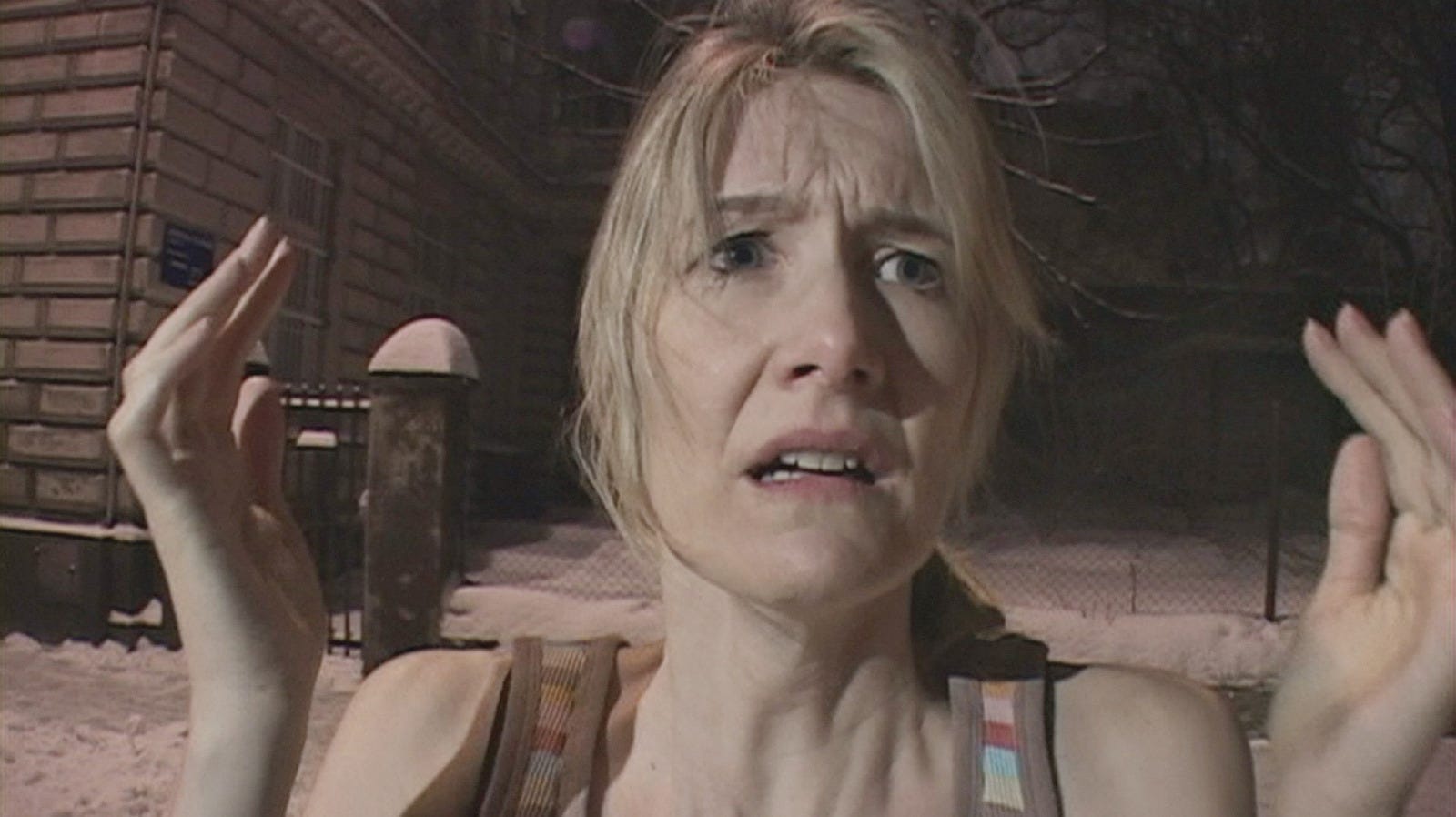
I’ve waited twenty years to watch this movie a second time, because I needed it to recede to a place where I could approach it again to corroborate my theory. Last night, the time came. Most of the scenes remained burned into my brain, and knowing what was coming relieved a good deal of tension, but the film remained tense and sometimes terrifying exactly because of how well it speaks in the language of a nightmare: a low-res digital camcorder assaults us with uncomfortably close shots of all-too human faces that are often distorted by perspective, lighting, and the poor quality of the image. It is profoundly uncomfortable from the get-go.
Lynch works in the subconscious, and so the appreciation of his works is no doubt dependent on the personal arrangement of one’s neurons and neuroses. (And that is why I am so skeptical of people who rabidly adore almost all of Lynch’s films.) This movie moves with dream logic. It is, in my view, a dream in itself—a guilt-induced feverish nightmare experienced by whichever Laura Dern character you want to believe is “real.” (Yeah…it’s that kind of a movie. Identities are always shifting and melding.) This is one film that I truly think I understand and most others do not. (Tár is another.) So, allow me to talk a little about my interpretation of the film rather than appraise its quality. It is great only in the visceral and layered way that it presents that meaning to me. (I suspect that Lynch himself would have hated me for analyzing his work in any way. But here we go.)
“Inland Empire” refers to a particular section of California, but it also prepares us for the sprawling interior world of the subconscious, the dreamer of dreams. The film also has a subtitle: A Woman in Trouble. I think it was this phrase that gave me the frame of reference inside which to understand the film’s surrealist and labyrinthine journey. I suspect that we have all heard said phrase used as a (now archaic) euphemism for a woman who is pregnant out of wedlock. Among the many repeating themes and images, pregancy is certainly a strong presence in the film. And so it seems natural to look at it through that lens.
To reduce this three-hour nonlinear free association of imagery to a coherent plot is almost silly, but I present the following situation that—at least for me—makes meaning of everything. I believe that this is a literal nightmare experienced by a married woman who became pregnant through the seduction of an alomst-predatory lothario and been driven to obtain an abortion. In fact, it may even be the workings of her mind during the precedure itself. It’s that simple. And yet none of that is simple. What’s surprising is her own guilt and repugnance at what she clearly sees as the murder of her child. I didn’t expect that perspective from Lynch.
So, what backs up this interpretation, and what does all of the weird imagery “mean”? Working with an achronological shifting landscape of episodes and images, it is hard to speak clearly and in an orderly fashion—but I endeavor to do just that. Perhaps it would help to list some of the major recurring motifs. (You know I love to list!)
Paranoia. Every scene is dripping with it. Just see how all the other characters seem to know something about the Dern character—exchanging glances, sharing mysterious laughs, speaking in suggestive non sequiters. See how the camera views them aslant, focused on their sprkling eyes, and how it begins by filming Dern in a more straightforward way, as she looks at them all with uneasy incomprehension. People take mysterious phone calls that reference her presence. They act as if they know her, while she has no knowledge of them. (“Look at me and tell me if you think you’ve seen me before.”) People are constantly hiding behind the scenery, watching and waiting. This is the common guilt reflex. She feels that her sin is obvious to everyone. That they’re all on to her secret.
Infidelity. Dern resists it continuously, falls into it, still fights to stop herself. There are endless conversations and references to the shame of cheating on one’s partner.
Promiscuity. What else do you think those rabbits represent? Also, then, fertility. And notice how many times children are mentioned only in the context of being killed. The overwhleming image of the film is the prostitute. There’s an entire chorus of them, leering and tacky and indolent. And dancing. The first people we see are a hooker and a john (and this woman watches the entire film, it seems, on her hotel television after the man leaves). Eventually, Dern comes out with it, saying “I’m a whore.” She then immediately mocks herself in the manner that the prostitutes have been mocking her. She cannot deal with admitting how she sees herself without creating a distance from herself and mercilessly laughing at her previous lines. Also: red lights everywhere.
Murder. But not simply murder. Murder performed by someone at the command of another. Murder acheived through the penetration of the womb with a “screw”driver. Murder that leads to blood covering the victim’s abdomen. One iteration of Dern’s character recalls violently severing a would-be-rapist’s eye (from which one is observed) and testicles (from which one is impregnated).
The alleyway. This has multiple connotations, including the journey through the mind, the typical place where prostitutes are found, and the shameful hidden (and dirty) place behind “the marketplace” (the agora, the place where life happens, the crowd, the buying and selling, the getting lost). Perhaps most crucially, the alleyway is where the “woman in trouble” traditionally went to hire an abortionist. When she finally lands in his office (all awkard explanations of sexual history), he stares at her with slovenly indifference, an “A” hanging on his wall, for Abortionist and Adultress alike.
Acting. Here, Lynch captures two ideas. Firstly, it is the way this fallen woman must pretend in order to get through her day, her affair, her secret, her shame. Also the way men seem to always undergo drastic personality changes, “becoming another person” when their woman is in trouble. Secondly, it works with the location: Hollywood, the Inland Empire, movie soundstages. This loops back to the sensation of always being watched. At one point, the frame expands to reveal a camera filming the scene we just watched. This happens on the corner of Hollywood and Vine, where all the hookers hang out. It is very much in Lynch’s wheelhouse to present Hollywood as a place where everyone is prostituting themselves while they are voyeuristically watched and watch others. (And are all the time watched on a cheap TV by a hooker in a hotel room?)
Corridors. The alley is clearly a permutation of this image, or vice versa. At the film’s end, Dern stalks through endless hallways (as of a cheap hotel for turning tricks), clutching a gun in fright. She is always lost. She ends up where she has been. She cannot see around the corner. It is fear itself. And when she finally shoots the man she finds waiting there, it also becomes the birth canal, the scene of the crime.
Outcasts. The main character’s shame and feeling of ostracism is not only shown through the many prostitutes. We also get an endless parade of “circus folk,” “gypsies,” foreigners, interlopers, criminals, etc. There is a feel surrounding all of the Eastern European characters of fairytale witches waiting for lost girls in the woods and vampires haunting the shadows. Dern feels that she has done the unforgivable and is now forced to the sinister edges of society, where you can blame your actions on hypnosis.
Absurdity. The film is full of dialogue that doesn’t connect. This is presented most purely in the scenes with the rabbits (who are being watched—and laughed at), but it runs throughout. For the first half of the movie, Dern’s face is constantly in a contortion of confusion, as she tries to penetrate the sinister hints that seem to lie in all of the out-of-nowhere stories and confessions. Her actions and fate have cast a shadow of lost meaning on her entire life.
Sinister domesticity. Dern wanders in and out of multiple homes, husbands, and lifestyles. They are all fraught…although usually in a mysterious way. These are the fears of a wife who has violated her marriage vows and had her own child killed. What has she made of “the family”? It becomes a place of fear, danger, and uncertainty. This is another aspect illustrated by the rabbit sitcom. It is a domestic space, but the family relationships are ambiguous: two females and a male. They speak to each other, but in a stilted and disconnected way that defines their unit through a lack of unity. An unseen audience laughs at their most serious confessions. “The home” has been made absurd through the destruction of the family.
And there you have some instances of what I see when viewing this film. It is a horror movie in which the horror is adultery and abortion. It is the frantic journey of a woman truly in trouble, who no longer knows who she is. She tours varies versions of herself, from vulgar to elegant, homeless to rich. And, in the end, after the violence and the mourning and the dissipation of anger…she quite literally finds herself again, for the first time comfortable and composed. She has made it to the palace of her inland empire by becoming lost from the marketplace and driven down the alley. Still, there is chaos, but now it is one of joy and worship, as a room full of women dance and lipsync to a gospel record by Nina Simone, while Dern is finally allowed to smile, to laugh, and to be herself.