I Love Boosters
2026
This is the year that we’re seeing the fallout from the 95th Academy Awards, where the Best Picture of 2022 was named Everything Everywhere All At Once. At that point, the Oscars had been slowly building up to what would become that critical moment, branching out into genres and directorial visions that started to muddy the idea of an “Oscars movie.” Perhaps we can trace it back to that ultimate Oscar disruption, Moonlight’s win, which took the Academy so by surprise that they announced a more conventional winner first (yes, a revisionist history, but appropriate in hindsight)! With oddball Best Pictures like The Shape of Water, Nomadland, and the Korean-language breakout Parasite, much more variety had started to trickle into the Academy’s tastes. It was when Daniels’ multiverse hotdog hand kung-fu taxes and laundry mother-daughter romance crashed through, however, that we knew a new world had arrived for the Academy.
Given the time it takes to make motion pictures, it’s pretty much right on schedule that the studios’ post-EEAAO choices would be bearing fruit now, in 2026. I’m not suggesting that I Love Boosters (which I’ll get to in a minute) will win Best Picture. No. I am saying that after the 95th Oscars, the gatekeepers of Hollywood started feeling out the new terrain, greenlighting films that skewed towards the bizarre and unconventional.
Look at this year. Out of the sixteen 2026 premieres I have seen so far are such big swings as The Drama, Mother Mary, The Bride!, and the grindhouse one-two punch of They Will Kill You and Is God Is. (And I tried to catch Good Luck, Have Fun, Don’t Die—but I missed it.) The box office this year is decidedly weird. True, none of these films has been a great critical success, but in what other year have I left the cinema feeling so often that the clowns were running the circus (and I kind of loved it)? Now, here comes the most Daniels-y movie yet: writer/director Boots Riley’s madcap caper, I Love Boosters.
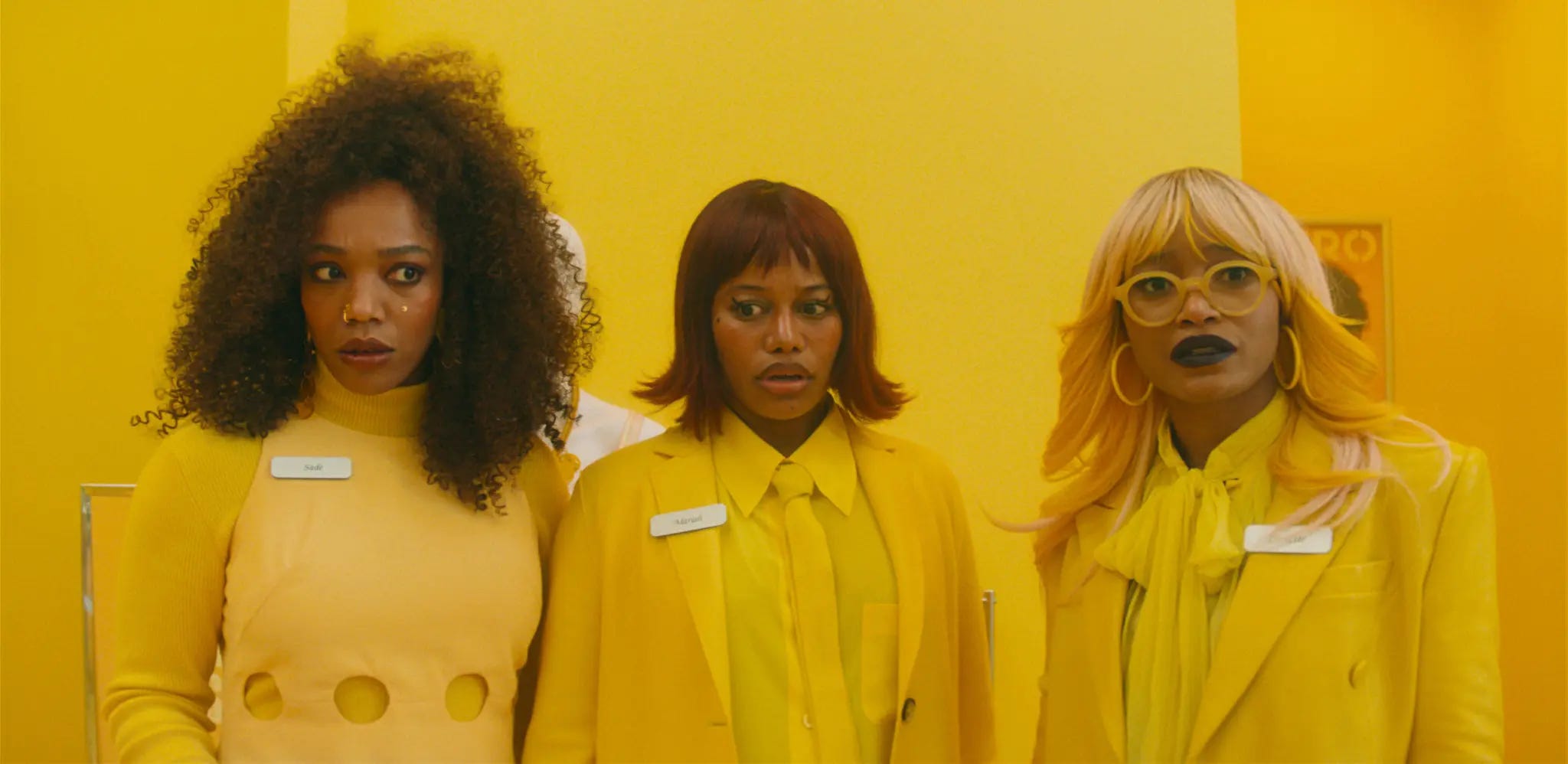
“Madcap caper” is the most understated description of the film possible. It is, head to tail, bonkers. In a bizarro present-day world, a trio of shoplifters (or “boosters”) is targeting their favorite designer’s high couture and selling it at big discounts in order to stay barely afloat financially yet always impeccably dressed. The designer (Demi Moore in a cool blonde wig) targets the boosters (Keke Palmer, Naomi Ackie, and Taylour Paige) right back, expecting to steamroll them off the map with her power and money. Something more unexpected happens. Shoot, about twenty-nine completely unexpected things happen.
Here is where I mapped out my thoughts after the movie:
So, I will try to break it down. I don’t expect the vast majority of my readers to watch this film. I probably don’t advise them to. But for those who like their eggs crazy-side-up, I will endeavor to omit spoilers while talking about the ultra-complicated plot and themes of I Love Boosters.
Visually, the film is on the extreme end of outré. The clothes the boosters steal, and/or design, are intentionally over-the-top avant-garde piñatas of fun, more than a little reminiscent of Stephanie Hsu’s getups in EEAAO. Truly, the costume work here is astounding in the way it samples from every trend in the style world, remixes them all at their highest pitch, and still produces scores of character-specific looks! It’s not just clothes: wigs and accessories flow here like milk and honey in Canaan. Likewise, the sets engage in the oddity. The fashion designer’s headquarters is in a skyscraper pitched at 45 degrees. (Apparently, this is a real building, but I doubt the floors there are all at the same angle as the exterior, as they are in this film.)
The theoretical and thematic framework of the story is even bolder and more complex. Behind the sci-fi, animation, and horror elements that appear out of nowhere and pile onto the heap of ideas is a matrix of highly intellectual statements about “dialectical capitalism”, exploitation politics, and the systems with which people envision and engage with the world.
One strand of thought follows the trickle-up effect of societal exploitation. A major plotline is set in a Chinese factory that manufactures the clothes central to the film. It looks at the West’s exploitation of the East in economic, health, and work arenas. It explores a culture of appeasement (or polite passivity) that gives people like Moore’s designer free rein to trample over workers in Asian countries. Another huge factor here is, clearly, the power imbalance of the wealthy elite versus the faceless sweatshop employees. In one of many such privilege-blinded lines, Moore replies to requests for better working conditions by saying, “Do you realize that it is actually more work for me to have you make the clothes than for me to do it myself?” Follow that sentiment the other direction, and you come across the exploitation of the consumers (“All my retail outlets work on a monthly rotation of monochromatic merchandise. If you want a different color, go to a different location. Deal with it.”) and retail employees (who are required to wear the ultra-expensive clothes at work but are also charged for those outfits).
Another strand of thought is rooted in the designer’s philosophy of fashion. She started her career as a scientist until she realized that “changing reality is impossible, but I can change how people perceive reality.” In her mind, what she does (“I don’t think you understand the work and sacrifices that go into all that I do so that you can look beautiful.”) is to use the human body as a canvas for her art, thereby uniting and shaping humanity itself. A pivotal line comes from her beleagured assistant (hello, Andi Sachs): “I don’t think people want to be the art. I think they want to be the artist.” And in some ways, they are. Moore’s character steals designs and appropriates existing trends, basically taking her cues from the way the boosters combine and alter her clothes, incorporating those ideas, and selling them back to the “urban” culture she disdains but relies on. This movie never met a concept that it didn’t want to push further, though, so we see how the same powerful people are not just designing the clothes people wear but the identities they put on, as well. There is good fun with television news interviews, where people with names like “Crying Black Mother” and “Upstanding Community Member” say things like, “Rent control? How they gonna tell me I can’t pay more for my apartment if I wanna pay more?” In a film where every single thing is stylized, the types of these recurring interviewees are literally designed as a way of changing the way people perceive reality…all for the better, of course….
The answers for all of the above problems are related to community, social action, and thinking of people as constantly changing beings instead of fixed types. The workers (factory and retail) must unionize. The hoi polloi must realize that they are all on the same side and reach out together with a fluid approach to understanding each other. The consumers must envision themselves as part of a strong whole instead of isolated and disempowered.
(I hope you don’t think we’ve run out of thematic material yet. Buckle up!)
Yet another strand of thought/story is based around the idea of thesis, antithesis, and synthesis (words that get thrown around a lot in Act 3). We could apply the model to the problems I’ve been outlining like this: by unifying your community’s home turf (thesis) and learning to identify the underpinnings of your opponents’ worldview (antithesis), you can reach a place of greater equity by dragging the fight into a third and middle sphere (synthesis).
‘Understanding’ is not a word that the film utilizes often, but it is the basic advice for all parties. Understand your community and where it stands in relation to other communities. Understand the rules of the game that the rich and powerful are playing, wherein they exploit your different communication styles and cultural priorities in exactly the same way they do the Chinese sweatshop workers. This is especially embodied in the need to dismantle/decode corporate doublespeak in order to hear what your oppressors are actually demanding of you. This doublespeak—or what I might call linguistic distortion—is used by many characters to comic effect. Moore’s “Christie”, Don Cheadle’s “Dr. Jack”, Eiza González’s “Violeta”, Will Poulter’s “Grayson”, and Kasmere Trice Stanfield’s “Tiffany with the laptop” all speak in this pseudo-intellectual gobbledygook that uses a profusion of buzzwords and contorted syntax to obscure the simple messages they’re conveying. (Speaking of Stanfield, her husband, LaKeith Stanfield, has a major subplot in the film that is the weirdest, most disturbing, and most baffling part of the whole thing.)
While González (in human form for once) brings the heavily abstracted idea of thesis/antithesis/synthesis to the fore, Poppy Liu’s central character, Jianhu, introduces another triptych of terms with her use of a device with three settings: teleportation, deconstruction, and “situational acceleration.” These concepts focus on the inherent conflicts (or contradictions) in all things. Well…two of them do: teleportation is pretty straightforward. It is originally used as a means to avoid tariffs, but it also works as a tool for bringing people together (literally) and re-centering the cultural conflicts I spoke of above. Deconstruction (a term that has become nauseatingly ubiquitous recently) breaks things into their component parts, suggesting that sometimes you need to break down ideas to look at their contributing factors and internal tensions in order to approach them. Situational acceleration, on the other hand, magnifies the inherent conflict within something, thereby sort of taking it to its apotheosis. This process suggests that sometimes you need to foreground the conflict in an idea so that you can better analyze and discuss it. Hopefully, I have done all of that in this very brief discussion of I Love Boosters’s thematic topography.
Within all of that, though, how is the actual film? I enjoy its wacko universe. I love its fashion overstatements. I really appreciate the entire cast. But what is going on with LaKeith Stanfield, and why is it so sexual, Cronenbergian, and ultimately unrelated to the rest of the movie? (One reviewer suggested that he represents the concept of distractions, which need to be pushed aside if one is to do what they’re meant to do.) The sound mixing is also difficult. The levels of music and dialogue are often off-center, leading to us missing whole conversations. Yet this is also a gag used in-world, where turning up the surrounding noise is a tool for dismissing critique and pushback.
Ultimately, I had a hard time holding onto my enjoyment of the film when it started to rapidly metamorphose. The sci-fi and horror elements introduced halfway through may just be too much for the film to carry, and they create such a bulk of material to resolve that the third act stretches out almost to the breaking point. But I still rate the film as above-average for its bold vision and the ways it successfully pulls off a lot of that vision, if not all. Grunge Eiza González was a nice change, and the trio of boosters is given a lot of opportunities to look stunning, hilarious, and everything in between. But, in terms of recommendation, I can only reiterate that this is a very, very odd film that is not suited to conventional tastes.