Hamnet
2025
Chloé Zhao began her film career with a very specific model. Her early movies (Songs My Brothers Taught Me, The Rider, Nomadland) are microbudget indies cast with non-actors in very quiet, internal, and socially conscious naturalistic dramas. They were not my thing, and when Nomadland won Best Picture (and every other top award out there), I sneered a little at the thought that they were rewarding a very niche style of filmmaking instead of the film itself. “Clearly,” I thought, “Chloé Zhao can only make one type of movie.” And then she followed that film with the glossy, sweeping superhero flick, Eternals. While fans reportedly hated the film, I have mostly found that MCU watchers like Eternals. I certainly do. But, to my point here, it immediately put the lie to my assumptions about Zhao’s abilities. Nothing could be more unlike The Rider than Eternals. I sat up and paid attention.
Now, after recovering from the whirlwind of dealing with MCU fandom (sorry, Chloé), she is finally back with a new film, and it is wonderfully distinct from all her other work, while still being rooted in a deeply feminine and primal understanding of the world and its people that we can now recognize as the true Zhao style. Based on the bestselling 2020 novel of the same name, Hamnet takes what scant historical records exist and imagines a narrative that links the death of William Shakespeare’s only son, Hamnet, with the writing of his play, Hamlet. Except that all of that story—the more male strand—is almost invisible for most of the film, focusing instead on Shakespeare’s wife, Agnes (whom we know these days as Anne Hathaway…but not, you know, Anne Hathaway Anne Hathaway, but Shakespeare’s wife, Anne Hathaway).
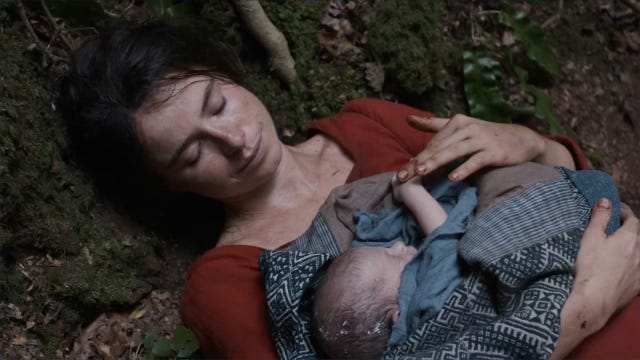
The first 2/3 to 3/4 of this film shows us Agnes (pronounced ANyes, like as in “Agnus Dei”) meeting an unnamed man, falling in love, marrying him, and bearing children. She is part of that era’s earth-mother paganism, preparing medicinal compounds with wild plants and age-old recitations similar to those of Macbeth’s Three Witches. Not too much is made of this as a religion. It’s portrayed more as a cultural tradition passed down among matriarchal peasants living in the surrounding woods. Indeed, Agnes never speaks of her poultices as potions or as having any magical properties. But she is most at home in the impossibly lush woods near her house and wanders off there to give birth alone.
This woodland setting is central to the film. Many important moments are played out around a large, gnarled tree that seems to be the home of Agnes’s soul. The tree is covered with thick moss and climbing plants, and a dark cave descends into its roots. It would be hard to find a more symbolic spot. While the cave is only lingered on once, its presence of darkness and mystery solidifies something about the core of the exploding greenery all around it. It is the feminine. And it is “the undiscovered country” on the other side of death, which Hamlet is so drawn to and repulsed by in his most famous soliloquy. And indeed, death is at the center of this story.
The ways in which Zhao and her actors (Jessie Buckley and Paul Mescal) bring life and warmth and play to the onscreen family unit are subtle and true. Few films have done such a good job of portraying a recognizable, happy family. That happiness is dramatically punctured with the death of 11-year-old Hamnet. (Jacobi Jupe is wonderful as the child, and the story of how he comes to die is beautiful and heartbreaking.) Agnes grows bitter and angry that her husband arrived home too late to see his son die. By then, he is working steadily in London—a place antithetical to Agnes’s nature-rooted heart. She believes that her husband is not facing up to the loss or dealing with the grief in the way she is.
And then she goes to London.
Agnes has never been a part of her husband’s work world, and it isn’t until she enters the city that we hear the name William Shakespeare used. This squalid urban environment is anathema to her, and she transfers that feeling onto all that goes on there, including William’s work. Amid her distaste at seeing London for the first time, there is a measure of awe when she, for example, enters The Globe Theatre. (Oh, be still, theatre heart: the life-giving embrace of The Globe!) She has never seen her husband’s work, though the family interacts with small extracts of his writing. She has never seen a play.
What happens in that theatre is beyond words. It is very like the pivotal dance in last year’s Wicked, which uses art and human bodies and faces to express a primordial internal change that acts as the pivot of the whole story. Although we never hear Agnes describe her experience (the film ends as the production of Hamlet ends), we see it all embodied by Jessie Buckley, who better have a lot of shelf space ready for this awards season. What she has scapegoated as her husband’s hiding from reality is revealed to be his signature descent into the unkind bowels of the same. The healing power of theatre and the nature of catharsis are opened up to Agnes as she stands at the base of that stage, looking at the verdant backdrop with a dark entryway at its center. Agnes and Will (and Hamnet) come together in that profound moment, though separated in space. They bring those in the cinema with them.
It is almost unprecedented that I have rated five new releases this year with the maximum score of five stars. But you better believe that Hamnet is one of those five.


