

Hadestown: The Musical
2026

In our world, professional theatre—especially musical theatre—has become a luxury product enjoyed mainly by the wealthy urban elite. Why? Because putting on a great play is expensive! Think just about the salaries for all those people on stage who put out world-class performances eight times a week! Then think of the cost of even a simple set, along with costumes and props and lights and sound and backstage and front-of-house employees! Heck, even the laundry bill is shockingly high! Now, consider that the only real venues that can house a play full-time (overhead costs!) are in New York City. Even for me, here in Pennsylvania, the three-to-four-hour drive to NYC is expensive and difficult. You have to drive all that way, watch a play, somehow eat three meals, and drive back. The last part usually happens around 2:00 AM, and your body and mind are stupidly tired from all the stress and stimuli of the metropolis. Harrowing stories from the drive back? I’ve got a couple. Or did you think you could afford to stay overnight in the Times Square area? (If you can, you also aren’t crying over the $300 tickets, like the rest of us.)
So (as I always say), theatre people (less than 15% of whom are employed in their craft at any one time) cannot afford to actually see theatre in America. We have our school loans like anyone else. We also require food, water, and shelter. The terrible thing is that we require theatre—and that is something we must save money (what money?) for all year long, or longer. And without it, yes, we’re raisins in the sun. Good theatre (not community theatre or high school theatre) sustains a vital spark in us that makes a tedious life worth living. Imagine being effectively barred from any access to your vocation/passion/trade. Just entering an empty theatre space can sustain me for a couple months.
And so, we come to the current point. If we can’t enter the room where it happens and experience that exchange of energy that live theatre provides (which we usually can’t), we need some kind of remote access to our medium. And God bless (truly and earnestly) programs like the UK’s National Theatre Live, which provides live recordings of a few plays each year to a select number of cinemas. (Those cinemas are still at least an hour from me, but that’s more doable. And the ticket price is within possibility.) A few other avenues for this type of thing exist: occasionally on PBS’s Live from Lincoln Center or Great Performances, in very rare livestreams of Broadway shows, and in the blessed medium of proshots.
I believe that the word has only recently been codified, but proshots have been around (sporadically) for decades. There are professional recordings of several Sondheim shows (Company x2, Passion, Follies, Into the Woods, and Sunday in the Park with George) and a couple Andrew Lloyd Webber musicals (Cats, sadly, included). There ends the list until recent years. In the last half-decade, proshots (professionally filmed performances of plays, with multiple cameras and steadicams onstage, etc.) have become more common. We have Sutton Foster’s iconic performance in Anything Goes. We have Hamilton with the original cast. We have Waitress, starring its composer, Sara Bareilles. We have David Byrne’s American Utopia (hallelujah!). Why so few? Because (on top of the massive costs of staging a show) proshots are very expensive to do well. And only 10-20% of Broadway shows recoup their investment, period. Adding a proshot is sort of like taking out a second mortgage. You take on more debt you may never be able to pay off.
Finally, some good news: proshots are becoming more common because people are actually going to the cinema to watch them and buying them on digital and physical media. In the past twelve months, we have feasted on the rapturously reviewed remount of Sondheim’s Merrily We Roll Along, Hadestown: The Musical is in cinemas now, and next month will see the arrival of Six. The bounty! (Is he finally going to talk about Hadestown? Yes!)
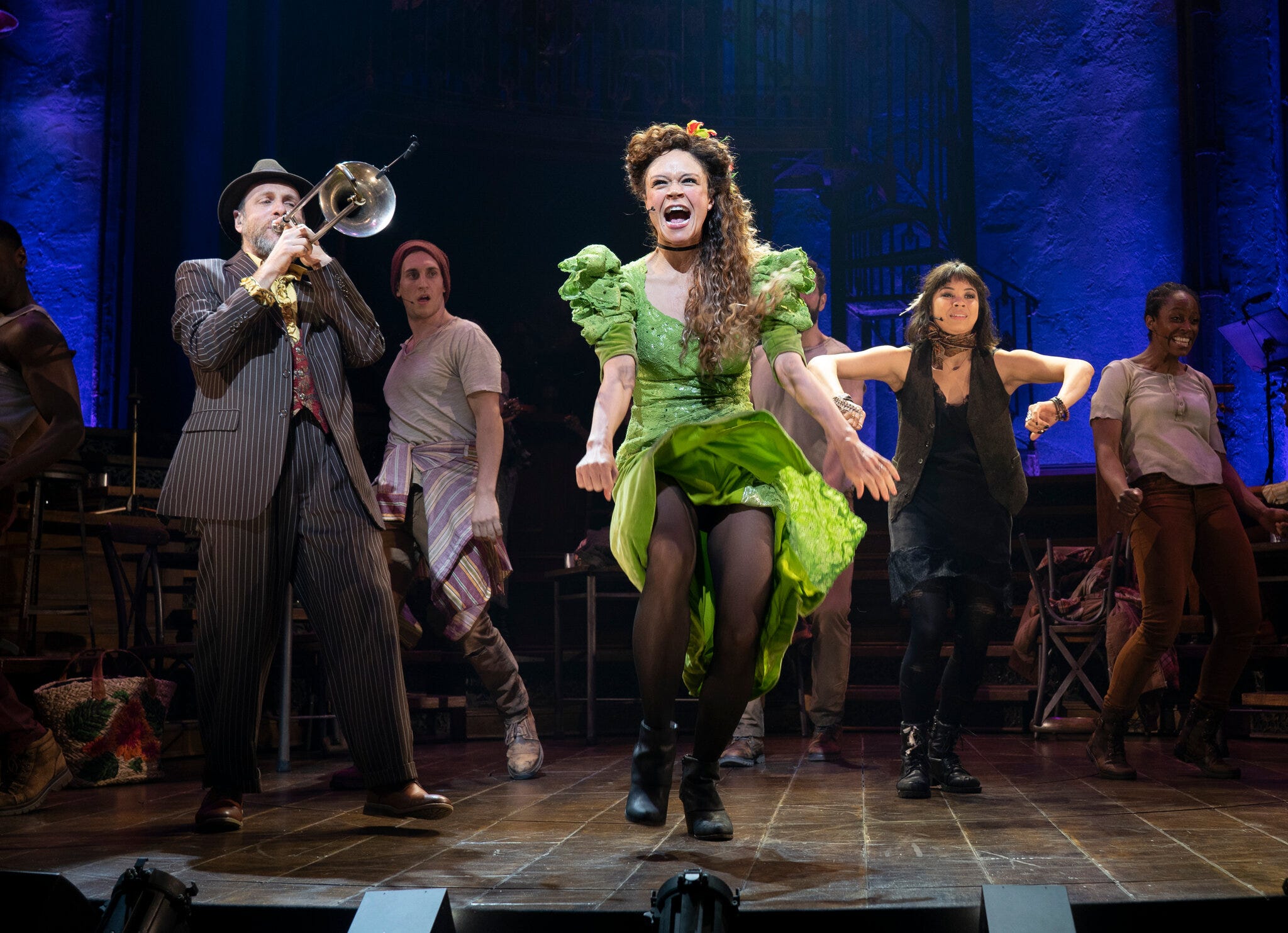
The best new musical of the past ten years (in fact, this year marks its tenth year on Broadway!), Anaïs Mitchell’s retelling of the Orpheus and Eurydice myth is probably the most beautiful musical I know. You all know how devoted I am to Sondheim, but Hadestown has a totally unique approach to its music, story, form, and performance that blend seamlessly into one 2.5-hour opus of masterful complexity and raw beauty. I usually list “Why Do We Build the Wall?” as my favorite song from the show, but that’s mainly because it is the only really contained individual song. The rest of the musical is broken into numbers, but it is more of a river of motifs that bubble over each other.
Set in a non-time and place that resembles 1930s New Orleans, the play is a literal retelling. Led by Hermes (our master of ceremonies), the cast interacts with the audience, acknowledging their presence and vital role in the proceedings. It is like a huge-scale campfire story. The characters are performing for us, “singing the song” in the same way the oral tradition kept these myths (including a certain other current blockbuster) alive. In keeping with that tradition, almost all of the dialogue rhymes and follows a rhythm, imperceptibly moving in and out of song mid-sentence. The music, influenced by New Orleans, is completely its own thing, as are the styles of the movement and staging. A simple set, which morphs from a railway bar to the factory town of Hades, is mostly an open space with three concentric turntables, the center of which raises and lowers. The simplicity of this design and its thematic weight is typical of the entire production: a story that is told and retold endlessly, about the cycles of seasons and oppression and journeys, can only be told with a revolving stage (and the central elevator piece literalizes Hell for us as it descends).
In the same way, the show’s plot and themes are made of wheels within wheels. The true genius of the piece is how far out those circles go—and how they all comment on and support one another. As with any telling of Orpheus and Eurydice, it is a tale of art, love, and death. Hadestown adds layers about marriage, politics, class, cyclical reasoning, nature, inspiration, resilience, and rebellion. The central pairs of lovers—Orpheus and Eurydice, Hades and Persephone—play out these themes from the bookend perspectives of youth and age (idealism and jaded experience). Love and power, as well as subservience and doubt, are matters of forgetting, or taking for granted. That simple everyday tragedy is at the core of Tragedy itself. If you start to undervalue or presume in your marriage, your leadership, your ambition, your art, your love, your oppression, or even the course of a millennia-old story…the entire world goes out of tune in that widening gyre.
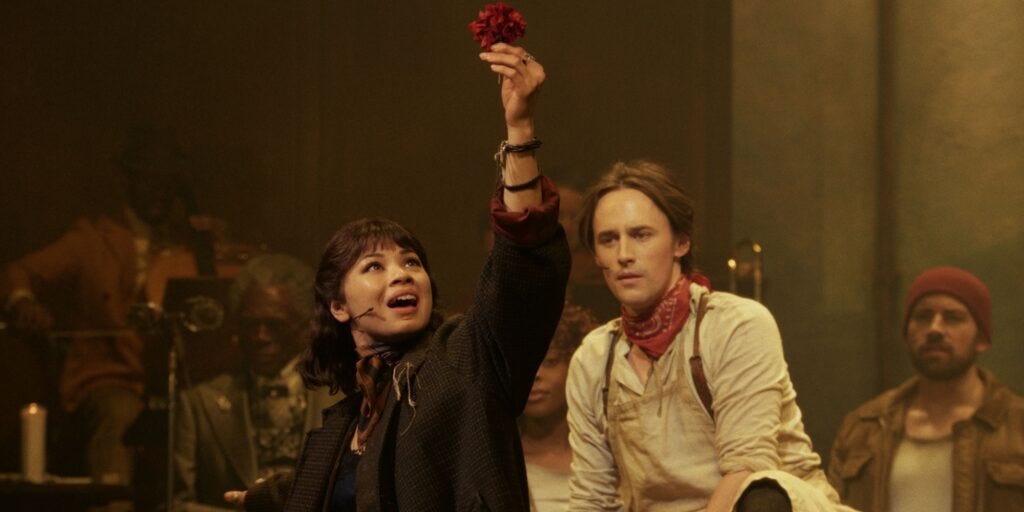
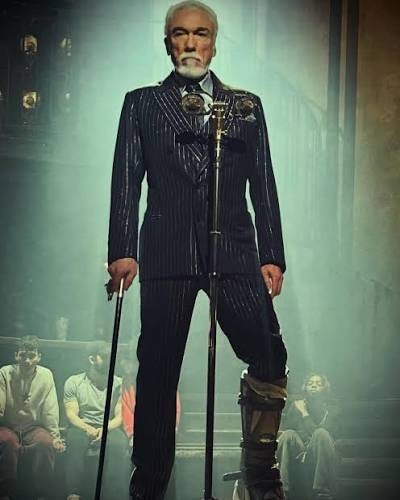
The Hadestown proshot, filmed in London, brings back the original Broadway principals (Reeve Carney, Eva Noblezada, André De Shields, Patrick Page, and Amber Gray) alongside the current West End Chorus and Fates. (These Fates are the weak spot of the proshot. Their voices don’t meld in the same liquid way that the originals’ did, and many notes that are foregrounded on the cast album are buried here.) This is vital, because each of these actors is so intrinsically bound to their character. Who can replace De Shields as Hermes, Carney as Orpheus, or the singular Gray as Persephone? Patrick Page—the only man who should ever be allowed to play Hades—suffered a bad leg injury the week before filming, and when I heard about it, I began to panic. However, in a lovely bit of serendipity, Page’s isolation boot causes him to move like a satyr. Its angle and restriction of movement actually enhance Hades’s characterization, making him look like a half-goat, a man in the middle of losing his humanity to a demonic influence. What could be more perfect?
When I saw Hadestown on Broadway (Yes, I won tickets!), I immediately realized that it is, more than any other musical, reliant on the live element of theatre. The way the actors pull in the audience by speaking to them, at the same time acknowledging the band members by name, creates a ritual space for this age-old myth to be reembodied. This is the only thing the proshot cannot replicate. I see no way around that, however…while I would have replaced these Fates in a heartbeat.
The bottom line is that you cannot see this cast perform this musical live in 2026. You likely can’t even afford to go see the current company on Broadway (but if you can, do). But, now, you and me and everyone we know can enjoy this beautiful production as many times as we wish! We can tell it again and again and again.