Father Mother Sister Brother
2025
Father Mother Sister Brother won the top prize at the Venice Film Festival this year (the Golden Lion), but for casual viewers, it will probably feel more like a quiet indie diversion that goes over old territory. However, I think it needs to be considered from within writer/director/composer Jim Jarmusch’s oeuvre to be appreciated.
Jarmusch is one of my favorite filmmakers, and this is a very Jarmuschy film. Throughout his career—in such great films as Coffee & Cigarettes, The Limits of Control, and Broken Flowers—the auteur has come back to some of his pet obsessions: repetition, coincidence, variations on a theme, color, mugs arranged on tabletops, intricate and personal stories that aren’t necessarily grounded in the characters’ dialogue, indeterminate family relationships, multinational settings, Black francophones, music… It is all there in his latest, with a huge helping of Harold Pinter in the mix. Groups of two or three people guard unexplained secrets and thinly veil their embarrassment over the course of banal conversations riddled with long, pregnant pauses. It’s basically Jim Jarmusch presents Harold Pinter’s Revue Sketches.
The film is a triptych of family reunions. In the “Father” section, uptight professionals Adam Driver and Miyam Bialik visit their father, played by Tom Waits, in rural Pennsylvania (holla!). From the casting, you get a good sense of how this will go. The patriarch has “always been weird, but more in an amusing way,” according to his children. After the death of their mother, it seems like he has taken a clear tip over the canyon edge of oddity, however. His son has been supporting him through a number of dramatic emergencies that his daughter has no knowledge of. Both treat Waits’s character with parental condescension, and the day passes in between painfully awkward moments and worried glances. But who is hiding what from whom?
In “Mother,” Charlotte Rampling is a novelist who doesn’t discuss her work with her two daughters, played by Cate Blanchett and Vicky Krieps. Right away, this presents questions: a well-to-do Irish novelist whose children don’t even know the titles of their mother’s books. Blanchett, as the oddly named Timothea, is the eldest daughter, who works for the Dublin Historical Society. She and her sister, Lilith (whose entire life is carefully unrevealed), moved to Dublin to be near their mother, who (on the advice of her therapist) only sees them once a year for afternoon tea. Lilith is a self-involved provocateur with pink hair and a pocketful of obvious lies. This trio manages to squeeze out even more awkward pauses of even longer length than the first family unit—perhaps due to their upper-class European milieu. This section of the film holds the most laughs, and it matches the other two for the abundance of unmentioned mysteries.
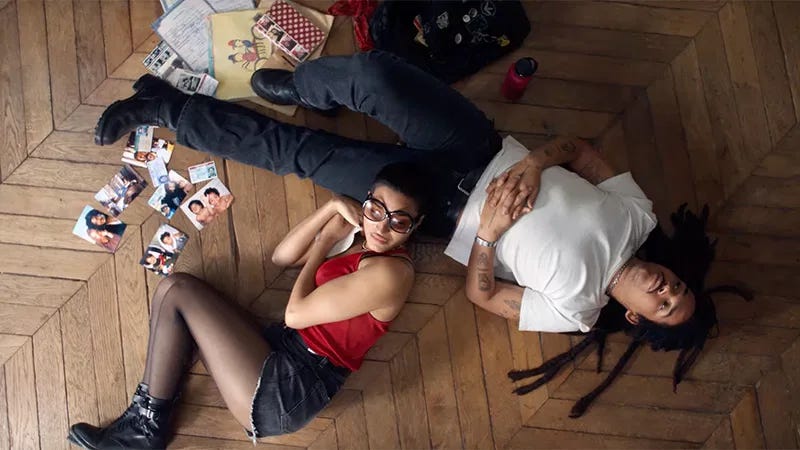
Finally, in “Sister Brother,” a pair of young adult twins return to Paris to deal with the apartment and possessions of their recently-dead parents (“Do we even know what they were doing flying a plane in the Azores?”). The comedy present in the first two installments is largely replaced here with pathos. These two actually love each other and genuinely express their real emotions. It is the lost parents who hold all the secrets in this scenario, as their son finds multiple IDs and a forged marriage license, among other surprises. Luka Sabbat and Indya Moore are the most engaging actors in the film, however, and we feel their loss while still exulting in their cosmopolitan upbringing and effortless cool. The Pinter pauses in this section are not during conversation, but in between spurts of sharing, as each sibling reminisces about the past and the fragility and impermanence of life.
What things run through all three? Repeated lines of dialogue, accidental color coordination, Rolex watches, toasts, old photos, and terms like “Nowheresville” and “Bob’s your uncle.” Of course, the main through-line is about how we dissemble around our families of origin and sometimes have more in common with people a continent away whom we will never meet. It’s a quiet affair, and the number of unanswered questions is large…but I don’t believe that there are answers. Knowing Jarmusch, I suspect that he wants us to fill in the blanks ourselves, drawing from our own experience and imagination. His films, even at their most mysterious, are not puzzles. They are experiments in meaning created by moving people, places, and ideas into each other’s orbits. The movie’s real protagonist is humanity, specifically those of us watching.