Eden
2025
Earlier this year, I was excited by the trailers for Ron Howard’s new film, Eden. For some reason, that movie seemed to fly quickly by beneath the radar, and I never saw it listed in a theatre. Which is ludicrous…as is its 52% Rotten Tomatoes score. Coming soon to Netflix, Eden is yet more proof that Howard is at the peak of his career, making exceptionally crafted and eminently watchable films.
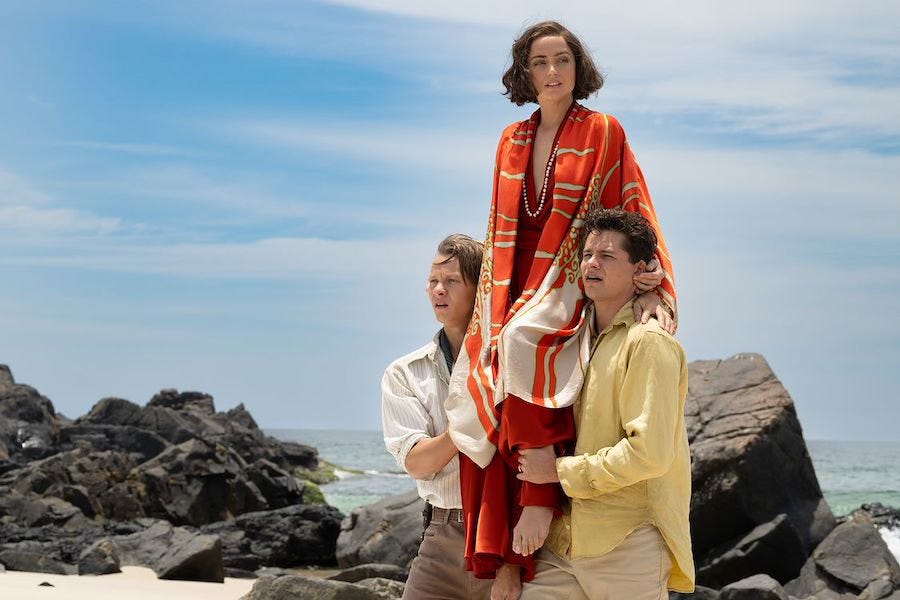
Eden tells a true story that had few witnesses, and therefore is based on the two extant accounts of what went on among three parties of pioneers on the Galapagos island Floreana in 1934. The first couple to settle there were extreme German philosophers, Dr. Ritter and Dora Strauch. Inspired by Nietzsche, they sought to escape society’s downfall while writing the handbook for creating a better one. The second to arrive were the Wittmer family, working-class Germans with a sick adolescent son, hoping to find a healthier climate and a fresh start among their country’s postwar desolation. Finally, a third group showed up, consisting of a posh and manipulative “baroness” and her three servant-lovers, who sought to build a luxury resort out of the island. Cue the fireworks!
All the details in the film check out, by the way, although choices had to be made about what actually happened during the film’s climax due to conflicting accusations. (Believe it or not, it seems that wilder things went on that were not included in the movie.) It is a case of fact beating out fiction for pure sensationalism. It seems such a tidy literary setup: three extreme groups, representing three distinct types of worldview, each seek to create their idea of a utopia in the same place. And yet, it is no writer’s creation.
In Howard’s thrilling and endlessly entertaining film, Ritter and Strauch are played by Jude Law and Vanessa Kirby; Mr. and Mrs. Wittmer are portrayed by Daniel Brühl and Sydney Sweeney; and the outrageous baroness is embodied by Ana de Armas. They all do a great job. This was my first Sydney Sweeney experience, and I sneered a little to begin with but gave up resisting pretty quickly. She is the weakest of the amazing cast, but that does not make her work weak. She’s simply playing in the majors.
So which ideology wins: social philosophy, family devotion, or corporate excess? They all take hits. While the island ends up under a definite surviving party, all the characters have to sacrifice ideals and break vows to survive. (Thesis statement alert!)
The film is perfectly shot and edited, well-acted, tense, and juicy. I highly recommend it. Ana de Armas exploits her sexuality as the louche and conniving baroness, and non-sexual male nudity appears throughout, and yet I don’t feel that any of it is gratuitous. Would I rather the nudity and sexuality came from not seemingly-perfect Hollywood sex symbols? Yes. But it’s all rooted in the story and its crazy characters.
What I said about Ron Howard’s Thirteen Lives applies here as well: it is just very well-made cinema! It’s as simple and as impossible as that. And yet this film seems to have been shoved between the cultural cracks, which is a real shame. It’s great stuff.


