Charles Dickens's Christmas Stories
1843-1848
In anticipation of this Friday’s in-person read-aloud of A Christmas Carol (message me if you want details!), let’s take a look at Charles Dickens’s other Christmas stories. After Carol became a huge success, Dickens wrote four more Christmas tales (all but one with a supernatural element) during the 1840s. The five novellas are often bound together, and you might even be surprised to find that you already own them. Following the formula of A Christmas Carol, these stories tend to focus on social realism, portraying the lowest classes while teaching a lesson. Here they are, as always, in order of my preference.
The Haunted Man and the Ghost’s Bargain
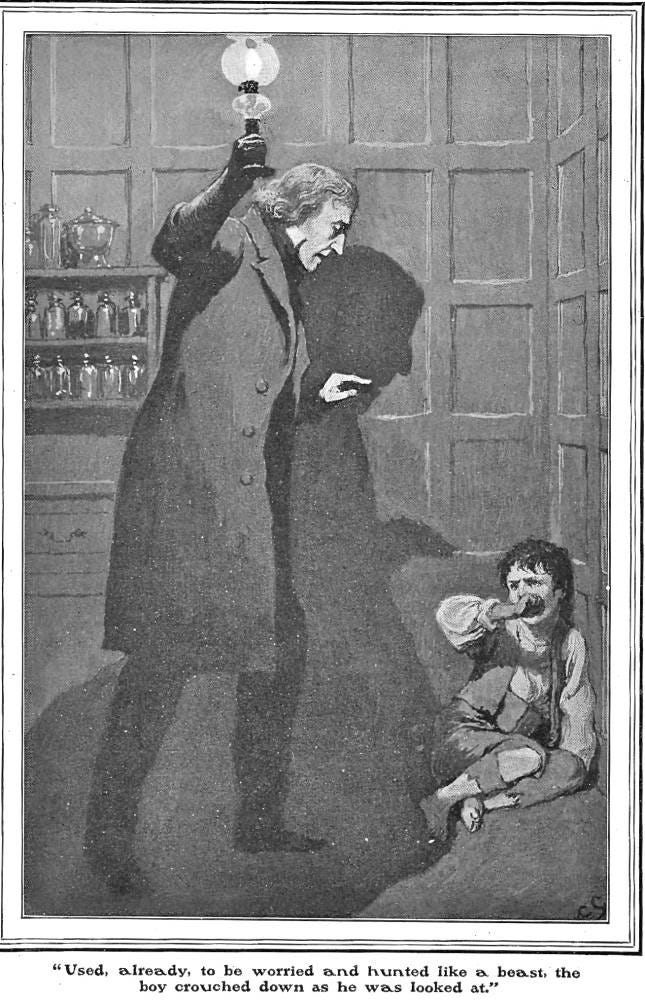
I love this novella! It is my favorite of Dickens’s celebrated Christmas Stories. Like A Christmas Carol, it contains a creepy and ambiguous ghostly figure and several tableaux of the suffering poor of London. Instead of a typical vague lesson about “loving each other” and “the spirit of the season” and “goodwill,” this one has a very concrete and little-used moral that you will have to read to discover. Dickens can always use a phrase and dismantle it at the same time, using everyday language with simultaneous earnestness and mockery. The humor here, side by side with the desolation, is some of his best, and as always, he has created recognizable characters that will stay with me. Dickens excelled at crafting characters that feel tangibly real while remaining humorously stylized. Several worlds populate this book, from the relatively well-off “haunted man” of the title (and his insidious doppelgänger) down to a feral child living in a tiny stone cave created by the supports of an aqueduct. The Tetterby family steals the show and most of the humor, while the pivotal Milly Swidger comes away with Best Dickens Name.
A Christmas Carol
You know this one, but if you’ve never read the original—or not read it out loud—you’re missing out! This story has had a huge and lasting effect on our conception of Christmas, and it’s not just the plot that has captured the imagination of millions: its language is a festival for the tongue. Want a taste? Watch the best film version, A Muppet Christmas Carol, which gains a lot of its quality by including passages of narration straight from the book (and Michael Caine). Best Dickens Name here goes to Mr. Fezziwig (or Fozzywig, if you’re in the Muppet version).
The Battle of Life
This is the oddball of the bunch, as it has no supernatural slant nor much focus on the destitute classes. The plot—especially the final section—can be a bit confusing due to Dickens implying more than we can easily glean today. The plot is not the draw, though. This story has some of Charles Dickens’s most delightful characters, most notably Clemency Newcombe and Mr. and Mrs. Snitchy (who also have the Best Dickens Name).
The Chimes
The weakest element of The Chimes may be its similarities to A Christmas Carol. Again, we get some amazing characterization, like “Trotty” Veck, the protagonist. This is technically a New Year's story, but Dickens included it in his Christmas Stories. The first half is better than the second, when most of the Carol connections kick in, but Veck is a guy you want to spend time with, and the imagery of the chimes’ ghostly forms is really great stuff. Best Dickens Name: Mrs. Chickenstalker.
The Cricket on the Hearth
I wish I liked it, but Cricket on the Hearth has an absurd plot and broader-than-usual characters. The title is also more interesting than the story and really doesn’t fit it well. More of a typical melodrama, this tale demands some serious suspension of disbelief. Tilly Slowboy is beat out for Best Dickens Name by Dot Peerybingle.