Barnaby Rudge
Charles Dickens
Perhaps Charles Dickens’s least-read novel, Barnaby Rudge is currently my favorite. Rudge was the first time Dickens had put in the time before he started publishing to cement his story, its themes, and its characters. His book prior to this one—The Old Curiosity Shop—especially showed the signs of the author making it up as he wrote. (His novels were released serially, and the demand was so great that he was publishing them long before he knew where the plots were actually headed.)
The main setting for the novel is the Gordon Riots that terrorized London in 1780, but the book starts well before these events, introducing a rich array of characters embroiled in the usual romances, intrigues, domestic strife, and hidden treachery. The book follows these stories—all of which hold a wonderful sense of the otherworldly, the supernatural, and the sinister—before suddenly breaking with its characters’ mysteries and introducing the historical figure of Lord Gordon. Gordon incited the populace of London, ripe for rebellion, into days of violent and destructive riots that targeted Catholics.
Suddenly, in the middle of a number of interesting and interweaving tales, the world is upended by the Gordon Riots. The technique is quite effective, as unrelated public figures and events rip our characters (and ourselves) out of their very unfinished narrative arcs, plunging them unexpectedly into a horrifying waking nightmare that makes all their quotidian concerns look petty.
Dickens writes of the riots with a terrifying precocity that rivals the greatest passages in fiction from any time. All of the shades of unnatural evil that he had worked into the characters’ stories pay off in the most unexpected way, as all of London is transformed into a senseless and pitiless scene straight out of hell. The damage of these vicious days is immense, with over seventy Catholic homes burned to the ground and an unknowable number of dead. And for all the disorder and chaos of this time, Dickens always reminds us that it is private grudges, innate violent urges, and mob insanity that are the true agents of hate—all of which make the climax feel inexorable and like some fated sacking of the city.
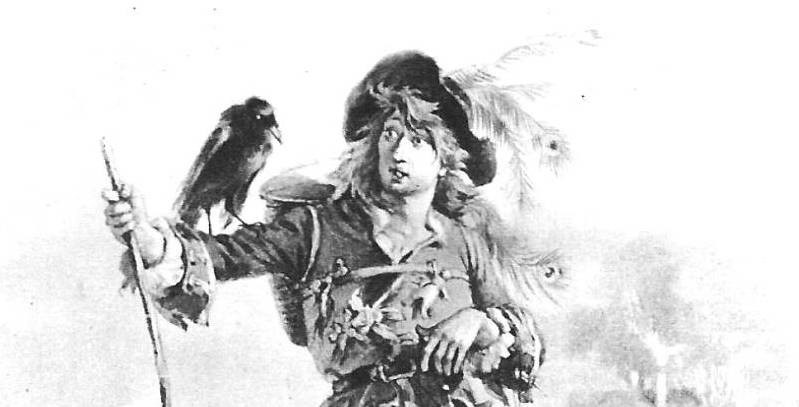
The madness of this historical event (about fifty years in the past when Dickens was writing) is reflected and questioned in the main character, an “idiot boy” in his twenties. Perceptive and imaginative, Barnaby is more effective than Dickens’s prior child saints (such as Oliver Twist and Little Nell) because he is not a child, although he is treated as one. Easily manipulated to any end, Barnaby is a picture of the common people of London, used as deadly weapons by Gordon and his lackeys. However, he is also a picture of innocence in his facility of forgetting, a phenomenon which had worked for good and ill in the fifty years between these events and Dickens’s day.
Barnaby is also a figure in whom the author—often accused of madness for eccentricities like his pet raven and restless bodily presence—writes himself. He is the point of convergence that can bring all of these events and characters together, like Barnaby. He has the capacity to see it all with a detached and fanciful eye, like Barnaby. Most notably, Barnaby also has a pet raven who can repeat certain phrases like a parrot and who became the actual inspiration for Edgar Allen Poe’s famous poem.
Of course, through the disruption of the riots—and in their aftermath—the various stories set in motion at the beginning of the novel eventually play themselves out, resulting in a doubly cathartic resolution and denouement. A number of these private stories are about the mistakes and abuses of fathers. This ultimately unifies the two strands of the book in a close and complex scrutiny of rebellion against authority in all its forms.
While Barnaby Rudge is 750 pages, I tore through it like the fire in the streets, caught up in the quality of the writing—which includes Dickens’s trademark humor amid the passages of chilling tragedy—and a deep investment in the characters that are introduced in the first third of the book. I recommend the audiobook, ably read by Nicholas Boulton.