1976, 2026: What will our anthem be?
Which films defined the bicentennial, and which might mark the USA's 250th year?
There are three films that I love especially because of when they were made. The time was 1975-6, and the bicentennial was sweeping the US. For me, these three movies are intentional comments on “America at 200.” I want to look at them a little and then speculate on the movies that will become time capsules of the country’s 250th birthday this year.
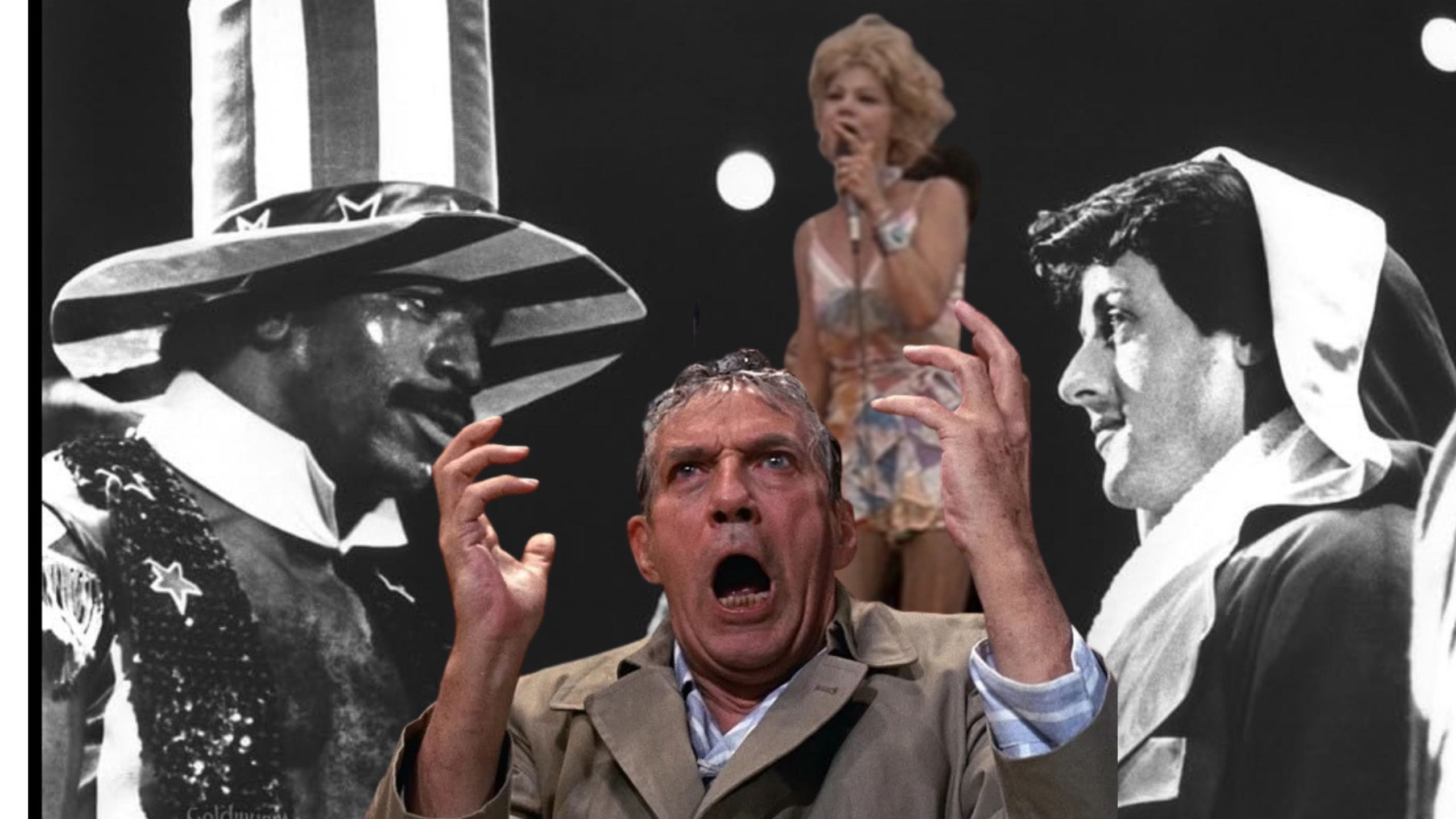
Nashville
Robert Altman’s masterpiece of a movie is a relevant and incisive slice of the two-hundred-year-old American pie. One of the best examples of postmodernism in film, it weaves together the lives of twenty-four characters over a few days in the title city. One critic explains the reason for this choice by suggesting that in 1976, the country music scene was one of the communities that most ardently and unanimously identified itself with the United States, almost by definition. Indeed, I don’t know if I have heard many pop or rock songs from the time that were written especially for the bicentennial, the way that Porter Wagoner and Dolly Parton’s “The Freedom Train” clearly was. In Nashville, Henry Gibson takes up the torch with his character’s jingoistic “200 Years”…just in case you doubted that the film was an intentional State of the Union address. His character’s name? Haven Hamilton.
For all its baked-in patriotism, the crowds in Nashville/Nashville are celebrating that most American of things: their right to achieve their dreams. That is, themselves…and the money that might be made by commodifying the same. We see it in the heartbreaking scene of Sueleen’s humiliation when that undercurrent rises to the surface. We see multiple characters shaping, guarding, and exploiting the person(a) of Barbara Jean (Ronee Blakely). We see characters inventing themselves on the fly, like Shelley Duvall’s “L. A. Joan.”
Here, the very idea of ‘America’ is shattered into endless subgroups and fame-hungry hordes. It is interlinked with sex, religion, and violence. No film made in the mid-seventies could escape the startling rise of violence as the national pastime, with a seemingly endless string of assassinations and the battle of and around the Vietnam War all recent traumas. What is most telling about the film’s treatment of violence? That after a brief panic, an ambitious unknown singer can get the people singing together again, repeating the timely refrain, “You may say I ain’t free. It don’t worry me.”
Rocky
If you’ve never thought of Rocky as a film about bicentennial America, consider the following facts. It is palpably set in 1976 Philadelphia (where the whole thing began). The plot is basically “poor boy has a (violent) dream that he can achieve at any cost.” Rocky’s climactic showdown is with a powerful Black man dressed as Uncle Sam.
So, what does it all coalesce into? We have the clichéd American Dream plot approached from two sides. In this corner, the liberated Black man who has won the right to literally represent the embodiment of his country. In this corner, the downtrodden child of immigrants who can marshal his willpower and convert it into muscle. Now, let’s watch them punch each other!
I don’t want to get too wrapped up in dissecting Rocky’s symbology of the USA, but I do want (like the movie) to lay out the important elements and allow the viewer to think about where they themselves might fit in this story of the clash of American Dreams. Apollo Creed is a flag-wrapped celebrity, and Rocky Balboa (consider the import of these names on your own time) is a never-say-die kid with a humble dream of kissing the girl from the pet shop and learning how to accept defeat on the way to victory (after victory after victory…I never watched any of the sequels). Perhaps most importantly, both of these men are inspirational characters of “coming from nothing,” and they only interact in the form of aggressive battle in front of a cheering coliseum…er, room.
Network
(Is there meaning in the fact that all of these films gather a wide variety of people under one-word titles? What do you think?)
One of the greatest American films ever made, Network also holds the distinction of perhaps being the most eerily prescient movie from Hollywood, ever. Are Americans getting tired of hearing bad news every evening? When newscaster Howard Beale (Peter Finch) decides he feels the same way, his on-air screed draws record ratings. What to do? Remake him as “the mad prophet of the airwaves” and the center of a (here’s that word again) fractured news program built as entertainment, not information. Under the guidance of Faye Dunaway’s Diana Christensen (another name that links a classical god to Christian lingo), “The Network News Hour” becomes a whirlwind of “acts” like Sybil the Soothsayer and the sensationalized carnage of the Ecumenical Liberation Front.
The effect of watching the film today is something along the lines of “America took a cautionary tale and made it aspirational. How very American.” Once again, all of this is tied into politics, sex, and violence. Ned Beatty’s astounding monologue near the film’s end lays out his vision of the world (and our current reality): “There is no America! There is no democracy! There is only IBM and ITT and AT&T and DuPont, Dow, Union Carbide, and Exxon. Those are the nations of the world today.”
Of course, Network is also very much about the way television shapes the country. Diana is equated with the medium of TV several times, finally being called “television incarnate.” She doesn’t care about truth, human life, or the welfare of the nation. She only cares about ratings, rattling through viewership statistics in bed with her lover as she works her way to a minuscule and perfunctory orgasm, only to immediately continue her report. That lover is the same man she arranges to have killed…for ratings.
What will our anthem be?
Now we find ourselves fifty years on, at the country’s 250th birthday. And what are the films that will mark this occasion? Who is making the defining American films of today?
I heartily welcome your suggestions.
With certainty, I can say that 2025’s Best Picture winner, One Battle After Another, will go down in history as one of those milestone pictures. Others, who set out to capture the zeitgeist, like Eddington, failed to capture the audience. Will they be unearthed fifty years from now and embraced as “before their time”?
As of today, I have only seen six films released in 2026, and, since this is the actual year of celebration, I assume that the second half of the year will bring us one or two more films to put in this category…but I don’t know what they will be. I look over lists of the upcoming movies, and none of them seems like a particularly good candidate.
But, then, what would such a film tackle? Not much has changed in fifty years, so fracture, multiplicity, dichotomies, violence, and entertainment remain musts. I expect that the truly defining films of this year will carry an intense fear and uncertainty. They may very well be horror films. I could predict some level of nihilism or hopelessness. They will be films that present an irreparably broken world. They may be about the aggressive clash of two extreme powers. But maybe we’re too close to it now to know what the hallmarks of our time are. Francis Ford Copolla’s Megalopolis covered a lot of relevant ground, but it didn’t hold together as a film. (But, then, is that what will show it to be most appropriate?)
Please, take some time to comment. I’d like to start a conversation about this.


